Marketing checklist including external and internal audit

Marketing checklist including external and internal audit
Slide 1 of 2
Favourites Favourites

Try Before you Buy Download Free Sample Product

Audience Impress Your
Audience
Editable 100%
Editable
Time Save Hours
of Time
The Biggest Sale is ending soon in
0
0
:
0
0
:
0
0
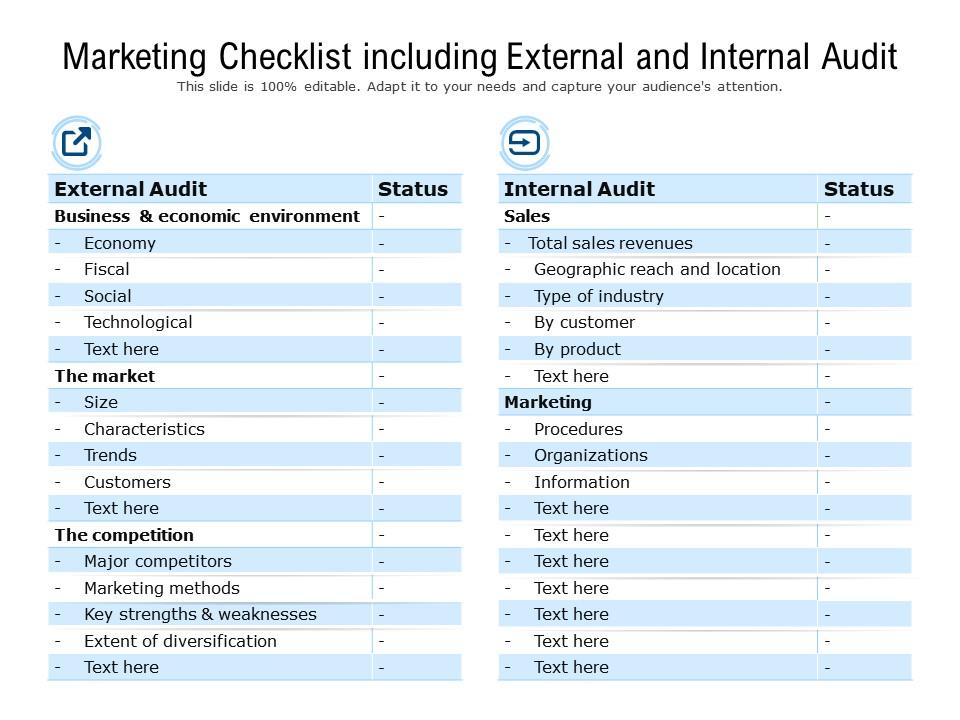
Presenting this set of slides with name Marketing Checklist Including External And Internal Audit. The topics discussed in these slides are External Audit, Business And Economic Environment, Internal Audit, Status, Marketing, Social. This is a completely editable PowerPoint presentation and is available for immediate download. Download now and impress your audience.

FAQs for Marketing checklist including external

Key objectives of conducting a marketing audit include evaluating current marketing performance, identifying strategic gaps and opportunities, assessing competitive positioning, analyzing resource allocation effectiveness, and ensuring alignment with business goals. These comprehensive reviews enable organizations to streamline marketing investments, enhance campaign targeting, and optimize customer acquisition strategies, ultimately delivering improved ROI and sustainable competitive advantage in increasingly dynamic markets.

Identify marketing strategy strengths and weaknesses through comprehensive performance analysis, competitor benchmarking, customer feedback evaluation, channel effectiveness assessment, and ROI measurement across all campaigns. This systematic audit approach enables organizations to pinpoint high-performing tactics while addressing gaps, ultimately delivering improved resource allocation, enhanced customer targeting, and stronger competitive positioning in increasingly dynamic markets.

Key metrics for online marketing performance include website traffic, conversion rates, cost per acquisition, return on ad spend, and customer lifetime value. These metrics enable organizations to streamline campaign optimization, enhance resource allocation, and accelerate revenue growth, with many businesses finding that comprehensive tracking ultimately delivers improved ROI and competitive advantage.

Marketing audits should be conducted annually for comprehensive evaluation, with quarterly reviews for rapidly changing industries and semi-annual assessments for established businesses. This frequency enables organizations to adapt strategies based on market shifts, competitive dynamics, and performance data, with many companies finding that regular audits ultimately deliver improved ROI and sustained competitive advantage.

Competitive analysis provides crucial market positioning insights by evaluating competitor strategies, pricing models, messaging approaches, and performance metrics against your own initiatives. Through systematic comparison of competitor campaigns, digital presence, and customer engagement tactics, organizations identify market gaps, benchmark their effectiveness, and uncover strategic opportunities, ultimately enabling more informed marketing decisions and sustainable competitive advantage.

Customer feedback can be effectively integrated through systematic collection via surveys, reviews, social media monitoring, focus groups, and direct interviews across all touchpoints. This comprehensive approach enables organizations to identify service gaps, validate marketing messaging effectiveness, and benchmark customer satisfaction against competitive offerings, while many businesses finding that structured feedback integration ultimately delivers enhanced customer experiences and stronger market positioning.

**INPUT**: What tools and software are best for tracking marketing performance metrics? **OUTPUT**: Top marketing performance tracking tools include Google Analytics, HubSpot, Salesforce, Adobe Analytics, and SEMrush, each offering comprehensive data collection and reporting capabilities. These platforms streamline campaign measurement by automating data integration, providing real-time dashboards, and enabling cross-channel attribution analysis, with many organizations finding that strategic tool combinations ultimately deliver deeper customer insights and improved ROI optimization. **Word count: 60 words**

Assess content marketing effectiveness through engagement metrics, conversion rates, lead generation quality, brand awareness growth, and ROI analysis across all channels. By tracking website traffic, social media interactions, email open rates, and sales attribution, organizations can identify high-performing content types and optimize strategies, ultimately delivering improved customer acquisition and retention rates.

Brand perception analysis strategies include social media monitoring, customer surveys, competitor benchmarking, brand sentiment analysis, and focus group discussions. These methodologies streamline insights by tracking online mentions, measuring customer satisfaction scores, and evaluating market positioning, with many organizations finding that combining quantitative data with qualitative feedback ultimately delivers comprehensive understanding and competitive advantage in increasingly crowded marketplaces.

Evaluate marketing channel ROI by analyzing cost-per-acquisition, conversion rates, customer lifetime value, and attribution data across touchpoints. Through comprehensive tracking tools and analytics platforms, businesses can compare email marketing, social media, and paid advertising performance, while measuring long-term revenue impact, ultimately identifying high-performing channels and reallocating budgets for maximum profitability.

When examining your target audience, consider demographics, psychographics, behavioral patterns, purchasing preferences, communication channels, pain points, and competitive influences. These factors enable organizations to streamline messaging strategies, enhance customer segmentation, and deliver personalized experiences, with many businesses finding that comprehensive audience analysis ultimately drives higher conversion rates and stronger market positioning.

Ensure your marketing audit aligns with business goals by mapping each marketing metric to specific business objectives, regularly reviewing performance against revenue targets, customer acquisition costs, and market share growth. Through strategic KPI alignment, organizations can identify gaps between marketing activities and business outcomes, optimize resource allocation for maximum ROI, and ultimately drive measurable growth that supports long-term competitive advantage.

Assessing compliance and regulations in marketing audits ensures adherence to data privacy laws, advertising standards, industry regulations, and consumer protection requirements while minimizing legal risks. This evaluation enables organizations to identify potential violations, streamline regulatory processes, and maintain brand reputation, with financial services and healthcare companies finding that proactive compliance assessments ultimately deliver competitive advantage and customer trust.

Identify action items by categorizing audit findings into high-impact areas like customer acquisition costs, conversion rates, and channel performance gaps, then prioritize based on potential ROI and implementation complexity. Start with quick wins that deliver immediate results, such as optimizing underperforming campaigns or reallocating budgets to top-performing channels, while planning strategic initiatives that enhance long-term competitive advantage and operational efficiency.

Marketing audit challenges include data silos, incomplete analytics, resource constraints, stakeholder resistance, and outdated measurement frameworks. Organizations can address these by establishing centralized reporting systems, conducting phased assessments, securing dedicated audit teams, and implementing comprehensive tracking tools, with many companies finding that systematic preparation and cross-departmental collaboration ultimately streamline the process and deliver actionable insights.

Ratings and Reviews

0% of 100
Review Form
Write a review
Most Relevant Reviews

No Reviews