

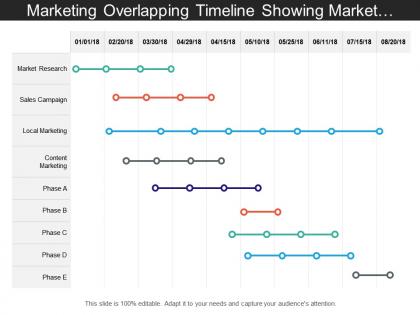
Marketing overlapping timeline showing market research sales campaign and local marketing




Try Before you Buy Download Free Sample Product
 Impress Your
Audience
 100%
Editable
 Save Hours
of Time


Looking for proficient PPT layout on market research, sales campaign, and marketing? Do not take stress! SlideTeam has come up with a predesigned marketing overlapping timeline showing market research sales campaign and local marketing PPT template design. This market research and analysis timeline PowerPoint template slide design has been structured utilizing proficient visual of the timeline which represents various months performance. As the layout slide is adaptable, you can change the years and months according to needs. Vibrant colors in this market overlapping timeline presentation slide will help you in attracting the focus of the audience. These will also help you in separating each stage from another stage. Recollecting client needs as a primary concern, our originators have given enough space to add significant data. You can use this unique template design for creating a professional presentation on a business marketing plan, marketing new product, sales campaign, sales improvement, business growth, brand marketing, and more. Quickly, download this predesigned marketing overlapping timeline showing market research sales campaign and local marketing PPT template design. Our Marketing Overlapping Timeline Showing Market Research Sales Campaign And Local Marketing enable you to get ahead of the curve. Complete all assignments before due date.
People who downloaded this PowerPoint presentation also viewed the following :
Marketing overlapping timeline showing market research sales campaign and local marketing with all 5 slides:
Our Marketing Overlapping Timeline Showing Market Research Sales Campaign And Local Marketing have dual magnetism. They attract both like and unlike minds.


FAQs for Marketing overlapping timeline showing market research sales campaign
Okay so you'll want to nail down your campaign goals first, then figure out who you're actually targeting. Pick your channels and set real deadlines - but add buffer time because trust me, everything takes longer than expected. Map out when you're creating content and how approvals will work (this part is always a nightmare). Budget allocation is key too. Work backwards from your launch date and be honest about timing. I always build in performance checkpoints so you can tweak things as you go. The deadlines that absolutely can't move? Build everything else around those first.
Honestly, think of it like a group project where nobody talks to each other - total disaster, right? Your marketing timeline prevents that chaos by showing everyone what's happening and when. You'll catch problems early, like two campaigns fighting over the same designer. Plus stakeholders can actually see priorities instead of guessing. I always start with the big stuff first, then squeeze in smaller tasks around those dates. Trust me, it beats the alternative of everyone just winging it and hoping things work out.
Honestly, Asana and Monday.com are solid picks if you want something with decent collaboration stuff. Trello's great too - their interface is just so clean, I'm kind of obsessed with it. Google Sheets actually works surprisingly well for basic timelines, plus everyone already knows how to use it so there's no learning curve. Oh, and if you're doing content marketing specifically, CoSchedule rocks because it connects to all your social platforms. My advice? Just start with whatever your team's already comfortable with. You can always upgrade later if you need fancier features.
Honestly, seasonal planning is all about working backwards from those big dates. Map out Q4 holidays, summer booking season, back-to-school - whatever hits your industry hardest. Then you gotta front-load all your campaign prep during the slow months. We totally blew it on Valentine's Day one year because we started planning like 3 weeks out (rookie mistake). I'd say sketch your content calendar 3-6 months ahead for major seasonal stuff, then slot in product launches around those peaks. Short answer? Figure out your seasonal patterns first. Everything else just falls into place after that.
So it really depends on where you are in the campaign. Start with the basics - reach, impressions, website traffic. Just see if anyone's actually paying attention, you know? Once you're rolling, engagement rates and click-throughs matter way more. That's when you can tell if people actually care or if they're just scrolling past. Conversions and ROI come last - honestly, that's the only stuff your boss will remember anyway. Brand sentiment's worth tracking too if you have the bandwidth. Oh, and set up your dashboards from day one. Trust me on this one - you don't want to be pulling reports at midnight before a big meeting.
Honestly, I'd check it every two weeks if you can swing it. Markets move crazy fast these days and campaigns never perform exactly like you think they will. Monthly reviews are the bare minimum, but the teams that actually crush it do quick check-ins way more often. New stuff pops up constantly - seasonal changes, budget tweaks, plus your boss will definitely throw curveballs at you. Just put a recurring meeting on your calendar or you'll never actually do it. Trust me on that one. Small tweaks work way better than completely redoing everything and messing up your whole flow.
Honestly, you've gotta do audience research before anything else or you'll just be guessing with your timeline. When are they actually online? What platforms do they hang out on? How long before they buy stuff? I made this mistake once - launched right when our audience was swamped and nobody cared lol. Some people need months of nurturing, others convert super fast. Figure out their patterns first, then build your schedule around that. Oh and don't forget seasonal stuff! Your research tells you whether you need a quick campaign or something longer.
Honestly, your marketing timeline is going to save your butt when everything hits the fan. You'll know exactly what's running and can kill anything that sounds completely wrong for the moment. Like imagine having some upbeat product launch going live right after terrible news breaks - yikes. Real-time updates are clutch here because you don't want to be digging through emails trying to figure out what's already scheduled. You can also find spots to squeeze in crisis messaging without blowing up your whole plan. Trust me, when things get messy, you'll be glad you're not flying blind.
Honestly, 3-6 months is the sweet spot for most launches - though it depends how complex your product is. I'd start building awareness around 12-16 weeks out, then really amp up your content and PR stuff at the 6-8 week mark. Final 2-4 weeks should be when you go all out with promotion. So many teams I know tried to rush this and totally kicked themselves later! Each phase needs breathing room - the teasing part, then educating people, then actually converting them. Oh and don't forget about post-launch follow-up (learned that one the hard way). Map it out backwards from your launch date and you'll be golden.
Ok so here's what I always do - start with digital since it's super quick to get live. Social comes next to build buzz and get people talking. Print is such a pain though, those deadlines are brutal so get that rolling early or you'll hate yourself later. Basically you want everything hitting at different times but still working together. I usually grab a calendar first and mark when I want to launch, then figure out backwards when each thing needs to start. The timing thing is honestly half the battle - get that right and your channels actually support each other instead of competing.
Oh man, everything takes WAY longer than you think - like seriously, double whatever timeline you have in your head. I learned this the hard way lol. Buffer time is your best friend, especially between campaigns. Legal reviews? Executive approvals? They'll add weeks you didn't see coming. Planning every tiny detail months ahead is pretty pointless since priorities change constantly anyway. Keep things flexible so you can actually pivot when urgent stuff pops up (and it will). I'd say build in at least 20% extra time for big milestones. Trust me on this one.
Color coding and icons are total game-changers for marketing timelines. You'll spot deadlines and dependencies instantly instead of drowning in text. Different colors for each campaign type, little milestone markers for launches - that kind of stuff. Progress bars show what's actually moving vs. what's stuck (and trust me, something's always stuck). I swear, half the timelines I see look like Excel threw up on them. Nobody has time to decode that mess. Start basic with colors and add more visual stuff as you figure out what your team needs to see quickly.
Start with the big picture stuff - milestones and major deliverables first. Then get into weekly details. Color code everything or use icons so people can actually scan it (because let's be real, nobody reads these things thoroughly). Buffer time is crucial since that "tiny tweak" always becomes a complete overhaul. Call out dependencies clearly - what you need from other teams and by when. Oh, and send both a live doc they can bookmark AND a PDF. Trust me on this one. You'll avoid so many "wait, which version?" headaches later. Learned that the hard way!
Honestly, just track what went wrong vs what you planned - it's such a game changer. Creative reviews ALWAYS take forever (seriously, why do we keep underestimating this?). Pull up your old campaign data and see where you're consistently off on timing. Approval processes are another killer. Build extra time into those problem areas next round. I keep a basic spreadsheet after each campaign - sounds nerdy but whatever, it works. Also note which channels moved fastest so you can lean on them when deadlines are tight.
So basically short-term stuff is your quick hits - campaigns that run maybe 1-3 months for immediate sales or promotions. Long-term is different, it's about building brand awareness over 6+ months. Budget-wise, short campaigns are usually smaller and more tactical. Here's the thing though - long-term gives you way better ROI but you need patience. Honestly you need both. Short-term pays the bills while long-term builds your foundation. I'd start by figuring out what you need to hit this quarter, then think about where you want your brand next year. Makes sense?
-
Very well designed and informative templates.
-
Nice and innovative design.