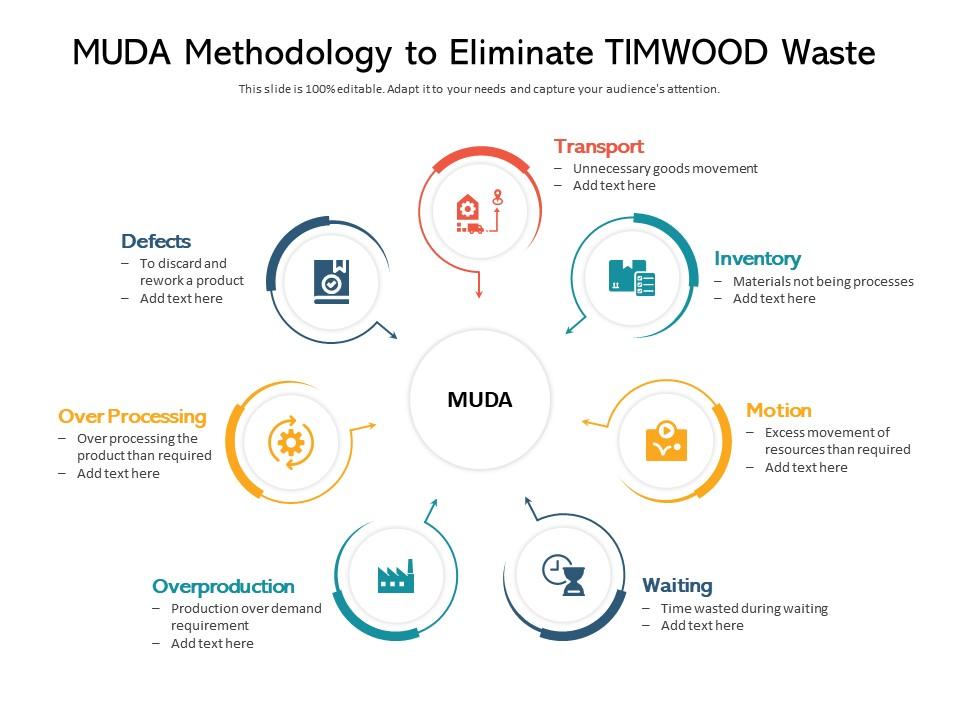
Muda methodology to eliminate timwood waste
Try Before you Buy Download Free Sample Product
Audience
Editable
of Time
Our MUDA Methodology To Eliminate Timwood Waste are topically designed to provide an attractive backdrop to any subject. Use them to look like a presentation pro.
People who downloaded this PowerPoint presentation also viewed the following :
Muda methodology to eliminate timwood waste with all 2 slides:
Use our MUDA Methodology To Eliminate Timwood Waste to effectively help you save your valuable time. They are readymade to fit into any presentation structure.
FAQs for Muda methodology to
Muda just means "waste" in Japanese. Toyota made it famous when they created their production system decades ago. Basically, it's any activity that eats up resources but doesn't actually help your customer. There are seven main types, though some people add an eighth now. What's kind of wild is how one Japanese company's term became the go-to word for waste in factories everywhere. When you're trying to fix processes, just walk through each step and ask yourself "does this actually matter to the customer?" If not, you've probably found your muda. Pretty simple concept but surprisingly effective.
Look, muda is basically just killing your efficiency by creating bottlenecks everywhere. You're burning time, money, and your team's energy on stuff that adds zero value - overproduction, waiting around, pointless movement between tasks. It's honestly like watching money drain out of a bucket with holes in it. The more waste you let slide, the slower everything gets and costs just keep climbing. My advice? Pick one wasteful process this week and axe it. You'll be shocked how much capacity that frees up for work that actually matters.
Okay so the big ones are overproduction - basically making way more stuff than people actually want. Then there's waiting time, which is huge - like when materials just sit there doing nothing between steps. Transportation waste is moving stuff around unnecessarily, and don't get me started on excess inventory just taking up space. Defects obviously suck because then you're doing everything twice. Over-processing is when you're doing extra work that doesn't add value. Oh and motion waste - that's workers walking around too much (not the same as transportation, which is materials moving). Honestly? Just walk around and time how long things sit idle. You'll be shocked at what you find.
Map out your whole process first - you'll spot waste everywhere once you see the full picture. Then just walk around and actually talk to people doing the work. They know what's broken! There are 8 main types of waste to hunt for: overproduction, waiting, transport, over-processing, inventory, motion, defects, and unused talent. That last one is huge - most companies are terrible at using people's brains properly. Don't try fixing everything though. Pick one waste and run a quick improvement event around it. Way better results that way.
Oh yeah, the 3 Ms! So Muda is the obvious waste - like waiting around or making too much stuff. But Mura and Muri are sneakier. Mura's when your processes are all over the place, and Muri is basically overloading people or machines. They're connected in this annoying way where fixing one helps the others. Like if you have uneven demand (Mura), you'll probably end up with extra inventory sitting around (Muda) and workers scrambling to catch up (Muri). Honestly, I've seen teams waste months trying to fix just one instead of tackling them together. Look for all three next time you're analyzing a process.
Training your team on Muda is honestly a game-changer. People can't eliminate waste if they don't know what to look for, right? Once they learn the seven types - overproduction, waiting, transport, overprocessing, inventory, motion, and defects - they'll start spotting inefficiencies everywhere. It's weirdly satisfying actually. Don't make it a one-and-done thing though. You'll need regular refreshers and hands-on practice to keep everyone sharp. Pro tip: train your supervisors first, then let them cascade it down to their teams. Works way better than trying to train everyone at once.
So IoT sensors on your machines will catch downtime and bottlenecks early - way before they mess up your whole day. Real-time dashboards show you exactly where stuff's getting stuck. The data's pretty overwhelming at first though, not gonna lie. Automated systems help with overproduction by matching actual demand instead of guessing. Oh, and predictive maintenance stops those random breakdowns that totally kill your momentum. My advice? Pick one production line to test this stuff on first. You'll spot waste patterns you had no clue existed. Then just expand from there.
Honestly, cutting out waste is like decluttering your whole business - suddenly everything just works better. Your costs drop because you're not throwing money at pointless stuff. Teams get way more done and actually enjoy their jobs since they're not constantly fighting broken processes. Customers love you because things happen faster and more reliably. The coolest part though? Once people start spotting waste everywhere, they can't stop fixing things before they blow up into expensive disasters. Maybe pick one messy process this week and see where time gets eaten up. You'll be shocked at what you find.
Waste in your processes is basically customer satisfaction poison. Customers deal with longer waits, higher prices, and crappier quality - who wants that? All that inefficiency means your team can't focus on stuff that actually matters to customers. I'd honestly start by tracing your customer's whole experience and spotting where things get messy. You'll probably find way more waste than you expected. The delays and defects just pile up until customers get frustrated enough to leave. Map it out from their perspective - that's where you'll see the real damage.
Yeah totally! Service industries are actually perfect for this stuff. You've got customers waiting in lines or on hold forever - that's pure waste right there. Then there's all the ridiculous approval steps that don't add any real value. I see this constantly with service errors too, where someone has to redo work because it got messed up the first time. Your team probably wastes tons of time just moving between workstations or juggling different computer systems. Map out one of your processes from start to finish, then time it. You'll spot the problems pretty quickly once you see where people are just... standing around.
So most companies track this stuff through metrics like cycle time, defect rates, and OEE (overall equipment effectiveness). Look at material waste reduction, shorter lead times, productivity gains - the usual suspects. Honestly, I've seen places go overboard with crazy complex dashboards when simple before/after comparisons work just as well. Maybe even better? Pick 2-3 metrics that actually match your biggest waste issues and stick with those. Don't overthink it. Track how much time, money, or resources you're actually saving after making changes. That's what matters.
Honestly, the hardest part is just getting people to actually want to change. Everyone gets so stuck in their routine - "we've always done it this way" mentality drives me crazy. Managers freak out about productivity dropping during the transition too. Oh, and spotting waste? Way trickier than you'd think. Sometimes people look super busy but they're basically just spinning wheels. Training takes forever and costs money upfront. Here's what worked for me though: pick one small department first. Get some quick wins, then use those success stories to convince the rest. Much easier to expand once you've got proof it actually works.
Honestly, visual management is like putting on glasses for the first time - suddenly all that waste just pops out at you. Kanban boards and process maps make bottlenecks super obvious. I'm obsessed with wall charts because they catch problems you'd totally miss otherwise. Color-coding shows you exactly where stuff gets stuck or moves like molasses. Those dashboards tracking cycle times? Game changers for spotting patterns. Just grab a whiteboard and sketch out your current process - I swear you'll immediately see what's broken. It's wild how something so simple works.
Everyone talks about Toyota's just-in-time thing, but honestly it's pretty brilliant - they cut storage costs by 75% just by ditching excess inventory. Amazon figured out their warehouse workers were walking around like crazy, so they mapped better picker routes and got 20% more productivity. Boeing's my favorite example though. Their 737 assembly used to take 22 days, but they stripped out all the pointless steps and got it down to 11 days. Here's what I'd do: pick one annoying waste in your process and actually map where it happens. You'll see the fixes right away.
So here's the thing - cultural attitudes totally mess with how teams spot waste. Japan nailed this because everyone feels comfortable calling out problems without it being weird. But in Western companies? People get nervous about pointing out inefficiencies since it might look like they're criticizing their boss. Nobody wants that drama. High power distance cultures wait around for leadership to give direction instead of just fixing stuff themselves. Honestly, you've got to build trust first - like, make sure people know they won't get in trouble. Then train them to see waste-spotting as teamwork, not tattling on coworkers.
-
Excellent work done on template design and graphics.
-
Design layout is very impressive.
-
Presentation Design is very nice, good work with the content as well.