New Software Development Best Practices

Rating:
90%
New Software Development Best Practices
Slide 1 of 6
Favourites Favourites

Try Before you Buy Download Free Sample Product

Audience Impress Your
Audience
Editable 100%
Editable
Time Save Hours
of Time
The Biggest Sale is ending soon in
0
0
:
0
0
:
0
0
Rating:
90%
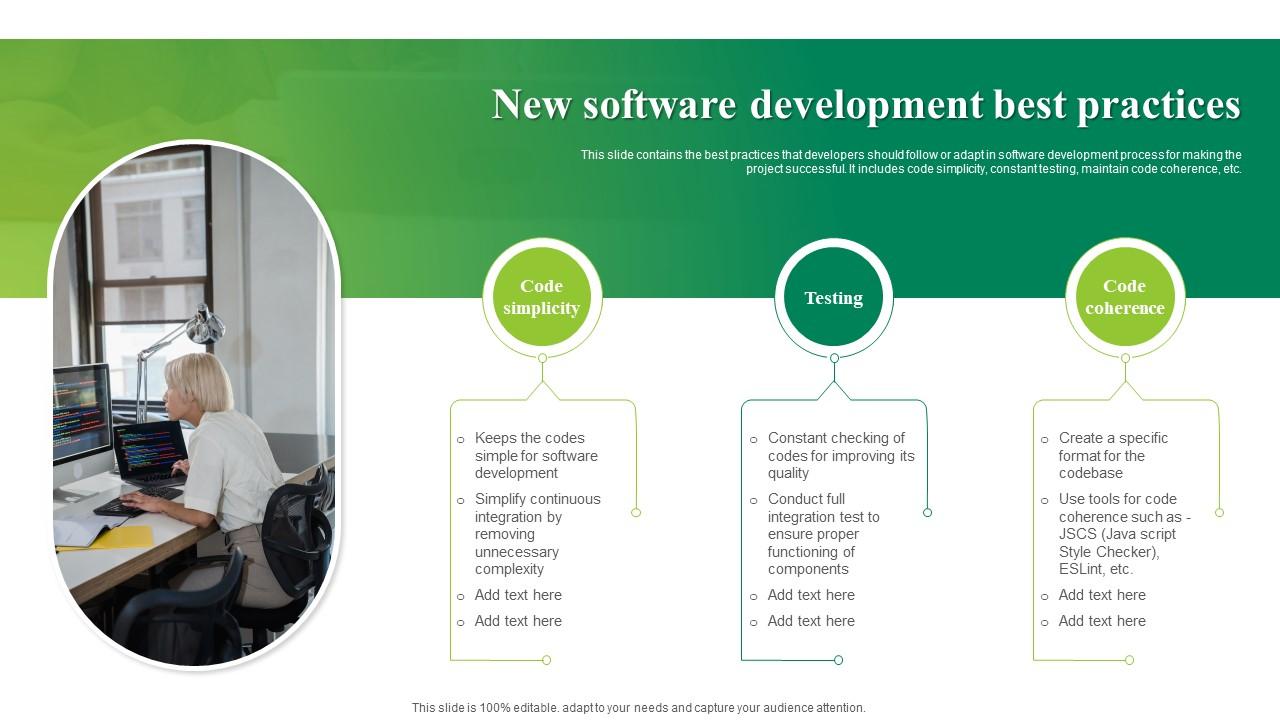
This slide contains the best practices that developers should follow or adapt in software development process for making the project successful. It includes code simplicity, constant testing, maintain code coherence, etc. Introducing our premium set of slides with New Software Development Best Practices. Elucidate the three stages and present information using this PPT slide. This is a completely adaptable PowerPoint template design that can be used to interpret topics like Code Simplicity, Testing, Code Coherence. So download instantly and tailor it with your information.

FAQs for New Software

Agile methodology revolutionizes modern software development by enabling iterative delivery, continuous feedback, enhanced collaboration, and rapid adaptation to changing requirements. Through sprint-based cycles and cross-functional teams, organizations streamline development processes, reduce time-to-market, and deliver higher-quality products, with many companies finding that Agile approaches significantly improve customer satisfaction and competitive responsiveness.

Code reviews enhance software quality by identifying bugs early, ensuring coding standards compliance, facilitating knowledge sharing, and reducing technical debt through collaborative oversight. Through systematic peer evaluation, development teams catch defects before production, improve code maintainability, and accelerate onboarding processes, with many organizations finding that structured reviews reduce post-release issues while strengthening overall codebase reliability.

Automated testing enhances software quality by continuously validating code changes, reducing manual testing overhead, and accelerating release cycles throughout development phases. These frameworks enable development teams to catch bugs earlier, maintain consistent performance standards, and deploy updates more frequently, with many tech companies finding that automated testing ultimately delivers faster time-to-market and improved customer satisfaction.

Version control systems enhance team collaboration by enabling simultaneous work on shared codebases, tracking individual contributions, managing merge conflicts, and maintaining comprehensive project histories. Through platforms like Git, development teams streamline coordination, minimize code conflicts, and accelerate deployment cycles, with many organizations finding that structured branching strategies ultimately deliver faster product releases and improved code quality.

Design patterns enhance software architecture by promoting code reusability, maintainability, scalability, and team collaboration through proven structural solutions. These standardized approaches streamline development processes by reducing complexity, accelerating problem-solving, and ensuring consistent implementation across projects, with many organizations finding that design patterns ultimately deliver faster development cycles, reduced technical debt, and more robust applications in increasingly complex software environments.

CI/CD significantly accelerates development cycles while enhancing reliability by automating testing, integration, and deployment processes, reducing manual errors and enabling faster feedback loops. Through automated pipelines, development teams streamline code releases, catch bugs earlier in the process, and maintain consistent quality standards, with many software organizations finding that CI/CD ultimately delivers faster time-to-market and improved system stability.

Effective project estimation strategies include breaking down projects into smaller tasks, using historical data analysis, employing multiple estimation techniques like three-point estimation, and incorporating buffer time for uncertainties. These approaches enable development teams to create realistic timelines through improved accuracy, better resource allocation, and proactive risk management, with many organizations finding that strategic estimation ultimately delivers enhanced project predictability and client satisfaction.

Technical debt significantly impacts long-term software performance by increasing maintenance costs, slowing feature development, and creating system instability through accumulated shortcuts and suboptimal code. While addressing technical debt requires upfront investment, organizations increasingly find that systematic refactoring enhances system reliability, reduces operational overhead, and ultimately delivers faster deployment cycles and improved scalability.

Documentation is critically important for maintaining code quality, enabling team collaboration, and reducing onboarding time for new developers. Tools like Confluence, GitBook, Notion, and automated documentation generators such as JSDoc or Sphinx streamline this process by integrating with development workflows, enabling real-time collaboration, and automatically generating API documentation, ultimately delivering faster project delivery and reduced maintenance costs.

API design best practices include RESTful architecture, consistent naming conventions, proper versioning, comprehensive documentation, and robust authentication protocols. These approaches streamline integration by ensuring predictable endpoints, clear error handling, and scalable performance, with many financial services and e-commerce platforms finding that well-designed APIs accelerate development cycles while enhancing system reliability.

Teams effectively manage feature requests and bug fixes through structured prioritization frameworks like MoSCoW method, impact-effort matrices, and stakeholder feedback systems, combined with clear documentation and regular review cycles. Through agile methodologies and dedicated backlog management, development teams streamline decision-making processes, reduce technical debt, and enhance product quality, ultimately delivering faster releases and improved user experiences.

**INPUT**: What practices promote security throughout the software development process? **OUTPUT**: Security-focused development practices include threat modeling, secure coding standards, regular code reviews, automated security testing, and dependency scanning. These approaches streamline vulnerability detection by integrating security checkpoints throughout development cycles, conducting penetration testing, and implementing access controls, with many organizations finding that proactive security measures ultimately reduce remediation costs while delivering more resilient applications and stronger customer trust. [Word count: 60 words]

Pair programming significantly accelerates learning and enhances code quality by combining two developers' perspectives, enabling real-time knowledge transfer, immediate error detection, and continuous code review. Through collaborative coding sessions, development teams reduce bugs by up to 60%, improve problem-solving approaches, and foster mentorship opportunities, with many organizations finding that pair programming ultimately delivers faster development cycles and stronger technical skills across their workforce.

Key metrics include code quality scores, defect density rates, sprint velocity, customer satisfaction indices, and time-to-market benchmarks. These measurements enable development teams to streamline delivery processes, enhance product reliability, and optimize resource allocation, with many organizations finding that systematic tracking ultimately delivers faster deployment cycles and improved competitive positioning.

Design thinking integrates into software development through user research, empathy mapping, ideation sessions, prototyping, and continuous testing throughout the development cycle. This human-centered approach enables development teams to create more intuitive interfaces, reduce costly redesigns, and deliver products that truly address user pain points, with many tech companies finding that early user involvement significantly improves adoption rates and customer satisfaction.

Ratings and Reviews

90% of 100
Review Form
Write a review
Most Relevant Reviews
  1. 100%

    by Darrel Burns

    Really like the color and design of the presentation.
  2. 80%

    by Williams Nelson

    The customer care of SlideTeam is very responsive. I was having a payment issue and they fixed it for me in no time.

2 Item(s)

per page: