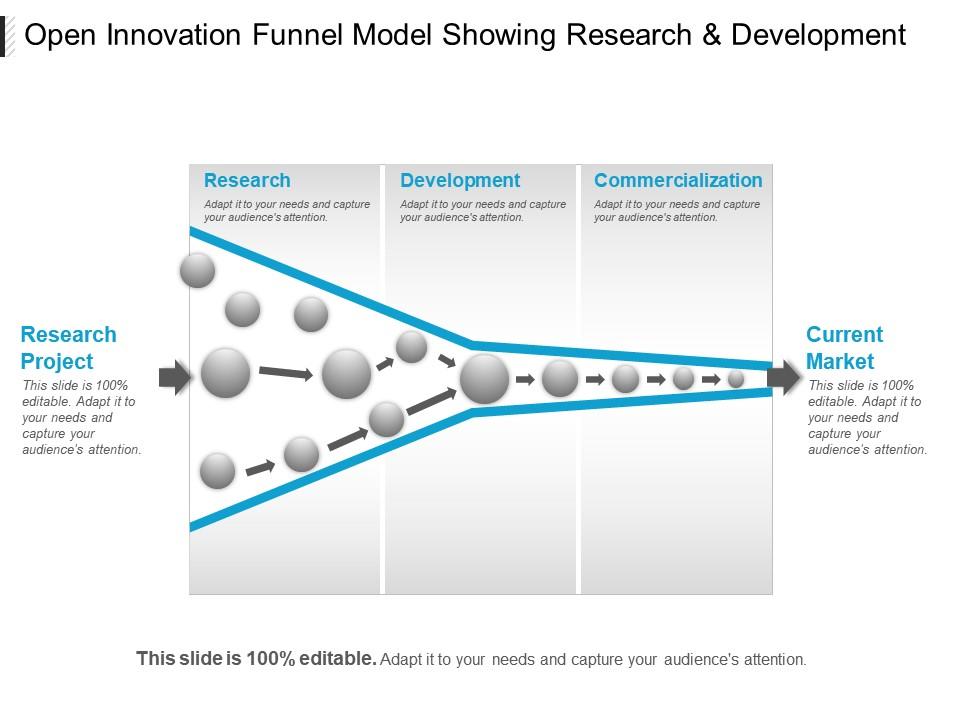
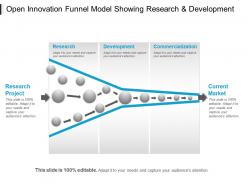
Open innovation funnel model showing research and development
Try Before you Buy Download Free Sample Product
Audience
Editable
of Time
Intimidate your rivals through the consistent execution of disruptive ideas with this Open Innovation Funnel Model Showing Research And Development PowerPoint presentation. You can include information about research, development, current market, research project, and commercialization with this business innovation PowerPoint slideshow. Employ this disruption template to generate innumerable novel ideas and convert them into concrete development plans. Take advantage of this organizational innovation PPT slide to assess various approaches and select the best project or product for higher financial advantage. Take the assistance of this innovation PPT model to portray the stages in the innovation process including ideas, criteria, testing, and external environment. Demonstrate the areas in which disruption is required such as portfolio management and decision quality with this business process transformation PowerPoint visual. Showcase out of the box techniques for manufacturing, marketing, etc. using this business automation PPT layout. Don’t forget to substantiate the role of information technology for streamlining your business functions with this disruption management image. Thus, download this innovation PowerPoint infographic to facilitate the full-fledged development of your company and implement ideas that are beyond the imagination of your competitors.
People who downloaded this PowerPoint presentation also viewed the following :
Open innovation funnel model showing research and development with all 5 slides:
Figure out how to build a firm financial base with our Open Innovation Funnel Model Showing Research And Development. It helps address economic challenges.
FAQs for Open innovation funnel model showing
The Open Innovation Funnel Model includes idea generation, screening and evaluation, concept development, prototyping, and commercialization stages. These stages streamline innovation by incorporating external partnerships, crowdsourcing insights, and collaborative development throughout the process, with many organizations finding that this approach accelerates time-to-market while reducing internal resource constraints and development costs.
The Open Innovation Funnel integrates external partnerships, crowdsourcing, academic collaborations, and customer co-creation alongside internal R&D, while traditional processes rely primarily on closed, internal development teams. This approach enables organizations to accelerate time-to-market, access diverse expertise, and reduce development costs, with many companies finding that external collaboration delivers breakthrough innovations and competitive advantages.
External collaboration serves as the primary driver of the Open Innovation Funnel Model, enabling organizations to leverage partnerships, joint ventures, licensing agreements, and strategic alliances throughout each funnel stage. Through these collaborative approaches, companies in sectors like pharmaceuticals, technology, and manufacturing accelerate product development, reduce research costs, and access specialized expertise, ultimately delivering faster time-to-market and enhanced competitive advantage.
Organizations can effectively manage idea influx through structured evaluation frameworks, dedicated innovation teams, digital platforms for submission tracking, and clear criteria for progression between funnel stages. This systematic approach enables companies like Procter & Gamble and IBM to process thousands of external ideas efficiently, ultimately delivering faster product development and enhanced competitive advantage.
Companies should evaluate funnel success through stage-specific metrics including idea submission rates, evaluation cycle times, concept feasibility scores, prototype development costs, and commercialization timelines. These metrics enable organizations to identify bottlenecks, optimize resource allocation, and measure ROI at each phase, with many innovation-driven companies finding that tracking conversion rates between stages ultimately delivers stronger portfolio performance and competitive advantage.
User feedback significantly influences the Open Innovation Funnel by validating concepts, refining ideas, and prioritizing development resources throughout each stage. Through continuous feedback loops, organizations can eliminate weak concepts early, enhance promising innovations, and align solutions with market needs, with many companies in sectors like consumer electronics and software finding that user insights reduce development costs while accelerating time-to-market for successful innovations.
Common challenges include managing intellectual property rights, coordinating diverse external partnerships, filtering high volumes of ideas effectively, aligning internal processes with external timelines, and maintaining quality control across multiple innovation sources. While these obstacles require strategic planning and robust governance frameworks, organizations in sectors like pharmaceuticals and technology are finding that structured collaboration platforms and clear IP agreements ultimately deliver faster innovation cycles and competitive advantages.
Companies balance internal resources with external ideas by establishing dedicated innovation teams, creating structured evaluation frameworks, and implementing phased integration processes that assess both technical feasibility and strategic alignment. Through strategic partnerships and collaborative platforms, organizations streamline resource allocation while maintaining quality control, with many finding that hybrid approaches ultimately deliver enhanced innovation capacity and competitive advantage.
Technology facilitates the Open Innovation Funnel through collaboration platforms, AI-powered idea screening, digital patent databases, cloud-based project management, and automated evaluation systems. These tools streamline partner identification, accelerate idea validation, and enhance cross-organizational communication, with companies like Procter & Gamble and IBM finding that digital innovation platforms reduce development cycles while expanding their external innovation networks significantly.
Effective filtering practices include establishing clear evaluation criteria, implementing stage-gate reviews, utilizing diverse cross-functional teams, applying scoring matrices, and maintaining transparent feedback loops. These approaches streamline decision-making by balancing innovation potential with business feasibility, resource requirements, and strategic alignment, with many organizations finding that systematic filtering reduces time-to-market while maximizing successful innovation outcomes.
The Open Innovation Funnel supports business model innovation by integrating external ideas, technologies, and partnerships throughout the innovation process, enabling companies to explore new revenue streams, value propositions, and market opportunities. Through collaborative partnerships with startups, universities, and industry players, organizations can rapidly test innovative business models, reduce development risks, and accelerate time-to-market, ultimately delivering competitive advantage in increasingly dynamic markets.
Technology, pharmaceuticals, automotive, consumer goods, and financial services have successfully leveraged open innovation funnels to accelerate product development and reduce R&D costs. These industries demonstrate that strategic external partnerships, combined with robust internal evaluation processes, enable faster time-to-market and enhanced competitive advantage, with many organizations finding that diverse innovation sources ultimately deliver breakthrough solutions.
Organizations ensure diversity and inclusivity in Open Innovation by establishing diverse partner networks, implementing inclusive evaluation criteria, creating accessible submission processes, and fostering cross-cultural collaboration frameworks. Through strategic outreach to underrepresented communities, minority-owned businesses, and global innovators, companies enhance creative problem-solving capabilities, reduce innovation blind spots, and ultimately deliver more comprehensive solutions that reflect broader market needs.
Intellectual property management within the Open Innovation Funnel Model presents both opportunities and complexities, requiring clear ownership frameworks, licensing agreements, joint development protocols, and strategic IP sharing mechanisms. These considerations enable organizations to protect core assets while fostering collaborative innovation, with many companies finding that structured IP governance ultimately delivers competitive advantage and accelerated product development across partnership ecosystems.
User innovation fits within the Open Innovation Funnel by contributing valuable insights and solutions at multiple stages, particularly during ideation and development phases. Through crowdsourcing platforms, beta testing programs, and co-creation initiatives, companies like Microsoft, LEGO, and Starbucks harness customer creativity to refine products, identify market needs, and accelerate innovation cycles, ultimately delivering more user-centric solutions and stronger market adoption.
-
Thanks for all your great templates they have saved me lots of time and accelerate my presentations. Great product, keep them up!
-
Attractive design and informative presentation.