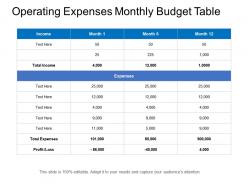
Operating expenses monthly budget table
Try Before you Buy Download Free Sample Product
Audience
Editable
of Time
Continue to achieve with our Operating Expenses Monthly Budget Table. They help guard against disappointments.
People who downloaded this PowerPoint presentation also viewed the following :
Operating expenses monthly budget table with all 5 slides:
Emulate the best with our Operating Expenses Monthly Budget Table. They give you a glimpse of excellence.
FAQs for Operating expenses
So operating expenses are just your regular business costs - rent, utilities, payroll, office stuff, marketing, insurance, legal fees. Software subscriptions too (seriously, those monthly charges are sneaky). These aren't one-time purchases or your actual product costs. They're what keeps the lights on every month. I'd group them into buckets like people costs, building costs, and admin stuff when you're looking at your P&L. Makes it way less overwhelming to track where your money's actually going. Trust me, categorizing saves you headaches later.
So basically operating expenses are your everyday costs - rent, payroll, utilities, that kind of stuff. Capital expenditures? Those are big purchases like equipment or buildings that'll help you for years. Here's why it matters: OpEx gets written off right away on your taxes, but CapEx has to be depreciated over time. Total pain if you mess it up (trust me, I learned this with a server purchase). Your accountant will thank you if you track them separately from day one. Quick test: will it last over a year? Then it's probably CapEx.
Get QuickBooks or just use spreadsheets if money's tight right now. Honestly, I'm kind of obsessed with year-over-year dashboards - they make weird spending patterns so obvious it's almost embarrassing. Break everything into categories like rent, payroll, utilities, that kind of stuff. Monthly reviews are way better than waiting until quarter-end when you're scrambling. Set budgets for each category and actually track where you're over or under. Automate whatever you can upfront. Then schedule those monthly sit-downs to dig into the numbers and tweak your spending. Making it routine is everything.
Yeah, cutting OpEx is probably the quickest win for profits - every dollar saved goes straight to your bottom line if revenue stays put. Just gotta be smart about what you cut though. Ditch stuff like duplicate software or wasteful processes? You'll see results right away. But don't touch critical things like key staff or quality checks - that'll bite you later when revenue drops. I'd start with obvious waste first, then figure out how to make everything else run smoother. Way easier than trying to boost sales honestly.
Honestly, get some expense management software - it'll auto-categorize your purchases and show you real-time spending. Way better than those endless spreadsheets we used to mess with. The AI stuff is actually pretty smart at catching weird patterns or flagging when you're about to blow your budget. Most tools sync with your credit cards too, which saves tons of time. Just don't go for the flashiest option - pick something that actually makes sense for how your team operates. I learned that one the hard way.
Yeah dude, seasonal swings can totally wreck your budget if you're not ready. Holiday retailers get slammed with extra staff and shipping costs in Q4 - it's brutal. Beach resorts basically hibernate in winter while ski places are counting pennies all summer. Agriculture's the obvious one with harvest crews and equipment timing. Even boring B2B companies feel it when their clients go seasonal. I learned this the hard way at my old job honestly. You gotta bake these patterns into your planning so you're not panicking when costs suddenly double.
When your operating costs get too high, they basically choke out your cash flow. You're bringing money in, but it's disappearing fast on expenses. Less cash means you can't handle surprise costs or jump on good opportunities when they pop up. The worst part? If your expenses grow faster than what you're making, you'll end up scrambling for credit or pushing off payments to suppliers (which honestly sucks for relationships). I'd check your expense-to-revenue ratio every month - it's one of those numbers that'll save your butt if you stay on top of it.
Grab some industry reports from IBISWorld or Bloomberg first - those usually have expense ratios broken down by sector. S&P Capital IQ is amazing if your company has access to it. Networking at conferences honestly gives you the best dirt though (and yeah, free coffee doesn't hurt). Compare your operating expenses as a percentage of revenue against similar-sized competitors. Just make sure you're adjusting for differences in business models. Oh, and company size matters way more than people think. Pull three solid competitor reports to start and see how you stack up.
Dude, start with the obvious stuff - beat up your suppliers for better rates and ditch the office if you can go remote. Most companies are bleeding money on software they never touch, so go through those subscriptions with a machete. Automate the boring repetitive crap, outsource what isn't core to your business instead of hiring people. Energy-efficient gear saves more than you'd think. Here's what I'd do: write down your 10 biggest expenses and ask yourself if each one can be cut, replaced, or done smarter. Don't just slash randomly though - that'll bite you later.
High operating costs force you to price higher just to break even. That puts you at a disadvantage against competitors who've figured out how to run leaner. Lower expenses give you way more room to play with pricing - you can either undercut everyone or keep prices similar and pocket better margins. The challenge is cutting costs without screwing up what makes your product good. I've seen companies go too far with cost-cutting and tank their quality. Worth doing a deep dive on your expenses every few months to spot where you're bleeding money unnecessarily.
So fixed expenses are like rent, insurance, salaries - they don't change no matter what your sales look like. Variable ones go up and down with how busy you are (materials, shipping, that kind of stuff). Here's the thing though - fixed costs can really screw you over when business is slow, but when things pick up they actually help your profits grow faster. I'd negotiate hard on the fixed stuff and be super careful about timing big commitments. Oh and definitely track them separately from variables - makes it way easier to see where you're bleeding money. Trust me on this one.
So basically, you've got two types of costs - stuff that stays the same no matter what (like rent, equipment payments) and stuff that goes up and down with sales. Operating leverage is just figuring out how much of your costs are fixed. Companies with tons of fixed costs? They're risky but potentially awesome. Small bump in sales = way bigger profit boost. But if sales tank, ouch - those fixed costs don't magically disappear. Manufacturing companies usually have crazy high fixed costs compared to, say, a consulting business. It's super useful for budgeting and knowing how screwed you'll be if things go sideways.
Honestly, forecasting saved my butt last year when I almost got blindsided by winter utility costs. Track your biggest expense categories monthly - utilities, rent, supplies, whatever eats up most of your budget. Look back at 12-24 months of data to spot patterns. Winter heating bills, holiday marketing pushes, that kind of stuff. You'll start noticing when costs are creeping up before they become a real problem. I usually focus on my top 5-10 expenses since tracking everything gets overwhelming fast. Build simple forecasts from those patterns and you won't get those nasty surprise bills that wreck your budget.
Honestly, the worst thing you can do is lump one-time costs with your regular monthly expenses - that'll mess up everything. Also don't just look at raw dollar amounts without thinking about how your revenue's growing or what's normal for your industry. Seasonality matters too since some costs naturally spike at certain times. Oh, and timing differences between periods will trip you up if you're not careful. What I'd do first is sort your expenses into clear buckets, then look at them as percentages of revenue instead of just the dollar figures. Way cleaner that way.
Yeah, training's gonna hurt your budget at first - no sugarcoating that. Materials, programs, plus your people aren't doing their regular work while they're learning. But here's the thing: trained employees screw up way less, which saves you money on fixes and do-overs. They work faster too. Plus they don't quit as much, so you're not constantly hiring and training new people (which is expensive as hell). Some even suggest better ways to do things once they know the job. Track what you spend vs what you save - that's how you'll know if it's worth it.
-
Topic best represented with attractive design.
-
The Designed Graphic are very professional and classic.