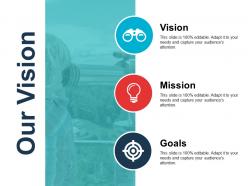
Our vision powerpoint slide deck template
You must be logged in to download this presentation.
Try Before you Buy Download Free Sample Product
Audience
Editable
of Time
Acquaint folks with gourmet foods through our PTS. Brief them on fine dining.
People who downloaded this PowerPoint presentation also viewed the following :
Content of this Powerpoint Presentation
In today’s digital era, whatever sticks, sells. A business can achieve ground-breaking sales today, if it’s able to strike the right chords on social media. A viral product, service or brand message can attract audiences in number, something that the urban lingo refers to as ‘trending’.
Brand mission and vision statements are two aspects of brand messaging that can help it create a buzz among audiences.
A mission statement is what a brand strives for everyday, and it can vary as the objective is achieved. A vision statement is more long-term. Employees store it at the back of their minds, and it broadly represents the ultimate state that an organization hopes to arrive at. Sometimes, brands can base their missions and vision statements on a popular cause. Sometimes, resonance with the Gen Z trends will create hype that becomes a phenomenal driver of social engagement and enquiries.
Consider Tesla with its always-in-the-news CEO, Elon Musk. Its vision statement is “to create the most compelling car company of the 21st century by driving the world's transition to electric vehicles. Similarly popular motivational talk-show, TED, follows a mission statement that aligns with its day-to-day engagements. Its mission statement being: Spread ideas, foster community, and create impact. Purely Elizabeth, a high-growth, natural foods business has maintained its vision statement as, We believe that food can heal.
If these phrases from the popular business names today are enough to stir your will to create one for yourself, this PPT Template is your sign to act. Ruminate on the most-relevant and clickable vision and mission statements that suit your brand and share it with stakeholders and audiences to make your first best impression.
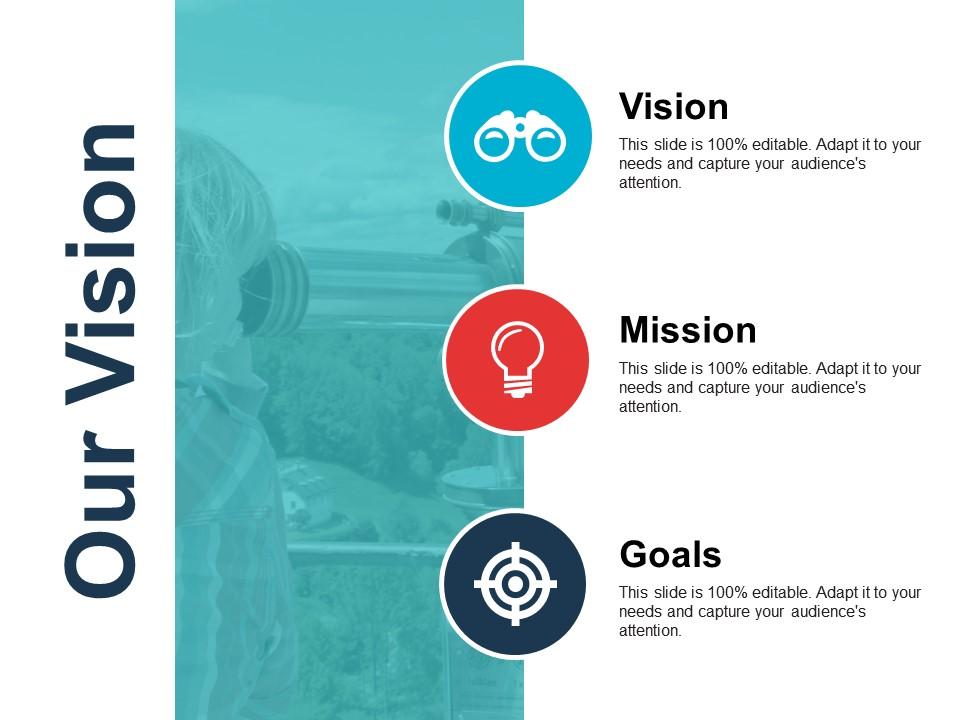
Template 1: Our Vision PowerPoint Slide Deck Template

Use this PPT Template to present your company’s vision, mission and goals. This presentation design can then be included in your company presentations, business proposals, orientations, or even manuals. Guide your stakeholders through your brand’s aim and impress them with the power of vision and everyday goals that you chase everyday. You can even use this PPT Layout to collect opinions about the best choice of mission, vision, and goals and share it with your company stakeholders.
Edit this PPT Slide as you wish and you can even add a photo signifying the unique value proposition that your business or doing business with you would bring to the table.
PS: Want to perform an in-depth research on designing the perfect mission and vision statement for your organization? Here’s the PPT Deck to guide you.
Our vision powerpoint slide deck template with all 5 slides:
Have Our Vision Powerpoint Slide Deck Template, will deliver. Good condition also guaranteed.
FAQs for Our vision powerpoint
Look, most vision statements are basically fancy nonsense that sounds impressive in boardrooms but means nothing to actual people. Here's what actually works: make it inspiring enough that people get excited about it, be super clear about the future you're creating, and paint a picture specific enough that someone can visualize it. I always think the best test is whether someone can repeat it back after hearing it once - if they can't, you've overcomplicated things. Also, if you need to look at notes to remember your own vision statement, that's probably a red flag.
Your vision is basically your team's GPS - it keeps everyone moving in the same direction instead of wandering around confused. People actually work way harder when they feel connected to something meaningful beyond just checking boxes all day. It helps with tough decisions too because you can ask "does this get us closer to our goal?" Plus your team will take bigger creative risks when they know what success looks like. I'd focus on nailing one sentence that actually gets people pumped about what you're building. Way harder than it sounds though.
So basically, when your team knows what you're actually working toward, they get it. Their daily grind suddenly connects to something that matters. People want to know the "why" behind their work - honestly, who doesn't? Without that bigger picture, you're just shuffling papers or whatever. But give them a real vision they can buy into? Now they feel like they're building something. The trick is talking about it regularly (not just once at some company meeting) and actually showing people how their specific job feeds into that goal. Makes all the difference.
Look, as a leader you're basically the main hype person for your vision. Tell stories constantly - make it feel real for everyone. Yeah, it gets annoying repeating yourself, but people need to hear it over and over to actually get it. Don't just save it for big meetings though. Bring it up in random conversations, hiring decisions, even when you're recognizing good work. The key is making it part of how you actually make choices every day, not just something pretty on the wall. That's how it sticks long-term.
Honestly, just put all three on paper side by side and see if they actually make sense together. Your vision should flow naturally from your mission and values - like, if you achieve this future state, does it actually fulfill what you exist for? I've watched so many companies where these completely contradict each other and it's just... messy. Does your vision require you to live those values you supposedly have? If there's weird gaps or conflicts, tweak the vision until they all reinforce each other. Nobody wants to work somewhere that can't figure out its own story.
So I'd start with employee surveys - do people actually get the vision and feel connected to it? Track whether your big decisions line up with what you're preaching too. Here's the thing though - if leadership isn't constantly talking about it, forget it. Nobody else will care. Also check if new projects naturally connect back to your vision or just seem totally random. But honestly? The best test is asking random frontline people to explain the vision in their own words. If they stammer through corporate buzzwords or look confused, your communication strategy needs serious work.
Honestly, visuals are a game-changer when you're trying to get people on board with your ideas. Stakeholders get hit with so much info daily - charts or even rough sketches on a whiteboard help them actually see what you mean. I'm a big fan of flowcharts for processes, mockups for products, that kind of thing. People remember visual stuff way better than just words anyway. Plus it helps when you've got team members who learn differently or maybe English isn't their first language. Start simple though - you don't need fancy graphics. A basic timeline can totally transform how your audience connects with what you're pitching.
Honestly, the worst thing you can do is make it super vague - like "we want to be the best company ever" or whatever. Don't write some massive paragraph that nobody will remember either. I've seen so many companies just copy what Apple or Google says, and it always feels fake. You gotta involve your actual team members, not just write it in some boardroom with executives. Test it out first too - see if people can actually repeat it back to you. One clear sentence that's specific to what you do? That's the sweet spot. Way better than those generic mission statements that could apply to literally any business.
Don't throw out your whole vision when things get messy - I've watched too many companies do this and regret it later. Your core purpose should stay the same, but everything else can flex. It's like GPS rerouting around traffic while you're still going to the same place. Markets shift constantly, so figure out what parts of your vision actually still make sense for customers. The foundational stuff that defines who you are? Keep it. The specifics about timing and methods? Totally fine to change those. Oh, and do quarterly check-ins to see if you need tweaks. Way better than waiting until you're completely off track.
Your vision is basically your brand's DNA - it drives everything. Messaging, visuals, market positioning, all of it. Without one? Your brand feels scattered and forgettable (seen it happen so many times). But when you've got that clear direction, every choice feels authentic because it's all filtered through the same lens. Here's what actually works: treat your vision like a gut check. Before making any brand decision, ask "does this fit where we're headed?" Sounds simple but it'll save you from making random choices that don't connect. The consistency is what makes people remember you.
Honestly, people forget bullet points but they'll remember a good story every time. Your vision needs that emotional hook - show them what success actually looks like day-to-day instead of just rattling off goals. I always think about specific scenarios: how will your customers feel? What's a regular Tuesday like for your employees in this better world you're building? The details matter way more than you'd think. Pick one concrete example that shows your vision in action, then run it by your team. Stories just stick better in people's heads.
Honestly, Miro and Mural are clutch for remote brainstorming - way better than trying to do it over Zoom calls. If you're meeting in person though, don't overthink it. Sticky notes and flip charts still work amazingly well, or try something like World Café if your group's into that. I'd grab input from everyone beforehand using SurveyMonkey or whatever. Then keep everything organized in Google Docs (or Cascade if you want to get fancy). Oh, and appreciative inquiry workshops are solid too - bit touchy-feely but people actually engage. Pick one digital tool plus one facilitation method that matches your team's vibe.
Look, when your company vision actually includes social and environmental stuff, it becomes the thing that guides every decision you make. Product development, supply chains, all of it. Your employees get way more excited about the work too - nobody wants to feel like they're just making rich people richer, you know? It stops being this box you check and becomes part of how you actually operate. Short sentences work here. Take a hard look at your current vision statement though. Does it sound like every other boring corporate mission, or does it actually say something about doing business responsibly?
Get everyone involved from day one - not just the executives making decisions in some boardroom. Different departments, different levels, the whole mix. Run workshops where people can actually say what success means to them, because honestly? Leadership usually has no clue what frontline staff care about. Some folks need processing time before they'll speak up, so plan for that. Create multiple ways for people to give input throughout the process. Then - and this is crucial - actually use their feedback. I've seen too many companies end up with pretty mission statements that half the workforce just rolls their eyes at.
Look, your vision isn't something you write once and forget about. I'd set up quarterly check-ins with your team to see if it still makes sense - markets change, people change. Companies get way too attached to visions that honestly don't mean anything anymore. Get feedback from customers and employees regularly so you'll catch when things feel off. Don't do massive rewrites though. Small tweaks work better than starting over. Oh, and literally put it in your calendar every few months or you'll forget to look at it.
-
amazing designs!
-
Thanks to share such good templates. Hope to get more.
-
Excellent work done on template design and graphics.
-
Amazing product with appealing content and design.