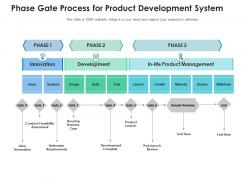
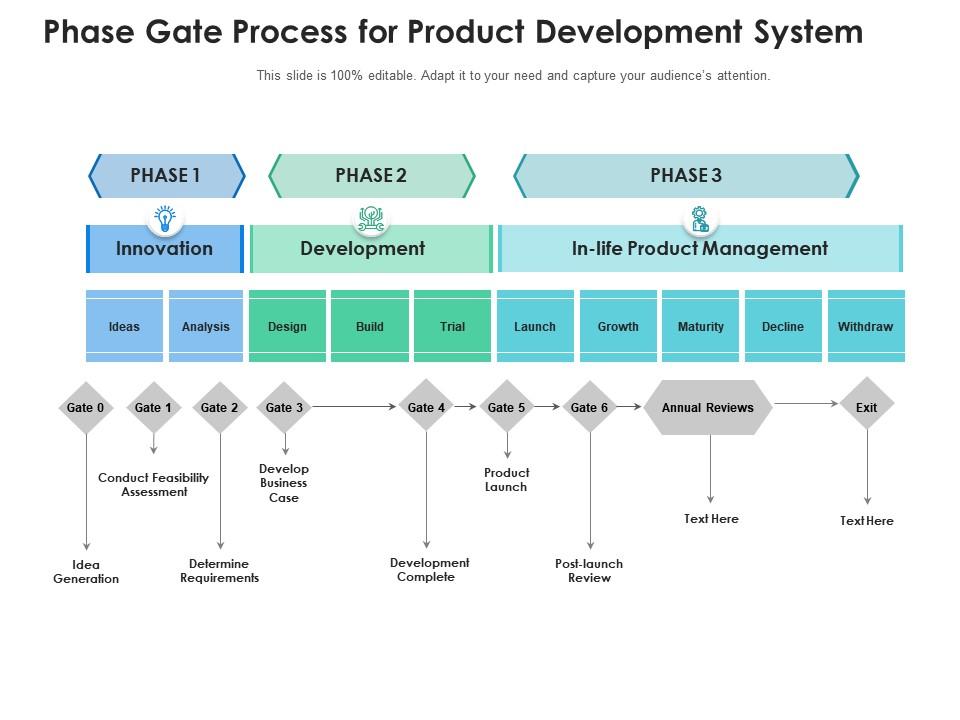
Phase gate process for product development system
Try Before you Buy Download Free Sample Product
Audience
Editable
of Time
Our Phase Gate Process For Product Development System are topically designed to provide an attractive backdrop to any subject. Use them to look like a presentation pro.
People who downloaded this PowerPoint presentation also viewed the following :
Phase gate process for product development system with all 2 slides:
Use our Phase Gate Process For Product Development System to effectively help you save your valuable time. They are readymade to fit into any presentation structure.
FAQs for Phase gate process for
The primary purpose of the phase gate process is to provide structured decision points that ensure projects remain aligned with business objectives, budgets, and timelines through systematic evaluation and approval stages. This approach enables organizations to minimize risks, optimize resource allocation, and maintain strategic focus, with many companies finding that gate reviews significantly improve project success rates and deliver measurable competitive advantage.
The phase gate process enhances decision-making by establishing structured evaluation points where stakeholders assess project viability, resource allocation, and strategic alignment before proceeding to subsequent phases. These checkpoints enable organizations to minimize risk, optimize investments, and pivot strategies based on real-time data, with many companies finding that systematic gates ultimately deliver faster project completion and improved resource efficiency.
The typical phases in a phase gate process include ideation, concept development, business case analysis, development and testing, market validation, and launch preparation. These structured phases enable organizations to systematically evaluate projects through defined checkpoints, minimize risks through early identification of issues, and optimize resource allocation, with many companies finding that this approach accelerates time-to-market while reducing development costs.
Teams effectively identify and define project gates by mapping critical decision points, establishing clear deliverable requirements, aligning stakeholder approval processes, and setting measurable success criteria for each phase transition. Through strategic gate positioning at natural project milestones, organizations streamline resource allocation, minimize risks, and enhance project visibility, with many finding that well-defined gates ultimately deliver better project outcomes and stakeholder accountability.
Stakeholders provide critical input during gate reviews, offering expertise, resource approval, and strategic guidance to evaluate project viability and alignment with business objectives. Through their diverse perspectives, stakeholders ensure projects meet market needs, technical requirements, and organizational priorities, while enabling informed go/no-go decisions that ultimately deliver better resource allocation and higher project success rates.
Gate criteria should include financial viability, technical feasibility, market potential, resource requirements, risk assessment, and strategic alignment with organizational objectives. These evaluation parameters enable project teams to make data-driven decisions by examining cost-benefit ratios, timeline adherence, and competitive positioning, with many organizations finding that standardized criteria streamline decision-making and ultimately enhance project success rates.
The phase gate process contributes to risk management by establishing structured checkpoints where teams assess potential threats, evaluate mitigation strategies, and make informed go/no-go decisions before advancing. Through systematic reviews at each gate, organizations identify risks early, allocate resources strategically, and prevent costly failures, with many companies finding that this approach reduces project risks by up to 40% while enhancing overall success rates.
The phase gate process adapts across industries through customized criteria, tailored checkpoints, and industry-specific risk assessments that align with sector regulations and market demands. In pharmaceuticals, gates focus on clinical trials and regulatory compliance, while manufacturing emphasizes production scalability and quality controls, ultimately enabling organizations to maintain systematic project governance while addressing unique operational requirements.
Success in the phase gate framework is measured through predefined criteria at each gate, including budget adherence, timeline compliance, quality metrics, stakeholder satisfaction, and risk mitigation effectiveness. These quantitative and qualitative assessments enable project managers to track progress systematically, with many organizations finding that this structured approach delivers improved project completion rates, better resource allocation, and ultimately enhanced ROI across their project portfolios.
Tools commonly used with the phase gate process include project management software, risk assessment matrices, financial analysis tools, stakeholder evaluation frameworks, and portfolio management systems. These technologies streamline decision-making by automating data collection, enhancing cross-functional collaboration, and providing real-time visibility into project performance, with many organizations finding that integrated dashboards ultimately deliver faster approvals and improved resource allocation.
The phase gate process facilitates collaboration by establishing structured checkpoints where cross-functional teams must align on deliverables, share insights, and collectively approve project progression. These mandatory review gates enable marketing, engineering, finance, and operations teams to identify potential conflicts early, streamline resource allocation, and maintain unified project vision, ultimately delivering faster time-to-market and enhanced product quality.
Organizations face challenges including stakeholder resistance to structured processes, resource allocation conflicts across multiple gates, lengthy approval cycles that slow innovation, inadequate cross-functional collaboration between departments, and difficulty balancing thoroughness with speed-to-market pressures. While these hurdles can initially impact project timelines, many companies find that addressing cultural change management, streamlining gate criteria, and training teams ultimately delivers improved project success rates and better resource efficiency.
Project teams can balance flexibility and structure by implementing adaptive gate criteria, incorporating iterative feedback loops, and establishing clear escalation pathways for scope adjustments. This strategic combination enables teams to maintain project governance while responding to changing requirements, with many organizations finding that flexible checkpoints, regular stakeholder reviews, and documented change processes ultimately deliver faster project outcomes and enhanced stakeholder satisfaction.
Effective gate reviews require clear evaluation criteria, cross-functional stakeholder participation, standardized documentation, objective decision-making frameworks, and predetermined timelines for each phase. These practices enhance project governance by ensuring comprehensive risk assessment, resource alignment, and strategic objectives validation, with many organizations finding that structured gate processes reduce project failures by up to 40% while accelerating time-to-market.
The phase gate process integrates with Agile methodologies by aligning gates with sprint reviews, incorporating iterative feedback loops, and using cross-functional teams for gate evaluations. This hybrid approach enables organizations to maintain strategic oversight while preserving Agile flexibility, with many technology companies finding that combining structured gates with continuous delivery ultimately delivers faster innovation cycles and improved risk management.
-
Informative presentations that are easily editable.
-
Helpful product design for delivering presentation.
-
Unique and attractive product design.
-
Awesome use of colors and designs in product templates.
-
Excellent work done on template design and graphics.
-
Very well designed and informative templates.