Pmp certification curriculum mission and vision of our institute
Try Before you Buy Download Free Sample Product
Audience
Editable
of Time
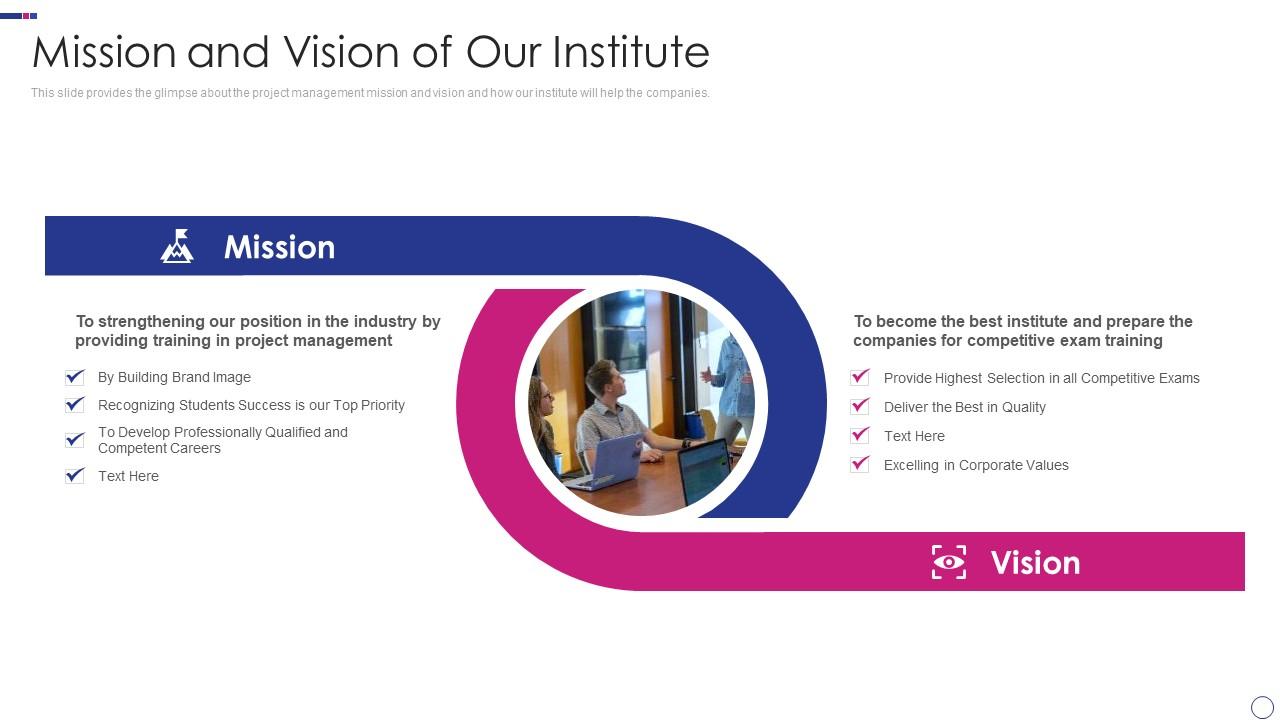
This slide provides the glimpse about the project management mission and vision and how our institute will help the companies.
People who downloaded this PowerPoint presentation also viewed the following :
Pmp certification curriculum mission and vision of our institute with all 6 slides:
Use our PMP Certification Curriculum Mission And Vision Of Our Institute to effectively help you save your valuable time. They are readymade to fit into any presentation structure.
FAQs for Pmp certification curriculum mission and vision
Honestly, the PMP is worth it if you're serious about this stuff. You're looking at like 20-25% more money on average, which is pretty sweet. Stakeholders actually listen to you more because they know you're not just winging it. Makes job hunting way easier too - recruiters love that certification. Oh and there's this whole network of other PMPs you get access to, which has been surprisingly helpful. The studying part kinda sucks though, not gonna lie. Plan for maybe 3-6 months of prep time. But yeah, if project management is your thing long-term, I'd go for it.
Dude, get the PMP. I'm not even kidding - most people see 15-20% salary bumps afterward. Companies actually hunt for PMP holders when they're filling senior PM roles, so you'll have way more options. It's like having a golden ticket that proves you can juggle complex projects without losing your mind. Honestly, the whole thing pays for itself within a year or two when you factor in raises and better job offers. I know the exam's a pain, but check salary surveys in your area first. You'll probably kick yourself for waiting so long.
So you'll need either a bachelor's degree with 3 years of PM experience, or just a high school diploma but then you need 5 years instead. Plus 35 hours of project management training either way. Here's the annoying part - your experience has to be actually *leading* projects, not just being on the team. PMI gets really picky about this during audits. They audit like 25% of applications randomly, so definitely keep good records of everything. Oh, and if your job title isn't obviously project management-related, that makes it trickier to prove. Start collecting your project details and certificates now!
There are 10 knowledge areas you need to know for the PMP exam. Integration, Scope, Schedule, Cost, Quality, Resource, Communications, Risk, Procurement, and Stakeholder Management. Integration's the worst one honestly - it connects everything so it gets confusing fast. Each area has different processes and tools they'll test you on, but here's the thing: the exam doesn't just want memorization. They want to see how these areas work together in actual projects. Like, you might get a question about schedule issues that also involves stakeholder communication, you know? Study them as connected pieces instead of separate chunks. That's how real projects work anyway.
Yeah, so PMP covers both old-school waterfall stuff and all the agile frameworks like Scrum and Kanban. Pretty much everything really - they want you knowing traditional project management AND the newer agile approaches. Most projects these days mix both anyway, so the exam tests hybrid methods too. You'll get into servant leadership and value-driven delivery concepts. Honestly it's a lot to cover but makes sense since real projects are messy and don't stick to one methodology. I'd start with the current PMBOK guide - it shows how they're balancing traditional PM with agile now.
Don't just memorize stuff - PMI wants you to actually apply the process groups and knowledge areas. I'd grab Rita Mulcahy's book or Andy Crowe's for prep. Practice exams are honestly where the magic happens though. PrepCast and PMTraining are solid choices. You'll figure out how PMI's brain works, which is... unique. Budget 3-4 months, maybe 10-15 hours weekly. Study groups help tons - teaching someone else really clicks things into place. Oh, and start those full practice tests early! They'll show you exactly what you suck at so you can fix it.
So PMP is basically the big one everyone wants, but you need like 4,500-7,500 hours of actual project work first - which is kind of a catch-22 when you're starting out. CAPM doesn't need any experience, so that's where most people begin. PRINCE2 is huge in Europe but honestly less relevant here unless you're dealing with UK clients or something. PMP definitely gets you the best salary bump and recognition worldwide, but the exam is brutal. I'd say go CAPM first to get your foot in the door, then grind out those experience hours and tackle PMP later. Way less overwhelming that way.
So your PMP expires every three years and you'll need 60 PDUs to renew it. Training courses count, webinars, volunteering, even reading PM books - they're surprisingly flexible about what qualifies. The key thing is logging everything in PMI's system as you go. Don't be like me and panic at month 35 trying to cram in PDUs! Spread them out over the three years. I actually found some of the webinars pretty decent, which was unexpected. Just stay on top of tracking and you'll be fine.
Oh, CCRs are just PMI's way of making sure you don't get rusty after earning your PMP. You've got three years to rack up 60 PDUs - that's their fancy term for continuing education credits. Training courses count, webinars too, plus volunteering or writing PM articles if you're into that sort of thing. Honestly, the tracking system is kind of annoying but whatever. Don't be like my coworker who waited until month 35 to start collecting them - total nightmare. Your cert goes inactive if you miss the deadline. Spread those 60 PDUs out over the full three years and you'll be fine.
So they completely changed the PMP exam back in 2021 - it's now split about 50/50 between traditional project management and Agile stuff. You'll get tons of questions on Scrum and iterative development now. Honestly, it's way better than just memorizing waterfall processes like we used to! The whole thing tests whether you can pick the right approach for different situations and switch between them. Oh, and definitely don't use old study materials - I made that mistake initially. You really need updated resources that cover both methodologies or you'll be screwed.
Dude, don't make the same mistake I did - I spent forever memorizing PMBOK processes when the actual exam is all about "what would you do in this situation" questions. Four hours is absolutely exhausting if you're not ready for it. Most people do like one practice test and think they're good... big mistake. The question format will throw you off completely. Take at least 3-4 full mock exams to build up your stamina - trust me on this one. Focus way more on situational practice questions than memorizing frameworks. That's what actually gets you through it.
Honestly, you'll want to quit studying at some point - everyone does. That's where study groups save you. Having people going through the same pain keeps you accountable. Those PMBOK concepts are brutal, but someone always explains it in a way that finally makes sense. I missed so much stuff that others caught during practice sessions. The online groups are super convenient, though local meetups have better energy if you can swing it. People who already passed share the best tips too. Oh, and hearing everyone's horror stories somehow makes you feel less alone in the struggle!
Honestly, PMP helped me way more with people stuff than I expected. The stakeholder mapping thing is clutch - you learn to figure out who actually has power vs who just makes noise. Communication planning sounds boring but it's a game changer when your team's all over the place. Plus you get real frameworks for handling conflict instead of just winging it. My meetings got way less chaotic once I started using their structured approaches. Pro tip though - don't wait til after the exam to try this stuff. Start mapping stakeholders and planning communications while you're studying. Your team will definitely notice the difference.
Yeah, the PMP exam is basically all scenarios now. You won't get those boring "define this term" questions anymore - thank god. Instead it's like "Your stakeholder wants scope changes super late in the project, what do you do?" Real situations you'd actually face as a PM. They throw everything at you - team drama, budget problems, stakeholder issues, risk stuff. Way better than the old format tbh. When you're prepping, don't just memorize the PMBOK processes. Figure out WHY things work that way. That's what'll save you when you're stuck between two answers that both sound right.
Honestly, companies with PMP-certified people just do better on projects. These folks stick to proven methods and actually manage risks properly - the difference is pretty noticeable. Projects finish on time and stay on budget way more often. Clients love seeing that certification too, gives the whole team more credibility. The standardized processes help with communication, which cuts down on those annoying delays we've all dealt with. I mean, nobody wants to explain why a project's three months behind again. If your company's struggling with project success rates, getting some PMPs is a solid move.
-
Editable templates with innovative design and color combination.
-
Good research work and creative work done on every template.