

Post Pandemic Business Playbook Powerpoint Presentation Slides





Try Before you Buy Download Free Sample Product
 Impress Your
Audience
 100%
Editable
 Save Hours
of Time


Post-pandemic business playbook lays out processes to raise awareness of new health and well-being protocols to enable business as usual and get back to work safely. Check out our professionally designed Post-Pandemic Business Playbook template that covers a guide for covid-19 pandemic preparedness and response for businesses. This presentation aims to provide an overview of the potential hazards posed in the workplace due to covid-19. This ppt includes a comprehensive risk assessment for all workplaces or to replace any legislated workplace safety obligations. Companies can use this ppt as a guide for employers in addition to guidance delivered by public health authorities such as the world health organization WHO. The outline of this playbook includes employer responsibilities, the hierarchy of controls, health screening, and isolation protocol. Further, it covers self-isolation and returning to the workplace protocol, physical distancing protocol, pathogen decontamination measures, employee training, and communication plan. Book a free demo with our research team now.
People who downloaded this PowerPoint presentation also viewed the following :
Content of this Powerpoint Presentation
Slide 1: This slide displays title i.e. 'Post Pandemic Business Playbook' and your Company Name.
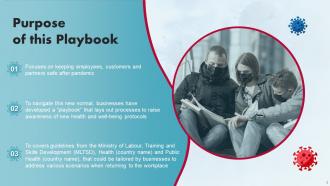
Slide 2: This slide presents purpose of the playbook.
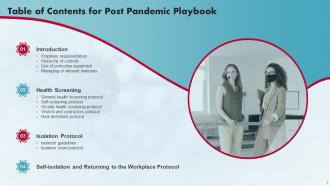
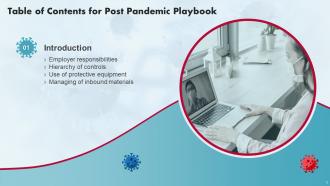
Slide 3: This slide exhibits table of contents.
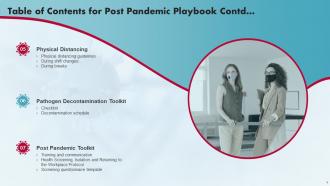
Slide 4: This slide also shows table of contents.
Slide 5: This slide depicts title for four topics that are to be covered next in template.
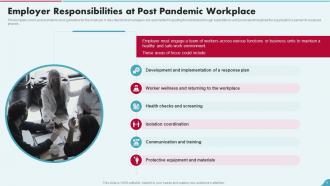
Slide 6: This slide covers post-pandemic work guidelines for the employer.
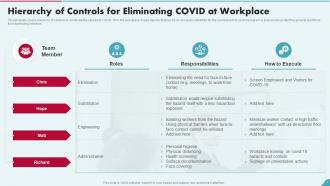
Slide 7: This slide covers hierarchy of controls to eliminate the spread of COVID-19 in the workplace.
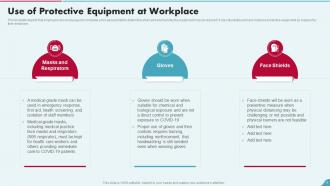
Slide 8: This slide depicts that employers are encouraged to complete a risk assessment to determine when and which protective equipment may be required.
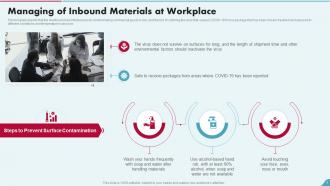
Slide 9: This slide depicts that the likelihood of an infected person contaminating commercial goods is low.
Slide 10: This slide depicts title for five topics that are to be covered next in template.
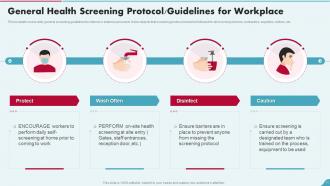
Slide 11: This slide covers daily general screening guidelines for internal or external personnel.
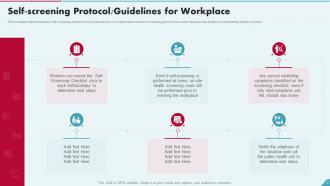
Slide 12: This slide depicts that daily self-screening protocol aims to prevent sick or symptomatic workers from leaving their homes.
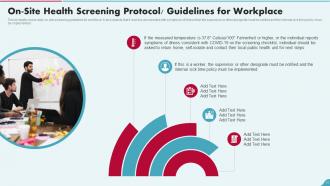
Slide 13: This slide covers daily on site screening guidelines for workforce.
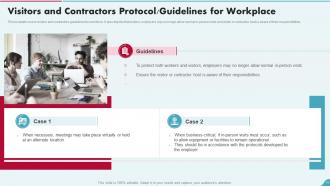
Slide 14: This slide covers visitors and contractors guidelines for workforce.
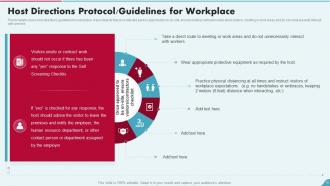
Slide 15: This slide covers host directions guidelines for workplace.
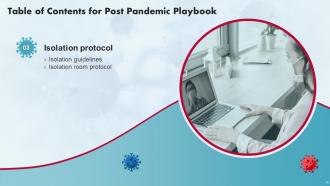
Slide 16: This slide depicts title for two topics that are to be covered next in template.
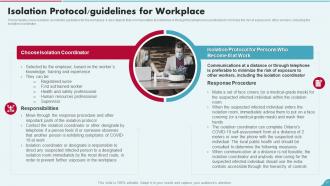
Slide 17: This slide covers isolation coordinator guidelines for the workplace.
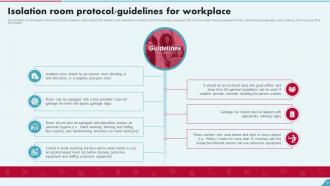
Slide 18: This slide covers isolation room protocol for workplace.
Slide 19: This slide depicts title for one topic that is to be covered next in template.
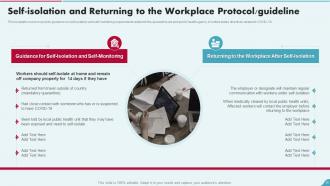
Slide 20: This slide covers to provide guidance on self-isolation and self-monitoring requirements related to the quarantine act and public health agency.
Slide 21: This slide depicts title for three topics that are to be covered next in template.
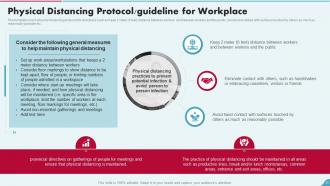
Slide 22: This slide covers physical distancing protocols for workplace such as Keep 2 meter (6 feet) distance between workers and between workers and the public.
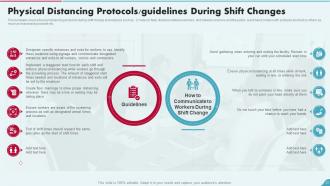
Slide 23: This slide covers physical distancing protocols during shift change at workplace such as: 2 meter (6 feet) distance between workers.
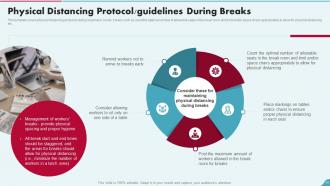
Slide 24: This slide covers physical distancing protocols during washroom, locker, breaks such as count the optimal number of allowable seats in the break room.
Slide 25: This slide depicts title for two topics that are to be covered next in template.]
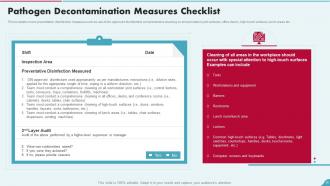
Slide 26: This slide covers preventative disinfection measures such as use of din-approved disinfectant, comprehensive cleaning on all workstation joint surfaces, etc.
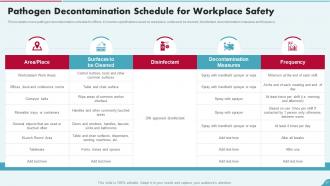
Slide 27: This slide covers pathogen decontamination schedule for offices.
Slide 28: This slide depicts title for three topics that are to be covered next in template.
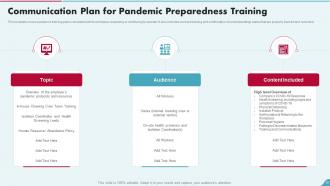
Slide 29: This slide covers pandemic training plans considered while workplace reopening or continuing to operate.
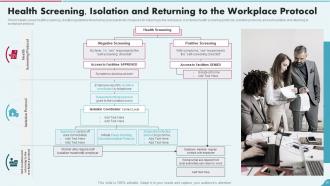
Slide 30: This slide covers health screening, isolation guidelines flowchart as post pandemic measures for returning to the workplace.
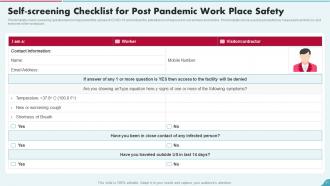
Slide 31: This slide covers screening questionnaire to help prevent the spread of COVID-19 and reduce the potential risk of exposure to our workers and visitors.
Slide 32: This is the icons slide.
Slide 33: This slide presents title for additional slides.
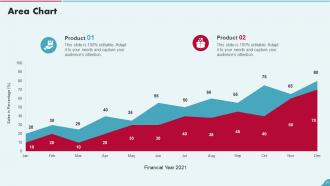
Slide 34: This slide exhibits monthly sales area charts for different products. The charts are linked to Excel.
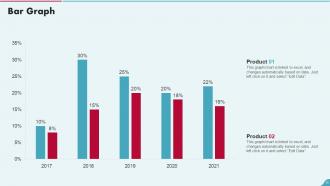
Slide 35: This slide showcases yearly bar graph for different products. The charts are linked to Excel.
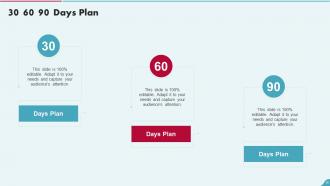
Slide 36: This slide depicts 30-60-90 days plan for projects.
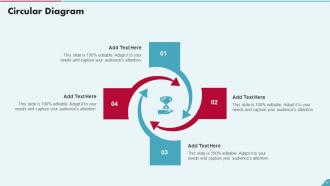
Slide 37: This slide presents circular diagram.
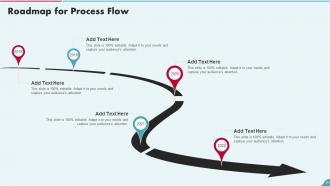
Slide 38: This slide shows roadmap.
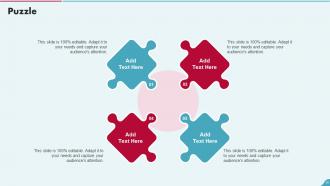
Slide 39: This slide displays puzzle.
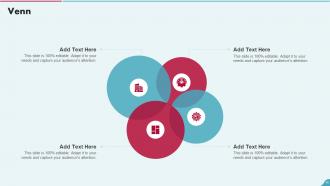
Slide 40: This slide displays Venn.
Slide 41: This is thank you slide & contains contact details of company like office address, phone no., etc.
Post Pandemic Business Playbook Powerpoint Presentation Slides with all 46 slides:
Use our Post Pandemic Business Playbook Powerpoint Presentation Slides to effectively help you save your valuable time. They are readymade to fit into any presentation structure.





FAQs for Post Pandemic Business Playbook
Honestly, you gotta spread your risk across multiple income streams - new products, different markets, whatever works for your business. Remote work and online sales aren't going anywhere, so your tech needs to actually function well (learned this one the hard way last year). Supply chains are still a mess globally, so having backup suppliers mapped out is pretty much non-negotiable now. I'd start by looking at your biggest weak spots first. Oh, and don't rely on just one revenue source anymore - that's like putting all your money on red at the casino.
Honestly, stop guessing what customers want and just ask them directly. Surveys work, but I'd also dig into your sales data and watch what they're actually saying on social media. Look at who's winning right now - those restaurants that jumped on delivery early, or how gyms immediately went online when everything shut down. They didn't overthink it. Before you completely flip your business model though, test small stuff first. Your current customers are perfect for trying out new ideas. Really focus on whatever new problems they're dealing with instead of trying to force your old way of doing things to work again.
Look, post-pandemic digital transformation isn't just nice to have anymore - it's make or break. Customers got used to everything being online during lockdowns and honestly, they're not going back. You've gotta digitize the clunky parts of your customer experience first. That's where you'll see the biggest impact. Companies crushing it right now? They're using automation and cloud tools to actually respond fast when things change. I'd start by figuring out where people still have to deal with outdated, manual processes in your business. Those friction points are costing you way more than you think.
Honestly, you've gotta stop relying on just one or two suppliers - that whole approach is dead after what happened in 2020. Find some local options too since those overseas chains are way too risky now. Yeah, keeping extra inventory costs more upfront, but it's worth it. The just-in-time thing was always kinda overrated anyway. Get some better forecasting software if you can swing it. Oh, and actually map out your whole supply chain - most people have no clue where their stuff really comes from. Start small though. Pick your three scariest supplier situations and make backup plans for those first.
Honestly, you've gotta be way more intentional about staying connected - can't just pop by someone's cube anymore, right? I'd start with regular one-on-ones and use Slack or whatever for async updates. Oh, and those virtual coffee chats actually work better than I expected. Focus on what people deliver, not whether they're online at 9am sharp. Some folks are juggling kids or weird schedules at home. Better to overcommunicate than have people wondering what's happening. Maybe audit how you're currently talking to everyone first? See where the gaps are.
Honestly, you've gotta ditch the generic messaging and get way more personal. People went through real stuff during the pandemic - acknowledge that instead of pretending nothing happened. Your old customer personas? Probably totally outdated now. I'd survey your current customers first about how their needs actually shifted (might shock you what comes up). Then create content that speaks to where they are TODAY, not their pre-2020 problems. Skip the pushy sales stuff - focus on being transparent and telling real stories. Most people are in completely different headspaces now, both digitally and emotionally.
Look, your employees' mental health isn't some nice-to-have anymore - it's literally make or break for keeping good people. Post-pandemic, everyone's burned out and companies are finally realizing you can't just tell people to "suck it up" (about time, right?). Flexible schedules, actual work-life balance, mental health resources - this stuff directly impacts your bottom line through better retention and performance. The smart move? Just ask your team what they actually need instead of guessing. Trust me, the companies doing this well are crushing it while others hemorrhage talent.
Look, the pandemic basically broke all the old rules, so I'd ditch most of your pre-2020 benchmarks - they're probably doing more harm than good now. Focus on three things: how customers actually behave today, where your operations are getting stuck, and what's happening in your market right now. Track real-time stuff like customer preferences and supply chain mess-ups. Oh, and don't forget digital engagement patterns since everyone's online now. Use predictive analytics to spot demand changes and find those new revenue opportunities that popped up during COVID. Honestly, move fast on insights rather than obsessing over perfect analysis.
Oh man, employment laws are changing constantly right now - remote work stuff, health requirements, leave policies. Data privacy rules got way stricter too. Honestly feels like every other week there's something new to worry about. Your contracts definitely need updates, especially if you've got people working from different states (tax nightmare). Retail and hospitality have even more headaches with local health regs still changing. I'd probably check in with a lawyer quarterly just so you don't get blindsided by something major.
Honestly, I'd go after SBA loans first - they've got way better terms since the pandemic stuff. Also check out local grants from your city or state, there's still recovery money floating around. Banks are actually lending again (crazy, right?). Community development financial institutions are solid too, they're specifically for smaller companies like yours. Oh and definitely see if your industry got any targeted funding - tons of sectors have their own programs now. Just make sure your books are clean and you can show how you're bouncing back. That part's huge when you apply.
Ditch the hour-tracking BS and focus on what people actually deliver. Get your team set up with tools like Miro or Notion so everyone can contribute no matter where they're working. I'd do "anchor days" where the whole team comes in for big collaborative stuff, then let people work from home when they need deep focus time. The companies that are winning right now? They stopped trying to recreate 2019 and built something completely different instead. Give people home office money, be flexible with time zones, and train your managers to care about results, not butts in seats. Oh, and start small - pick one team to test this with first.
Definitely start gathering feedback through surveys and social media monitoring - also just talk to your customers directly. The pandemic changed everything, so you need to know how their needs shifted. Weekly check-ins work great, or monthly if that's more realistic for your schedule. Here's the thing though - actually DO something with what you learn. I can't tell you how many businesses collect all this feedback then just... ignore it. Use it to update your products or change how you deliver services. Maybe even pivot completely if needed. Pick one feedback method and start this week.
Hey! So the biggest thing is making sure people aren't scared to mess up or pitch crazy ideas. Give everyone one hour a week for passion projects - seriously, this works. Mix up your teams, let people try different roles, and when someone fails? Celebrate it if they learned something valuable. Most innovation comes from screwing up anyway. Your leaders need to actually show they're adaptable too, not just talk about it. Oh, and let people make quick decisions without running everything up the chain first. Cross-functional stuff is where the magic happens.
Track the obvious stuff first - cash flow, revenue vs pre-2020, customer retention. Cash flow's probably your best reality check tbh. Employee satisfaction matters too, even if it's harder to measure. But here's the thing - don't just rely on numbers. Actually talk to your customers and team about how things feel different. Monthly check-ins work way better than waiting for quarterly reports. Oh, and mix the hard data with gut feelings from people on the ground. You want to catch problems early before they snowball into bigger issues.
Look, people are still paying attention to how companies acted during the pandemic. Did you support your workers? Help out the community? Customers definitely remember who stepped up and who basically disappeared or said something stupid. Your CSR stuff has to be real though - none of that fake "we care so much" marketing garbage that makes everyone cringe. Pick areas where you can actually make a difference and be honest about it. Honestly, I'd start by looking at what you did (or didn't do) during COVID and work from there.
-
Graphics are very appealing to eyes.
-
I am glad to have come across Slideteam. I was searching for some unique presentations and templates for my business. There are a lot of alternatives available here.