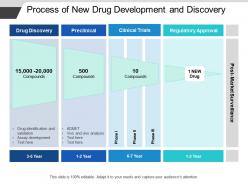
Process of new drug development and discovery

Process of new drug development and discovery
Slide 1 of 5
Favourites Favourites

Try Before you Buy Download Free Sample Product

Audience Impress Your
Audience
Editable 100%
Editable
Time Save Hours
of Time
The Biggest Sale is ending soon in
0
0
:
0
0
:
0
0
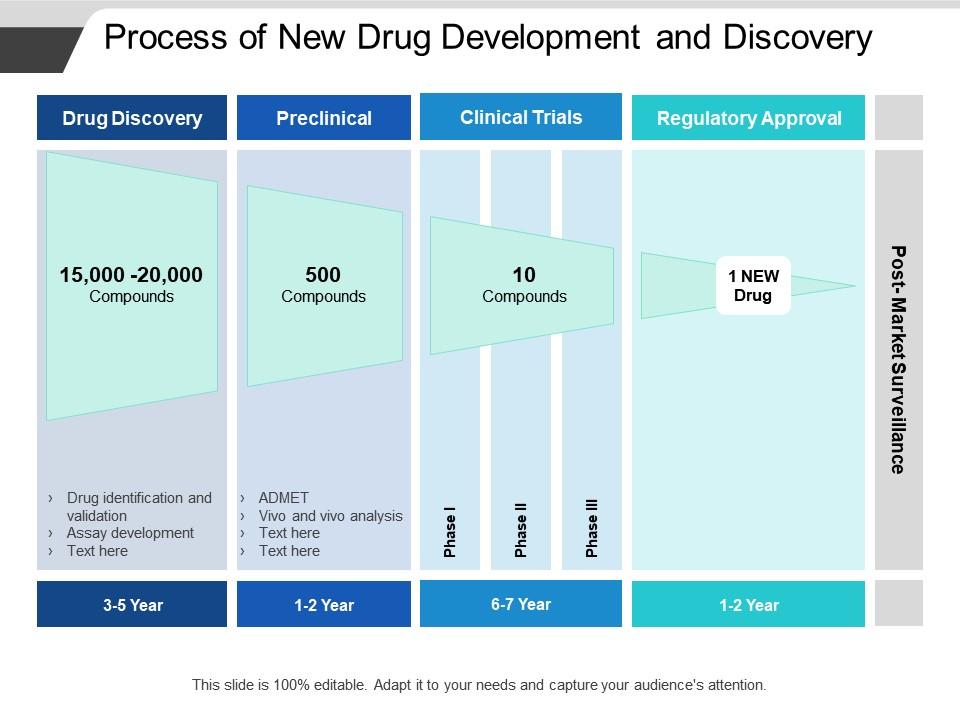
Presenting this set of slides with name - Process Of New Drug Development And Discovery. This is a four stage process. The stages in this process are Drug Discovery, Science, Medical.

FAQs for Process of new drug

Pharmaceutical R&D includes drug discovery, preclinical testing, clinical trials (phases I-III), regulatory approval, and post-market surveillance. These stages streamline by identifying promising compounds, ensuring safety through rigorous testing, and demonstrating efficacy across diverse patient populations, with many pharmaceutical companies finding that strategic investment in early-stage research ultimately delivers faster market entry and competitive advantage.

Regulatory requirements significantly extend pharmaceutical R&D timelines to 10-15 years and increase costs to over $1 billion per drug by mandating extensive preclinical testing, multi-phase clinical trials, and comprehensive safety documentation. While these stringent standards present development challenges, they ultimately ensure patient safety and market confidence, with many pharmaceutical companies finding that early regulatory engagement and adaptive trial designs help streamline approval processes.

Technology revolutionizes pharmaceutical R&D through AI-powered drug screening, predictive modeling, automated laboratory systems, cloud-based data analytics, and digital clinical trial platforms. These innovations streamline discovery timelines by identifying promising compounds faster, optimizing trial designs, and enhancing regulatory submissions, with many pharmaceutical companies finding that integrated digital approaches reduce development costs while accelerating time-to-market significantly.

Data analytics improves pharmaceutical R&D decision-making by identifying promising drug compounds faster, predicting clinical trial outcomes more accurately, and optimizing resource allocation across research portfolios. Through predictive modeling and real-world evidence analysis, pharmaceutical companies streamline candidate selection, reduce development timelines, and minimize costly late-stage failures, ultimately delivering more targeted therapies while significantly lowering R&D costs.

Recruiting and retaining clinical trial participants faces challenges including patient awareness limitations, complex eligibility criteria, geographic accessibility barriers, time commitment concerns, and safety apprehensions. These obstacles significantly impact pharmaceutical companies' research timelines and costs, with many organizations finding that enhanced digital outreach, streamlined protocols, and patient-centric approaches ultimately deliver improved enrollment rates and study completion.

Personalized medicine has transformed pharmaceutical R&D strategies by shifting focus toward targeted therapies, biomarker-driven drug development, and precision treatment approaches tailored to individual genetic profiles. Companies now invest heavily in companion diagnostics, genomic research, and smaller patient cohorts for clinical trials, with biotechnology firms and major pharmaceutical companies finding that this approach reduces development costs while improving treatment efficacy and patient outcomes.

Ethical considerations in pharmaceutical R&D include informed consent, patient safety protocols, equitable participant selection, data transparency, and rigorous risk-benefit analysis throughout clinical trials. These standards ensure vulnerable populations are protected while enabling researchers to develop life-saving treatments, with regulatory bodies like FDA and EMA increasingly requiring comprehensive ethical frameworks that balance innovation with patient welfare and scientific integrity.

Academic-industry partnerships enhance R&D outcomes by combining universities' fundamental research capabilities with pharmaceutical companies' development expertise, regulatory knowledge, and commercialization resources. These strategic collaborations accelerate drug discovery timelines, reduce development costs, and increase success rates, with many biotech firms and major pharmaceuticals finding that shared expertise ultimately delivers faster market entry and more innovative therapeutic solutions.

Patient-centric approaches revolutionize drug development by incorporating patient perspectives, real-world evidence, and outcome measures that matter most to those receiving treatment. These methodologies enhance clinical trial design, accelerate regulatory approval processes, and improve treatment adherence, with pharmaceutical companies finding that patient engagement ultimately delivers more effective therapies and stronger market acceptance.

Pharmaceutical companies manage intellectual property through strategic patent filing, comprehensive prior art searches, competitive landscape monitoring, and cross-licensing agreements with partners. These approaches enable robust protection of innovative compounds, processes, and formulations while minimizing infringement risks, ultimately delivering competitive advantage and maximizing return on substantial R&D investments.

Emerging biopharmaceutical R&D trends include personalized medicine, AI-driven drug discovery, gene and cell therapies, digital biomarkers, and precision oncology. These innovations streamline development timelines, enhance target identification, and enable tailored treatments, with many pharmaceutical companies finding that strategic combinations of these technologies ultimately deliver faster clinical outcomes and competitive advantages.

Global health policy significantly influences pharmaceutical R&D funding through regulatory frameworks, government grants, tax incentives, and priority disease designations that direct resources toward specific therapeutic areas. Policies promoting orphan drug development, pandemic preparedness, and neglected diseases create funding opportunities, while many pharmaceutical companies find that aligning research portfolios with policy priorities enhances access to public-private partnerships and accelerates market approval pathways.

Companies can reduce R&D attrition rates through enhanced target validation, predictive modeling, strategic partnerships with biotech firms, patient-centric trial designs, and robust biomarker identification. These approaches streamline drug development by improving early-stage decision-making, accelerating patient recruitment, and enabling more precise therapeutic targeting, with many pharmaceutical organizations finding significantly improved success rates and reduced development costs.

Market needs shape pharmaceutical research by directing resources toward high-prevalence diseases, underserved patient populations, and areas with limited treatment options. Companies increasingly prioritize conditions like diabetes, oncology, and rare diseases based on patient demand and regulatory incentives, while market feedback guides clinical trial design and drug formulation strategies, ultimately delivering targeted therapies that address specific healthcare gaps and commercial opportunities.

Artificial intelligence accelerates drug development by identifying promising compounds, predicting molecular behavior, optimizing clinical trial designs, and analyzing vast datasets for safety patterns. Through machine learning algorithms, pharmaceutical companies streamline discovery timelines from decades to years, reduce research costs significantly, and enhance success rates, with major firms like Pfizer and Roche leveraging AI for faster, more targeted therapeutic breakthroughs.

Ratings and Reviews

0% of 100
Review Form
Write a review
Most Relevant Reviews

No Reviews