Profit and loss appropriation account presentation portfolio

Rating:
90%
Profit and loss appropriation account presentation portfolio
Slide 1 of 5
Favourites Favourites

Try Before you Buy Download Free Sample Product

Audience Impress Your
Audience
Editable 100%
Editable
Time Save Hours
of Time
The Biggest Sale is ending soon in
0
0
:
0
0
:
0
0
Rating:
90%
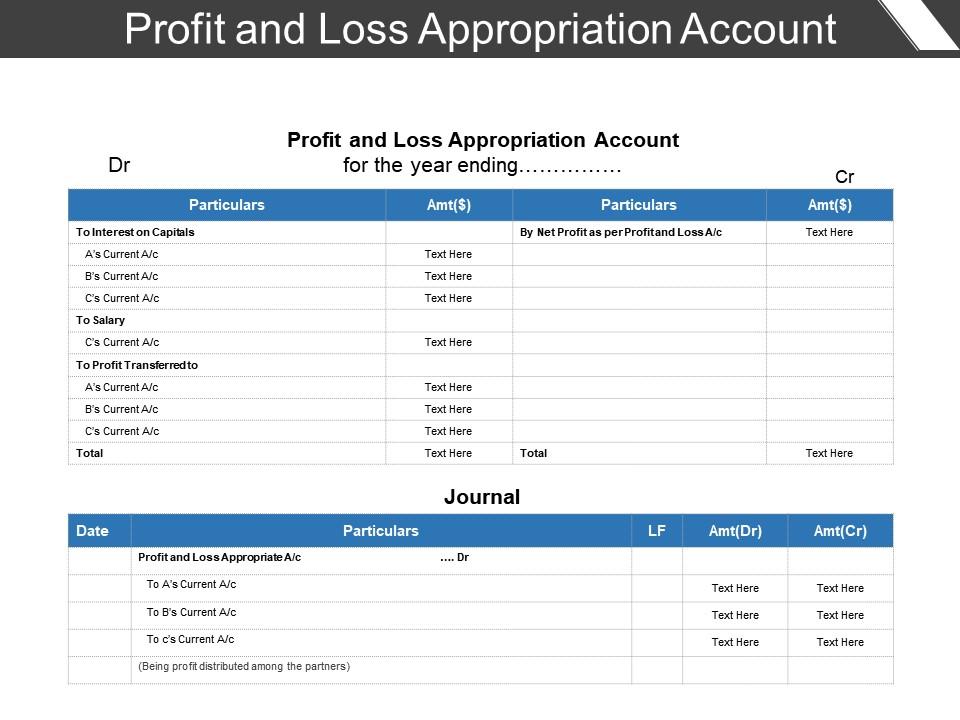
Presenting Profit And Loss Appropriation Account Presentation Portfolio. Save your time with an easily available, completely editable PPT slide. You can make the necessary alterations in the font color, font size and font style. The color of the diagram and background can be formatted. Get this slide in standard as well as widescreen size. You can add or edit text anywhere in the PowerPoint template. Its compatibility with Google Slides makes it accessible. You can customize and save the slide in PDF and JPG formats as well.

People who downloaded this PowerPoint presentation also viewed the following :

FAQs for Profit and loss appropriation

The Profit and Loss Appropriation Account shows how net profit is distributed among partners, shareholders, or retained for business growth, detailing allocations for dividends, reserves, bonuses, and reinvestment. This account enhances transparency in financial reporting by clearly documenting profit utilization decisions, enabling stakeholders to understand management's strategic priorities while ensuring compliance with partnership agreements and corporate governance requirements.

The Profit and Loss Appropriation Account differs by focusing on how profits are distributed rather than calculated, detailing allocations like partner salaries, interest on capital, reserves, and dividend payments. While traditional P&L accounts determine net profit through revenue and expense analysis, appropriation accounts guide strategic financial decisions by showing profit utilization across stakeholders, ultimately enabling better resource allocation and transparency in partnership and corporate financial management.

Key components include retained earnings from previous periods, current year profits, dividend distributions to shareholders, transfers to various reserves, and statutory allocations. These elements enable organizations to demonstrate transparent profit distribution, ensure regulatory compliance, and maintain strategic reserves for future growth, with many corporations finding that systematic appropriation enhances stakeholder confidence and supports long-term financial stability.

Shareholders' dividends appear as appropriations in the Profit and Loss Appropriation Account, reducing the distributable profits after all expenses and taxes are calculated. Companies allocate dividends to equity shareholders and preference shareholders based on their dividend policies and statutory requirements, with remaining profits typically transferred to reserves, ultimately strengthening the company's financial position while rewarding investor loyalty and maintaining competitive shareholder returns.

Businesses retain profits when prioritizing expansion, debt reduction, research and development, market volatility preparation, or regulatory compliance requirements. Companies in growth phases, technology sectors, or capital-intensive industries like manufacturing often reinvest earnings to fund new equipment, product development, and market expansion, ultimately delivering enhanced competitive positioning and long-term shareholder value.

The Profit and Loss Appropriation Account plays a crucial role in assessing financial health by showing how profits are distributed among dividends, reserves, retained earnings, and statutory requirements, providing insights into management's strategic priorities and capital allocation decisions. This transparency enables investors, creditors, and stakeholders to evaluate the company's dividend sustainability, growth reinvestment capacity, and long-term financial stability, ultimately delivering a comprehensive view of operational success and future viability.

The Profit and Loss Appropriation Account demonstrates profit distribution policy through statutory reserves, dividend allocations, bonus provisions, and retained earnings transfers. This account enables companies to balance shareholder returns with strategic reinvestment, ultimately reflecting management's approach to growth financing and stakeholder value creation across various business cycles.

Retaining earnings significantly enhances a company's future growth potential by providing internal funding for expansion, research and development, technology upgrades, and strategic acquisitions without relying on external debt or equity financing. This self-funded approach enables organizations to pursue long-term opportunities, invest in competitive advantages, and maintain financial flexibility, ultimately delivering sustainable growth and stronger market positioning.

Reserves are treated as appropriations of profit in the Profit and Loss Appropriation Account, appearing on the debit side as allocations from net profit for specific purposes like general reserves, contingency reserves, and statutory reserves. These strategic allocations enable businesses to strengthen their financial position, ensure regulatory compliance, and build capital buffers for future growth, with many organizations finding that systematic reserve creation enhances investor confidence and operational stability.

Common adjustments during Profit and Loss Appropriation Account preparation include partner salary allocations, interest on capital contributions, interest on drawings, bonus calculations, and reserve fund transfers. These adjustments ensure accurate profit distribution among partners by accounting for predetermined compensation structures, capital investment returns, and strategic reserve allocations, ultimately delivering transparent financial reporting and equitable partnership arrangements.

A partnership's Profit and Loss Appropriation Account distributes profits among partners based on predetermined ratios, capital contributions, and partnership agreements, while corporations allocate profits through dividend declarations to shareholders and retained earnings transfers. Partnerships typically include partner salaries, interest on capital, and profit-sharing arrangements directly in appropriation, whereas corporations focus on shareholder dividends and strategic reserves, with partnerships offering more flexible, personalized distribution mechanisms that reflect individual partner contributions and agreements.

The "transferred to reserves" figure represents the portion of profits strategically allocated to strengthen financial stability, support future growth initiatives, and comply with regulatory requirements. This allocation demonstrates prudent financial management by creating buffers for economic uncertainties, funding expansion projects, and meeting statutory obligations, with many organizations finding that systematic reserve building enhances investor confidence and provides competitive advantages during market volatility.

Tax liabilities in profit and loss appropriation accounts are recorded as appropriations from net profit, including provisions for current income tax, deferred tax liabilities, and advance tax payments. For example, manufacturing companies set aside corporate tax provisions, while partnerships allocate tax responsibilities among partners, and multinational corporations account for transfer pricing adjustments, ultimately ensuring accurate financial reporting and regulatory compliance.

The Profit and Loss Appropriation Account enhances transparency by clearly detailing how net profits are allocated among partners, reserves, dividends, and retained earnings, providing stakeholders with comprehensive visibility into financial decision-making processes. This systematic disclosure enables investors, creditors, and regulatory bodies to assess management's strategic priorities, evaluate company stability, and make informed decisions, ultimately delivering greater accountability and trust in an increasingly scrutinized business environment.

Challenges in preparing a Profit and Loss Appropriation Account include accurate profit calculation, complex partner agreement interpretations, interest computation errors, salary and commission disputes, and regulatory compliance requirements. These accounting complexities can create delays in financial reporting, partnership disagreements over distributions, and potential audit issues, with many accounting firms finding that systematic documentation and clear partnership agreements ultimately streamline the appropriation process and minimize conflicts.

Ratings and Reviews

90% of 100
Review Form
Write a review
Most Relevant Reviews
  1. 100%

    by Desmond Garza

    Thanks for all your great templates they have saved me lots of time and accelerate my presentations. Great product, keep them up!
  2. 80%

    by Chuck James

    Excellent template with unique design.

2 Item(s)

per page: