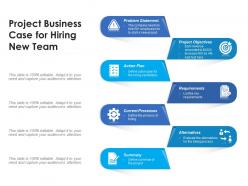
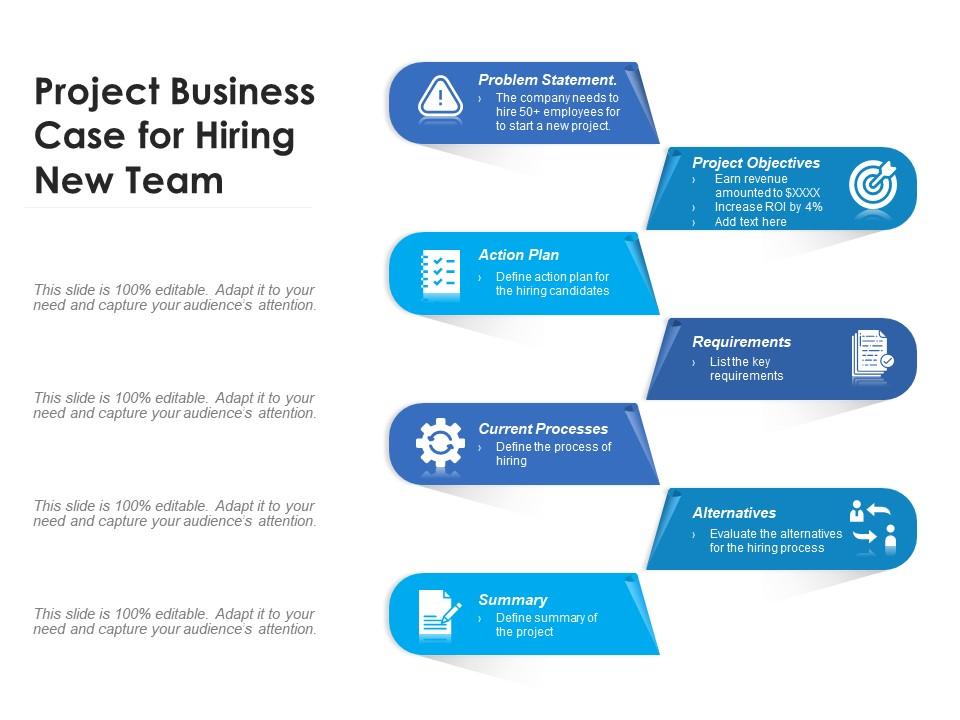
Project business case for hiring new team
Try Before you Buy Download Free Sample Product
Audience
Editable
of Time
Our Project Business Case For Hiring New Team are topically designed to provide an attractive backdrop to any subject. Use them to look like a presentation pro.
People who downloaded this PowerPoint presentation also viewed the following :
Project business case for hiring new team with all 2 slides:
Use our Project Business Case For Hiring New Team to effectively help you save your valuable time. They are readymade to fit into any presentation structure.
FAQs for Project business case for
Start with an exec summary, then lay out the problem clearly. Your solution comes next - include timeline and costs. Financial projections are obvious but don't skip the stakeholder analysis (seriously, people always forget this and then wonder why nobody's on board). Risk assessment too. Success metrics matter so you can actually prove it worked later. The whole thing should tell a story - problem leads to solution leads to value. Keep slides tight but prep backup details. They'll definitely have questions you didn't think of. Oh, and make sure your timeline's realistic or you'll regret it.
Honestly, visuals are a game-changer for business cases. Charts showing ROI projections make your numbers pop way more than boring paragraphs. Before/after process flows? Gold. Executives scan slides super fast anyway, so give them something that sticks. Infographics help break down complex stuff too - though I've seen people go nuts with animations that just confuse everyone. Don't do that. Focus on your strongest data points and make them visual. People remember what they can actually *see* happening. Clean charts beat walls of text every single time.
Dude, the worst thing you can do is be vague about what problem you're actually fixing. Like, don't just throw around "this boosts efficiency" without numbers to back it up - stakeholders will see right through that BS. Put your best stuff upfront since half these people won't read past the first paragraph anyway. Be super clear on costs and timeline too. Oh, and here's the thing - figure out what's actually stressing your audience out first, then build your whole pitch around solving THAT. Makes way more difference than you'd think. Success metrics matter too, obviously.
Okay so basically you gotta read the room first. Executives? Hit them with the money stuff and big picture impact right away. Technical people want to understand the actual problem and how you're gonna solve it - I swear, half the presentations I've sat through bombed because someone pitched implementation details to the C-suite. Department heads care about day-to-day operations and what resources they'll need. Short version: figure out what's keeping your audience up at night, then lead with that. Don't make them wait for the stuff they actually care about.
Focus on NPV, IRR, and payback period - those are the big ones execs actually look at. NPV shows if you're creating real value, IRR gives you the return rate, and payback tells you how fast you'll get your money back. ROI matters too, but honestly? I've seen leadership teams barely glance at it if the other three look solid. Oh, and definitely throw in some sensitivity analysis for best/worst case stuff. Start there, then maybe add cost-benefit ratio if you've got room left over.
Honestly, start with a real customer's problem - something that'll make everyone go "oh shit, that's us." Don't dump data first or people will check out. I literally watched a VP nod off during a PowerPoint once. Create this whole arc: here's what sucks now, here's what happens if we ignore it, and boom - here's how we fix it. Quote actual customers if you can. The weird thing is execs will totally forget your ROI numbers but they'll remember that story about the frustrated client who almost left. Hook them with the human stuff first, then hit them with your metrics.
Dude, this is honestly make-or-break stuff. Your project has to directly tie into whatever big goals the company's chasing - revenue, cost cuts, expansion, whatever. I've watched really solid ideas get tossed because execs couldn't see the connection to strategy (even when it was super obvious to us). Don't make them guess how your thing fits the bigger picture. Spell it out clearly which priorities you're hitting. Without that link? You're basically just asking for money with no real proof of value. Trust me, that strategic alignment piece will save your proposal from the rejection pile.
Look, risk assessment is basically proving to everyone you're not completely delusional about your project. Start by listing what could actually go wrong, then figure out how likely each thing is and how bad it'd be. Put numbers on it when you can - like "20% chance we're delayed by 2 months" instead of just "might be risky." Then explain how you'd deal with each problem. Executives eat this up because most people just pretend nothing will go wrong (which is obviously BS). Oh, and don't overthink it - you just want to show you've considered the realistic downsides. Makes your whole business case way more believable.
Start with your strongest stat - the one that makes people sit up and pay attention. Charts and graphs are your best friend here because honestly, nobody's scrolling through raw spreadsheets to find your point. Pick data that actually ties to money or growth opportunities. Market size, customer segments, competitive stuff - but don't throw everything at them. I learned this the hard way once. Connect each number to what it means for the business. You're basically building a story that leads to "here's why we should do this thing." Keep it visual and keep it focused.
Give them 3-4 solid options, not just yours vs doing nothing. Build a criteria matrix showing how each stacks up on cost, timeline, risk - the usual suspects. Be honest about the trade-offs or they'll know you're BS-ing them (trust me, they always do). Include real numbers for implementation - costs, timelines, all that stuff. Actually, this is where most people mess up because they lowball their favorite option. Show you've thought it through properly, then make your recommendation based on what the data actually says. Pretty straightforward once you get the hang of it.
So basically, you want to put dollar signs on everything you can. Figure out what you're saving or earning - like reduced costs, more revenue, higher productivity - then estimate the money impact over maybe a year or two. The ROI math is easy: (benefits minus costs) divided by costs times 100. Don't ignore the fuzzy stuff either though. Better employee satisfaction means less turnover, and you can totally calculate what that saves in hiring costs. Just don't go crazy optimistic with your numbers - nobody believes that anyway. Honestly, a simple spreadsheet comparing ongoing benefits vs. project costs makes it super clear for whoever's writing the checks.
Oh absolutely, you need that timeline in there. Break it into like 3-5 major phases - don't get crazy with daily details (save that mess for later). Mark your dependencies and where the big shots need to make decisions. I learned this the hard way but always build in some buffer time because something always goes sideways. Make it ambitious enough that they're impressed but not so crazy they think you're delusional. High-level works best - executives want to see you've actually thought this through without drowning in the weeds. Shows you're serious about deliverables and when they'll see results.
Honestly, that feedback from your first presentations is so valuable - don't sleep on it. Write down the obvious questions but also notice when people looked confused or skeptical. Which financial numbers did they challenge the most? That's where you need better data, obviously. If stakeholders kept coming back to the same worries, those are their real priorities. Address every single concern in your next version. But here's the thing - don't just fix problems. Use their comments to get ahead of future objections and craft something that actually hits what these decision-makers care about.
Just use PowerPoint or Google Slides honestly - they're still the best for this stuff. Canva's actually pretty decent if you need nicer templates and don't have to stick to boring corporate colors. Pull your charts from Excel or Tableau if you've got access. People way overthink the tools though. Your content matters way more than whether you picked the perfect transition animation. Clean visuals help, sure, but I'd rather see solid financial projections than fancy graphics. Pick a simple template, nail your three main points, and spend most of your prep time getting those numbers right instead of obsessing over design details.
Honestly, you'll want to build a template that's got the basics locked down - exec summary, financials, timeline stuff. But then make room for industry-specific sections that you can swap out. Tech companies need to talk about scalability and security, while manufacturing is all about supply chain issues and regulations. Totally different worlds. The financial metrics part is huge too - SaaS folks care about monthly recurring revenue, retail cares about inventory turnover. Start with whatever makes or breaks companies in your industry and build those sections right into the template structure. Makes the whole process way smoother.
-
Awesomely designed templates, Easy to understand.
-
Great designs, Easily Editable.
-
Qualitative and comprehensive slides.
-
Easily Understandable slides.
-
Excellent design and quick turnaround.