

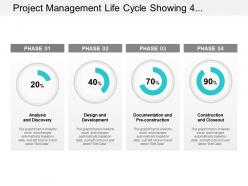
Project management life cycle showing 4 phases with value of percentage complete





Try Before you Buy Download Free Sample Product
 Impress Your
Audience
 100%
Editable
 Save Hours
of Time


The best course emerges with our Project Management Life Cycle Showing 4 Phases With Value Of Percentage Complete. All alternatives are equally assessed.
People who downloaded this PowerPoint presentation also viewed the following :
Project management life cycle showing 4 phases with value of percentage complete with all 5 slides:
Our Project Management Life Cycle Showing 4 Phases With Value Of Percentage Complete are really clued up. They are just the thing for your depth of knowledge.


FAQs for Project management life cycle showing 4 phases with value
The key phases of the project management life cycle include initiation, planning, execution, monitoring and controlling, and closing. These phases streamline project delivery by establishing clear objectives, developing comprehensive roadmaps, implementing coordinated activities, and ensuring quality outcomes, with many organizations finding that structured lifecycle management significantly reduces costs, minimizes risks, and enhances overall project success rates.
The project initiation phase establishes project foundation by defining clear objectives, identifying key stakeholders, conducting feasibility assessments, securing initial approvals, and allocating necessary resources. Through strategic planning and stakeholder alignment, organizations streamline project execution, minimize scope creep, and enhance delivery timelines, with many companies finding that thorough initiation reduces overall project risks by up to forty percent.
Stakeholder analysis identifies key individuals and groups affected by the project, assessing their influence, interests, and potential impact on project success. This strategic evaluation enables project managers to develop targeted communication strategies, manage expectations effectively, and secure necessary support, with many organizations finding that thorough stakeholder mapping significantly reduces project risks and enhances overall delivery outcomes.
Risk management strategies integrate into project execution through continuous monitoring, proactive issue identification, and real-time response protocols that address emerging threats immediately. By establishing dedicated risk assessment checkpoints, implementing automated tracking systems, and maintaining cross-functional communication channels, project teams can pivot quickly when challenges arise, ultimately minimizing disruptions while keeping deliverables on schedule and within budget.
Common monitoring and controlling tools include Earned Value Management, performance dashboards, variance analysis, change control systems, and quality audits. These techniques enable project managers to track progress against baselines, identify deviations early, and implement corrective actions, with many organizations finding that integrated monitoring approaches ultimately deliver better project outcomes and stakeholder satisfaction.
Project managers ensure effective communication by establishing clear channels, conducting regular stakeholder meetings, using collaborative tools, creating detailed documentation, and implementing feedback loops. Through structured communication plans, teams streamline coordination across planning, execution, and closure phases, while stakeholder alignment and transparency ultimately deliver improved project outcomes and reduced risks.
**INPUT**: What are the signs that a project may be deviating from its planned schedule? **OUTPUT**: Schedule deviation signs include missed milestones, resource allocation delays, scope creep, budget overruns, and declining team productivity metrics. These indicators enable project managers to implement corrective measures early, with many organizations finding that proactive monitoring across manufacturing, healthcare, and IT sectors ultimately delivers better outcomes and maintains competitive timelines.
The project closure phase captures lessons learned, documents best practices, and evaluates performance metrics to create institutional knowledge for future projects. Through systematic reviews and stakeholder feedback, organizations identify successful strategies, avoid recurring pitfalls, and refine methodologies, ultimately building competitive advantage through continuous improvement and enhanced project delivery capabilities.
Project management software streamlines life cycle execution by automating task scheduling, enabling real-time collaboration, centralizing documentation, tracking progress transparently, and managing resource allocation efficiently. These platforms enhance project visibility across teams while reducing administrative overhead, with many organizations finding that integrated software delivers faster project completion, improved stakeholder communication, and ultimately stronger competitive advantage through optimized operational efficiency.
Agile methodologies transform traditional project management by introducing iterative sprints, continuous stakeholder feedback, and adaptive planning that replaces rigid sequential phases. Through regular retrospectives and daily standups, organizations streamline development cycles, enhance collaboration, and deliver incremental value, with many software companies and financial services finding significantly faster time-to-market and improved customer satisfaction.
Quality management across project stages involves establishing clear standards, implementing regular reviews, conducting continuous monitoring, and maintaining stakeholder feedback loops throughout each phase. By integrating quality checkpoints at milestone completions, using standardized documentation processes, and employing cross-functional quality teams, organizations streamline delivery while minimizing rework costs, ultimately ensuring project outcomes meet specifications and stakeholder expectations consistently.
Ethical considerations include stakeholder transparency, resource allocation fairness, conflict of interest management, data privacy protection, and environmental responsibility. These principles guide project managers by ensuring honest communication with teams and clients, maintaining budget integrity, and prioritizing sustainable practices, ultimately delivering successful outcomes while building trust and reputation across organizations.
Cultural differences significantly impact multinational project management through varying communication styles, decision-making processes, hierarchy expectations, time orientations, and conflict resolution approaches. These variations require project managers to adapt their leadership methods, establish clear communication protocols, and implement flexible frameworks that accommodate diverse work styles, ultimately enabling better cross-cultural collaboration and project success.
Critical success factors include clear project objectives, stakeholder engagement, effective communication, adequate resource allocation, skilled team members, and strong leadership support. These factors work together by ensuring alignment between project goals and business outcomes, maintaining consistent progress tracking, and enabling proactive risk management, with many organizations finding that projects with well-defined success criteria deliver significantly higher ROI and stakeholder satisfaction.
Lessons learned influence future practices by identifying successful strategies, highlighting process improvements, and documenting risk mitigation approaches for replication across projects. Through systematic knowledge capture, organizations streamline project planning, enhance resource allocation, and accelerate delivery timelines, with many companies finding that institutionalizing these insights significantly reduces project failure rates while improving overall operational efficiency.
No Reviews