Project scope and deliverables example of ppt
Try Before you Buy Download Free Sample Product
Audience
Editable
of Time
It is essential that project stakeholders easily understand the purpose as well as justification of a project. The project scope and deliverables PowerPoint template is useful to give baseline understanding the project’s scope as well as deliverables, along with that explain the work needed to complete the deliverables, and to make sure common understanding of the project’s scope among all the stakeholders. The project scope statement PPT slide act as a baseline document for defining scope of the portfolio management database (PMD) project, project deliverables, work which needed to accomplish the deliverables, and making sure a common understanding of the project’s scope among all stakeholders. All project work needs to occur within framework of the project scope statement as well as directly support the project deliverables. By using project scope template to demonstrate that any changes to the scope statement need to get through the approved project change management process before implementation. This template is a very helpful tool for stakeholders to understand the investments needed to make. Our Project Scope And Deliverables Example Of Ppt are conversant with any fresh changes. They allow you to gather greater expertise.
People who downloaded this PowerPoint presentation also viewed the following :
Content of this Powerpoint Presentation
If you’re launching an innovative product, implementing a complicated marketing campaign, or constructing any architecture, all projects need planning and implementation. Project Deliverables are the lifeline of this process. 40% of organizations constantly accomplish the entire benefits of their projects and in this place, deliverables become a major factor. Project deliverables are milestones that highlight progress and elaborate on the successful accomplishment of several project phases. The project deliverables monitor and track the progress of the project and identify any hindrance that may hamper the success of the project.
If you’re launching a groundbreaking project, here’s a set of templates that showcase the scope and deliverables.
Therefore, to understand the scope and the deliverables of a project, the experts of SlideTeam have prepared a set of well-designed customized templates, which is a comprehensive guide that discusses the important steps of project scope and deliverables. These templates are 100% customizable; therefore, you can change the information to meet your requirements.
Let’s explore the templates!
Template 1- Project Scope and Deliverable Example Template

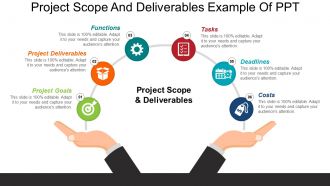
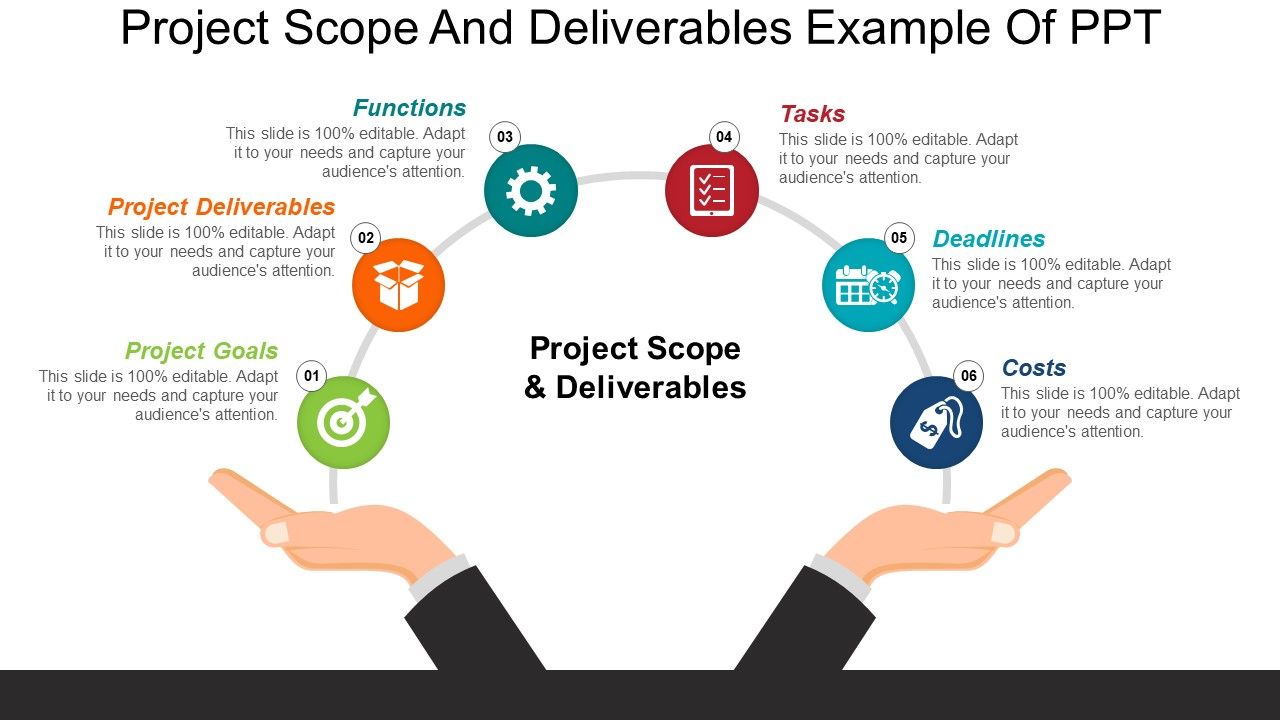
Check out our project scope and deliverable PowerPoint Presentation Template, which helps the stakeholders understand the purpose of a project. This is a useful template that gives you an insight into the scope of a particular project as well as deliverables along with that, it highlights the steps needed to finish the deliverables. Additionally, this template ensures the stakeholders understand the project scope. This slide highlights the topic, including project goals, project deliverables, functions, tasks, deadlines, and costs. Use this template to demonstrate any required changes for the project scope to get approval from project management. Also, this template can be used to provide an idea about the investment to all the stakeholders. Therefore, download this template now.
Summing it up
Therefore, it can be concluded that our Project Scope and deliverables template is designed precisely to ensure clear insights about the boundaries of the project and the expected outcomes. You can use this template to get a detailed idea of the project parameters and the realistic expectations for accomplishment. Grab this template to align all your project inception, schedule, and manage the deliverables team’s effort and offer the stakeholders a clear idea about the project to achieve a successful project.
Project scope and deliverables example of ppt with all 5 slides:
Bring an end to expressions of intolerance with our Project Scope And Deliverables Example Of Ppt. Enlighten folks on bigotry.
FAQs for Project scope and deliverables
Start with what you're actually building and what's off-limits - that's your foundation. Your objectives, deliverables, and acceptance criteria come next. Budget and timeline constraints matter too, though honestly those usually get thrown out the window halfway through anyway lol. Don't forget stakeholder requirements and any tech limitations you're dealing with. Getting everyone to agree upfront is crucial - document everything before you start. I always make a must-have vs nice-to-have list first. Keeps you from getting distracted by shiny features later. Oh, and boundaries are everything - be super clear about what you won't do.
Oh this trips people up all the time! Product scope = what you're actually building (the features, functions, all that stuff). Project scope = how you'll get there (your timeline, meetings, testing, resources, whatever). Building an app? Product scope covers login screens, dashboards, UI elements. Project scope is your sprints, deployment work, stakeholder check-ins. Honestly gets confusing because they sound so similar. Quick test when you're planning: ask "am I talking about the actual thing we're making, or the work process?" That usually clears it right up.
Honestly, stakeholder interviews are your best bet - that's where you get the real deal on what people actually need. Throw in some workshops when different teams need to figure stuff out together. Don't forget to dig through any existing docs (there's always some random process guide floating around). User observation is amazing if you can pull it off - people say one thing but do something totally different, trust me. Oh, and surveys help when you need input from a ton of people. Just make sure you walk through scenarios with stakeholders afterward to double-check everything makes sense.
Look at three things when you're sorting through deliverables: business value, dependencies, and how risky stuff is. Business impact comes first - what's gonna move the needle for customers or revenue? Dependencies are next because some things literally can't happen until others are done. High-risk items? Get those out of the way early so you're not panicking later when something breaks. Honestly, I'd just make a simple scoring matrix for each one. Way better than trying to keep it all in your head. Your stakeholders won't hate you when the important stuff actually ships on time.
Definitely get stakeholders involved early - they know what they actually need way better than you do. Ask about their requirements and priorities upfront so you can figure out what's essential vs just wishful thinking. Trust me, there's nothing worse than building something "perfect" that sits unused because you missed the mark. Document everything they tell you and get them to sign off on the scope. I learned this the hard way on a project last year. Their input helps set realistic boundaries too, and honestly saves you from those annoying scope creep conversations later when everyone suddenly remembers five more features they "definitely" need.
Honestly, the key is checking in with stakeholders constantly and connecting everything back to company goals. I always kick off project phases by asking "how does this actually get us closer to where we want to be?" Sounds obvious but you'd be amazed how easy it is to get lost in the weeds. Set up quarterly reviews where you literally map your scope against business priorities - like, physically draw it out if you have to. Anything that doesn't clearly support a goal? Question it hard. Keep a doc showing these connections so when people want scope changes, you've got backup.
Dude, poorly defined scope will absolutely wreck your project. Stakeholders start throwing in "quick additions" left and right since you never drew clear lines. Your timeline? Gone. Budget gets blown because nobody knows what they're actually building. The team starts getting pissed working on stuff that keeps changing - honestly can't blame them. Then when everything falls apart, the finger-pointing begins. You can't even measure success because what does "done" even mean? I know it's tempting to just dive in, but seriously - lock down the scope first. Draw those boundaries hard. Trust me on this one.
Honestly, you've gotta get your change control process locked down from day one. Write everything out super clearly - what you're doing, what you're NOT doing, all of it. When someone comes asking for "just a tiny change" (which btw is never tiny), stop and actually figure out how it'll mess with your timeline and budget before agreeing. Regular check-ins help catch scope creep before it gets out of hand. And here's the thing - don't feel bad about saying no when changes would torpedo the whole project. I learned that one the hard way.
Start with a deliverables register - list everything with deadlines, who's doing what, and acceptance criteria. Break it down visually with work breakdown structures too. Simple templates are honestly the way to go since they keep everyone on the same page. Document how things connect to each other and set measurable quality standards. Get stakeholders to actually sign off on this stuff (trust me on that one). Oh, and dependencies between deliverables matter more than people think. Keep everything visual when you can and put it all in one spot the team can access easily.
First thing - nail down exactly what you're building and what you're NOT doing. Trust me, scope creep is brutal if you don't set boundaries early. Get all your stakeholders involved so nobody can claim they weren't heard later. Your scope statement needs to cover the what, why, and how you'll know when you've won. Don't forget timeline and any big constraints. Once it's drafted, get your sponsor to actually sign off on it (not just nod along in a meeting). This document becomes your shield when people start asking for "quick additions."
Okay so scope changes are gonna happen - just get out in front of them fast. I always shoot off a quick email first explaining what changed and why, then do a proper meeting if it's a big deal. People absolutely lose their minds when they find out about changes through the grapevine, trust me on this one. Follow your usual communication channels but document everything in writing too, even the stuff you talked through verbally. Oh and set up some kind of change log so stakeholders can check it whenever instead of bugging you constantly. Being transparent beats damage control every single time.
Honestly, you gotta nail down what "success" looks like before you even start - otherwise you're just guessing later. Does it actually fix what your stakeholders were complaining about? Check your quality stuff too: performance hits, user feedback, whatever technical specs you promised. Budget and timeline matter but that's basic project management. Here's the thing though - I've seen people get obsessed with metrics and miss the bigger picture. What really counts is whether this thing actually moves your project forward. Set those benchmarks early, then be brutal about checking them at every milestone. Don't let anyone move the goalposts halfway through.
Get everyone on a call together - no more of this back-and-forth email nonsense. Have each person explain their request and why they think it's so crucial. You'd be surprised how many "conflicts" just vanish once people actually understand what the other person is trying to accomplish. For the real disagreements that are left? Go back to your original project goals and let those guide the decision. Oh, and definitely document whatever you decide and make everyone sign off on it. Trust me on that last part - people have selective memory when things go sideways later.
Dude, seriously - flowcharts and tables are your best friends here. People just won't read those massive text blocks (I sure wouldn't). Break it down with visuals instead. Show your project phases in a flowchart, list deliverables in a simple table. Templates keep you from forgetting stuff too - they make you think through timelines, resources, all that good stuff every time. Honestly, I'd rather see a one-page summary with some graphics than sit through another 10-page scope document. Your stakeholders will actually pay attention for once.
Dude, you absolutely need change management or your project will get demolished by scope creep. I'm talking budget blown, timeline destroyed - the whole thing. What happens is stakeholders keep piling on "tiny" requests until your original plan is unrecognizable. Been there, learned the hard way! Set up a formal process right away: impact assessments, approval workflows, documentation for everything. Get your change control board going early and actually stick to it. I know it sounds bureaucratic but trust me, saying no gets way easier when you've got a process backing you up.
-
excelente
-
Great product with effective design. Helped a lot in our corporate presentations. Easy to edit and stunning visuals.
-
Innovative and attractive designs.