Real estate agent marketing plan
Try Before you Buy Download Free Sample Product
Audience
Editable
of Time
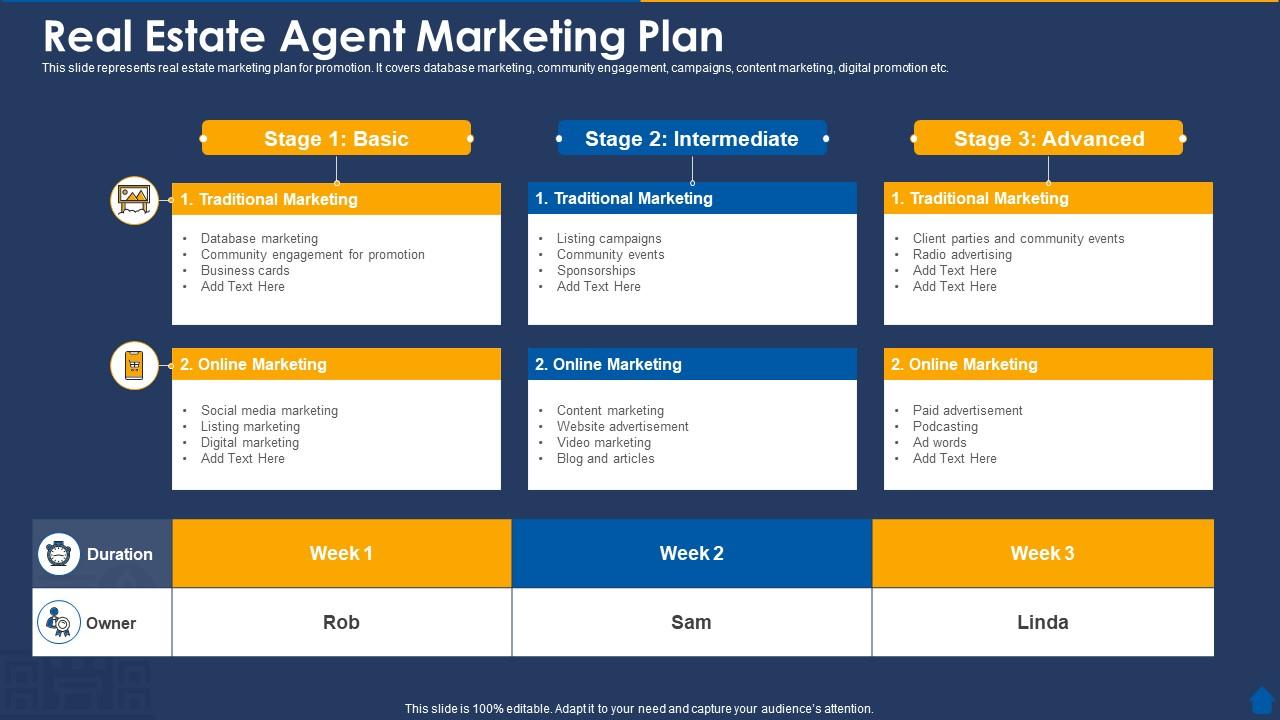
This slide represents real estate marketing plan for promotion. It covers database marketing, community engagement, campaigns, content marketing, digital promotion etc.
People who downloaded this PowerPoint presentation also viewed the following :
Real estate agent marketing plan with all 6 slides:
Use our Real Estate Agent Marketing Plan to effectively help you save your valuable time. They are readymade to fit into any presentation structure.
FAQs for Real estate
Essential components include target audience analysis, competitive market research, brand positioning strategy, digital marketing channels, content creation calendar, lead generation systems, and performance tracking metrics. These elements work together by identifying ideal clients, establishing market differentiation, and leveraging multiple touchpoints like social media and email campaigns, ultimately delivering consistent lead flow and higher conversion rates for real estate professionals.
Social media enables real estate professionals to showcase properties through virtual tours, targeted advertising, client testimonials, and neighborhood highlights while building personal brand authority. Platforms like Instagram and Facebook allow agents to reach specific demographics, engage with potential buyers through live Q&As, and share market insights, ultimately generating more qualified leads and faster sales cycles.
Market research forms the foundation of effective real estate marketing plans by identifying target demographics, analyzing competitor strategies, understanding pricing trends, and revealing buyer preferences and behaviors. Through comprehensive market analysis, real estate professionals can strategically position properties, optimize marketing channels, and craft messaging that resonates with specific buyer segments, ultimately delivering faster sales and higher returns.
Real estate agents can leverage SEO by optimizing their websites with local keywords, creating valuable content about neighborhoods and market trends, claiming Google My Business listings, and building quality backlinks from local directories. These strategies enhance search rankings by improving local visibility, establishing expertise, and increasing organic traffic, with many agents finding that consistent SEO efforts ultimately deliver more qualified leads and stronger market positioning.
A real estate marketing plan should include property listings with high-quality photos and virtual tours, market analysis reports, client testimonials, neighborhood guides, and social media content showcasing local amenities. These materials work together by building trust through transparency, educating potential buyers about market conditions, and demonstrating expertise, ultimately delivering faster sales cycles and enhanced client relationships.
Virtual tours and 3D walkthroughs revolutionize property marketing by enabling remote viewing experiences, reducing unnecessary site visits, increasing engagement time, and expanding reach to international buyers. These technologies streamline the sales process by pre-qualifying serious prospects, accelerating decision-making timelines, and ultimately delivering higher conversion rates, with many real estate agencies finding significantly reduced marketing costs and faster property sales.
**INPUT**: What are the most effective lead generation strategies for real estate professionals? **OUTPUT**: Effective real estate lead generation strategies include digital marketing campaigns, referral programs, open house events, social media advertising, and content marketing through blogs or market insights. These approaches streamline client acquisition by building trust, showcasing expertise, and maintaining consistent market presence, with many real estate professionals finding that combining online visibility with personalized relationship-building ultimately delivers higher-quality leads and faster conversions. **Word count: 60 words**
Email marketing campaigns can be tailored through personalized property recommendations, neighborhood-specific content, virtual tour invitations, market insights, and buyer journey staging. Real estate professionals increasingly segment audiences by budget, location preferences, and purchase timeline, delivering targeted listings, local school information, and mortgage guidance that streamlines the buying process while building trusted advisor relationships.
Essential metrics include lead generation volume, conversion rates from leads to appointments, cost per acquisition, time on market, listing views and engagement, and closing ratios. These indicators enable real estate professionals to optimize campaign performance, allocate marketing budgets more effectively, and identify which channels deliver the highest-quality prospects, ultimately enhancing sales velocity and competitive positioning.
Branding influences real estate marketing strategy by establishing trust, differentiating services, and creating memorable client experiences that drive referrals and repeat business. Through consistent visual identity, targeted messaging, and professional positioning, real estate professionals enhance their market credibility, attract quality leads, and command premium pricing, ultimately delivering competitive advantage in increasingly crowded markets.
Crucial budget considerations include digital advertising costs, professional photography and staging expenses, content creation investments, lead generation tools, and market research allocations. These strategic investments streamline property visibility by enhancing online presence, accelerating buyer engagement, and maximizing ROI, with many real estate professionals finding that balanced budget allocation across multiple channels ultimately delivers faster sales and higher property values.
Local market trends significantly shape real estate marketing strategies by influencing pricing approaches, target demographics, promotional channels, and competitive positioning tactics. In rapidly appreciating markets like Austin or Seattle, agents emphasize investment potential and urgency, while in slower markets, they focus on value propositions and buyer incentives, ultimately enabling more targeted messaging and resource allocation.
Partnerships with local businesses enhance real estate marketing by expanding referral networks, increasing community visibility, and building credible local connections through cross-promotional opportunities. These strategic alliances enable agents to access new client bases, leverage complementary services like mortgage brokers and home inspectors, and demonstrate neighborhood expertise, ultimately delivering stronger market positioning and more qualified leads.
Storytelling enhances property marketing by creating emotional connections, highlighting unique features, showcasing neighborhood lifestyles, and differentiating listings through compelling narratives rather than basic specifications. Through strategic storytelling, real estate professionals transform standard property descriptions into engaging experiences that resonate with buyers' aspirations, ultimately accelerating sales cycles and commanding premium prices in increasingly competitive markets.
Video marketing in real estate delivers enhanced property visualization, increased buyer engagement, broader market reach, faster sales cycles, and improved brand credibility. Through virtual tours and property showcases, real estate agents attract more qualified leads, reduce unnecessary site visits, and build stronger emotional connections with potential buyers, ultimately accelerating transactions and establishing competitive advantage.
-
Really like the color and design of the presentation.
-
Easy to edit slides with easy to understand instructions.