

Rebranding Strategy Timeline Of Account Based Marketing Firm




Try Before you Buy Download Free Sample Product
 Impress Your
Audience
 100%
Editable
 Save Hours
of Time


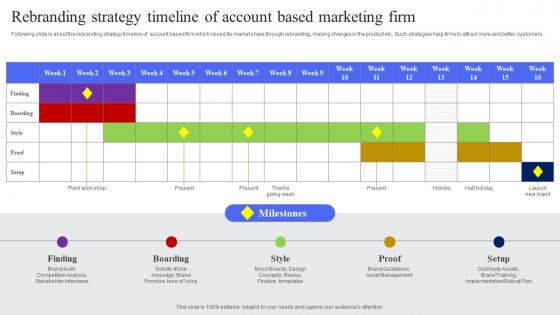
Following slide is about the rebranding strategy timeline of account based firm which raised its market share through rebranding, making changes in the product etc. Such strategies help firms to attract more and better customers.
People who downloaded this PowerPoint presentation also viewed the following :
Rebranding Strategy Timeline Of Account Based Marketing Firm with all 6 slides:
Use our Rebranding Strategy Timeline Of Account Based Marketing Firm to effectively help you save your valuable time. They are readymade to fit into any presentation structure.






FAQs for Rebranding Strategy Timeline Of Account
Rebranding for an account-based marketing (ABM) firm involves assessment, strategy, design, implementation, and evaluation phases, ensuring alignment with target accounts. These stages streamline brand messaging by refining value propositions, visual identity, and client experiences, with many financial services and tech companies finding that a cohesive brand delivers increased lead quality. Ultimately, this delivers enhanced market positioning and a competitive advantage in an increasingly crowded landscape.
Rebranding effectiveness requires tracking key metrics throughout each phase, including brand awareness surveys, website traffic analysis, and social media engagement rates, alongside lead generation figures. These technologies streamline measurement by monitoring brand mentions, sentiment analysis, and conversion rates, with many marketing institutions finding that consistent data analysis enables agile adjustments. Ultimately delivering optimized campaigns and enhanced ROI, while presenting both challenges and opportunities for data interpretation.
Critical milestones in a rebranding strategy timeline include market research, brand messaging development, visual identity design, content creation, and launch planning. These phases streamline operations by ensuring consistent messaging, enhanced visual appeal, and targeted content, with many financial services and healthcare institutions finding that a phased rollout minimizes disruption. Ultimately delivering improved brand recognition and a strengthened competitive advantage, while presenting both challenges and opportunities.
Stakeholder engagement should be integrated throughout the rebranding timeline by initiating early communication, soliciting feedback during design phases, and providing regular updates on progress. While crucial for buy-in, it also requires dedicated resource allocation for workshops, surveys, and one-on-one meetings, with many marketing firms finding that proactive involvement streamlines adoption. Ultimately delivering enhanced brand advocacy and minimized internal resistance, this ensures a successful launch and sustained momentum in an increasingly competitive landscape.
Market research fundamentally shapes the rebranding timeline for an account-based marketing firm by identifying target audience perceptions, competitor positioning, and emerging industry trends. While crucial for initial assessment, it also informs phased rollouts—with many firms finding that continuous monitoring reveals optimal messaging and timing. These insights streamline resource allocation, minimize risk, and ultimately deliver enhanced brand resonance and competitive advantage in an increasingly dynamic landscape.
Rebranding for an account-based marketing (ABM) firm typically spans 6-9 months, encompassing research (1-2 months), brand strategy (2-3 months), and creative execution (3-4 months). These phases streamline by aligning brand messaging with target accounts, enhancing client experiences, and improving market positioning. With many financial services and tech companies finding that a phased approach minimizes disruption, ultimately delivering increased lead quality and stronger client relationships.
Rebranding pitfalls commonly include inconsistent messaging, neglecting employee buy-in, and underestimating the timeline, alongside failing to thoroughly research competitor positioning. These challenges present both opportunities and risks, with many marketing firms finding that a phased rollout—spanning market analysis, internal communication, and visual updates—streamlines the transition. Ultimately delivering enhanced brand recognition and a competitive advantage, while minimizing disruption to ongoing account-based marketing efforts.
Communicating a new brand identity to existing clients requires a phased approach encompassing email announcements, dedicated account manager briefings, and updated case studies. While maintaining continuity is crucial, it also presents an opportunity to showcase evolved expertise and value propositions, with many firms finding that proactive communication builds trust and minimizes disruption. These efforts enhance client relationships by demonstrating commitment to innovation, ultimately delivering increased loyalty and expanded service opportunities.
Rebranding timelines benefit from project management software like Asana or Trello, alongside brand guideline templates, competitive analysis documents, and stakeholder communication plans. These technologies streamline workflows by facilitating task assignment, progress tracking, and collaborative feedback, with many marketing institutions finding that integrated platforms enhance operational efficiency. Ultimately delivering a focused, phased rollout and improved brand consistency.
Rebranding for an account-based marketing (ABM) firm should align with business goals by first defining target account profiles, then crafting messaging that resonates with their specific pain points, and finally, updating all client-facing materials. While this presents both challenges and opportunities, a phased rollout—starting with website updates and progressing to sales collateral—enhances brand consistency, ultimately delivering increased lead quality and stronger client relationships with many firms finding that a focused rebranding boosts revenue by 15-20%.
Brand element testing involves A/B testing logos, messaging, and visuals with target accounts, alongside focus groups offering qualitative feedback, and social listening to gauge initial reactions. These technologies streamline by identifying resonant themes, minimizing risk, and maximizing impact, with many marketing firms finding that phased rollouts deliver better adoption and ultimately enhanced brand recognition and customer experiences.
Team alignment throughout a rebranding timeline requires consistent communication, clearly defined roles, and shared access to project milestones, including brand guidelines and key messaging. While rebranding presents both challenges and opportunities, establishing regular cross-functional meetings—involving marketing, sales, and leadership—enhances transparency and ensures everyone understands the evolving brand narrative, ultimately delivering buy-in and a unified customer experience.
Brand health post-rebranding should be monitored through website traffic, social media engagement, and lead generation rates, alongside brand awareness surveys and customer sentiment analysis. These technologies streamline data collection by tracking key performance indicators, providing insights into reach, resonance, and ultimately delivering improved marketing ROI and enhanced competitive advantage, with many firms finding that consistent monitoring enables agile adjustments.
Customer feedback can be incorporated into the rebranding strategy timeline through surveys, interviews, and social listening, enabling a data-driven approach to messaging and visual identity. While rebranding often focuses on outward perception, it also necessitates understanding customer preferences, with many marketing firms finding that direct input streamlines the process. This ultimately delivers enhanced customer experiences and a competitive advantage, accelerating adoption of the new brand identity and fostering lasting loyalty.
Maintaining client retention during rebranding involves proactive communication, consistent service delivery, and demonstrating continued value. These strategies include personalized updates, exclusive previews of the new brand, and reaffirming commitment to existing contracts. While rebranding presents both challenges and opportunities, many firms find that transparently showcasing enhanced capabilities ultimately delivers increased client confidence and fosters stronger, long-term partnerships.
-
SlideTeam’s pool of 2Million+ PPTs has really benefited my team, everyone from the IT department to HR. We are lucky to have crossed ways with them.
-
Excellent products for quick understanding.