Revenue Bridge Highlighting Three Year Trends

Rating:
100%
Revenue Bridge Highlighting Three Year Trends
Slide 1 of 7
Favourites Favourites

Try Before you Buy Download Free Sample Product

Audience Impress Your
Audience
Editable 100%
Editable
Time Save Hours
of Time
The Biggest Sale is ending soon in
0
0
:
0
0
:
0
0
Rating:
100%
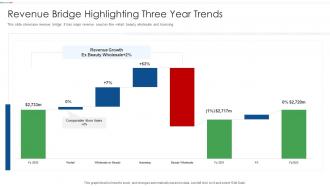
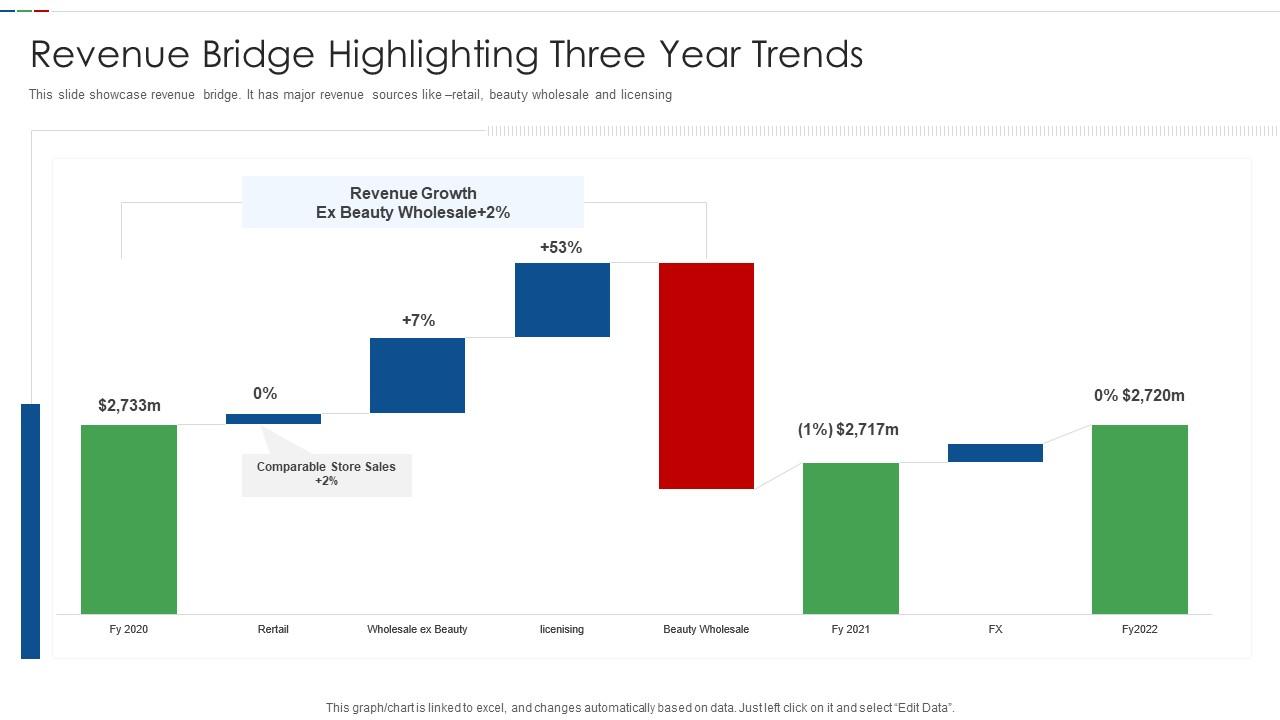
This slide showcase revenue bridge. It has major revenue sources like retail, beauty wholesale and licensing Introducing our Revenue Bridge Highlighting Three Year Trends set of slides. The topics discussed in these slides are Revenue Growth, Revenue Bridge, Sales. This is an immediately available PowerPoint presentation that can be conveniently customized. Download it and convince your audience.
People who downloaded this PowerPoint presentation also viewed the following :

FAQs for Revenue Bridge Highlighting

Key indicators that signal revenue trend changes include declining customer acquisition rates, shifting average order values, changing customer retention metrics, fluctuating market share, and evolving seasonal patterns. These metrics enable businesses to identify emerging opportunities and challenges across sectors like retail, financial services, and manufacturing, ultimately delivering strategic insights that enhance forecasting accuracy and competitive positioning.

Seasonal fluctuations create varying revenue patterns, with retail experiencing holiday surges, tourism peaking in summer months, agriculture following harvest cycles, and financial services seeing year-end investment spikes. These predictable variations enable strategic planning through inventory management, workforce adjustment, and cash flow optimization, with many organizations finding that anticipating seasonal trends delivers competitive advantage and operational efficiency.

Consumer behavior significantly influences revenue trends through purchasing patterns, brand loyalty shifts, seasonal demands, digital adoption rates, and price sensitivity responses. These behavioral changes drive companies to adapt their strategies, product offerings, and pricing models, with retail, hospitality, and technology sectors finding that understanding consumer preferences enables better forecasting, targeted marketing, and ultimately sustainable revenue growth.

Businesses can leverage data analytics to forecast revenue trends through predictive modeling, historical pattern analysis, customer behavior tracking, market correlation studies, and seasonal trend identification. These analytical approaches enable organizations to anticipate demand fluctuations, optimize pricing strategies, and allocate resources strategically, with many retail and financial services companies finding that data-driven forecasting delivers significantly improved accuracy and competitive advantage.

Economic conditions significantly impact revenue trends across sectors, with healthcare and utilities often showing resilience during downturns, while retail, hospitality, and luxury goods face sharper declines. These variations create strategic opportunities for businesses to diversify portfolios, adjust pricing models, and enhance operational efficiency, with many organizations finding that economic volatility ultimately drives innovation and competitive repositioning.

Emerging technologies revolutionize traditional industry revenues by automating processes, enhancing customer experiences, and creating new service offerings that reduce operational costs while increasing market reach. Banks leveraging AI for loan processing, hospitals using telemedicine platforms, and retailers implementing omnichannel solutions consistently report higher profit margins and accelerated growth, ultimately delivering competitive advantages in increasingly digital markets.

Companies can adapt to shifting revenue trends by diversifying revenue streams, leveraging data analytics for predictive insights, investing in digital transformation, enhancing customer retention strategies, and exploring new market segments. These approaches enable organizations to streamline operations, minimize risk exposure, and accelerate growth opportunities, with many businesses finding that strategic diversification ultimately delivers competitive advantage and sustained profitability.

B2B revenue trends typically show longer sales cycles, higher transaction values, and more predictable recurring patterns, while B2C markets demonstrate faster purchase decisions, seasonal fluctuations, and volume-driven growth. Through strategic account management and subscription models, B2B companies achieve steady revenue streams, whereas B2C businesses leverage marketing campaigns and consumer behavior analytics to drive frequent transactions, ultimately delivering different but complementary approaches to sustainable growth.

Global events like pandemics and trade wars create significant revenue volatility, supply chain disruptions, shifting consumer behaviors, market access restrictions, and accelerated digital transformation needs. These disruptions present both immediate challenges and strategic opportunities, with many organizations finding that diversifying revenue streams, enhancing operational flexibility, and investing in resilient technologies ultimately delivers competitive advantages in an increasingly unpredictable business environment.

Companies can identify new revenue streams by analyzing customer behavior data, exploring adjacent markets, leveraging existing assets for new applications, and monitoring emerging technology trends. Through strategic market research and customer feedback analysis, organizations across sectors like retail, healthcare, and financial services discover untapped opportunities, ultimately diversifying income sources and building resilience against economic volatility.

The most effective ways to communicate revenue trends include visual dashboards with clear charts, executive summaries highlighting key metrics, comparative analysis against targets, trend forecasting with supporting data, and regular stakeholder briefings. These approaches enhance transparency by presenting complex financial data accessibly, enabling informed decision-making, and building stakeholder confidence, with many organizations finding that consistent, visual communication ultimately delivers stronger investor relations and strategic alignment.

Small businesses can compete by leveraging agility, personalized customer experiences, niche market specialization, digital transformation tools, and strategic partnerships with local communities. These approaches enable faster adaptation to market changes, more targeted service delivery, and cost-effective innovation, with many small enterprises finding that their flexibility and customer intimacy ultimately deliver competitive advantages that larger corporations struggle to replicate.

Marketing strategies significantly influence revenue trends by driving customer acquisition, enhancing brand positioning, optimizing pricing models, and improving customer retention rates. Through targeted campaigns, personalized messaging, and data-driven insights, organizations across retail, financial services, and healthcare sectors streamline market penetration while maximizing customer lifetime value, ultimately delivering sustained growth and competitive advantage.

Companies can utilize customer feedback to enhance product development, improve service quality, identify new market opportunities, and strengthen customer retention strategies. Through systematic feedback analysis, businesses streamline operations, reduce churn rates, and accelerate innovation cycles, with many organizations finding that customer-driven improvements ultimately deliver higher satisfaction scores and sustained revenue growth.

Businesses should focus on revenue growth rate, monthly recurring revenue (MRR), customer acquisition cost (CAC), lifetime value (CLV), and average revenue per user (ARPU) to assess trend performance. These metrics enable organizations to identify growth patterns, optimize pricing strategies, and enhance customer retention, with many companies finding that tracking these indicators together delivers comprehensive insights into revenue sustainability and competitive positioning.

Ratings and Reviews

100% of 100
Write a review
Most Relevant Reviews
  1. 100%

    by Dante Wells

    Placing an order on SlideTeam is very simple and convenient, saves you a lot of your time. 
  2. 100%

    by Charles Peterson

    I looked at their huge selection of themes and designs. They appeared to be ideal for my profession. I'm sure I'll grab a few of them.

2 Item(s)

per page: