Review customer journey map step by step process creating digital marketing strategy ppt grid

Rating:
80%
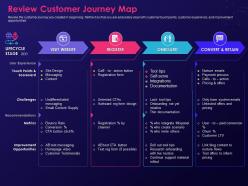
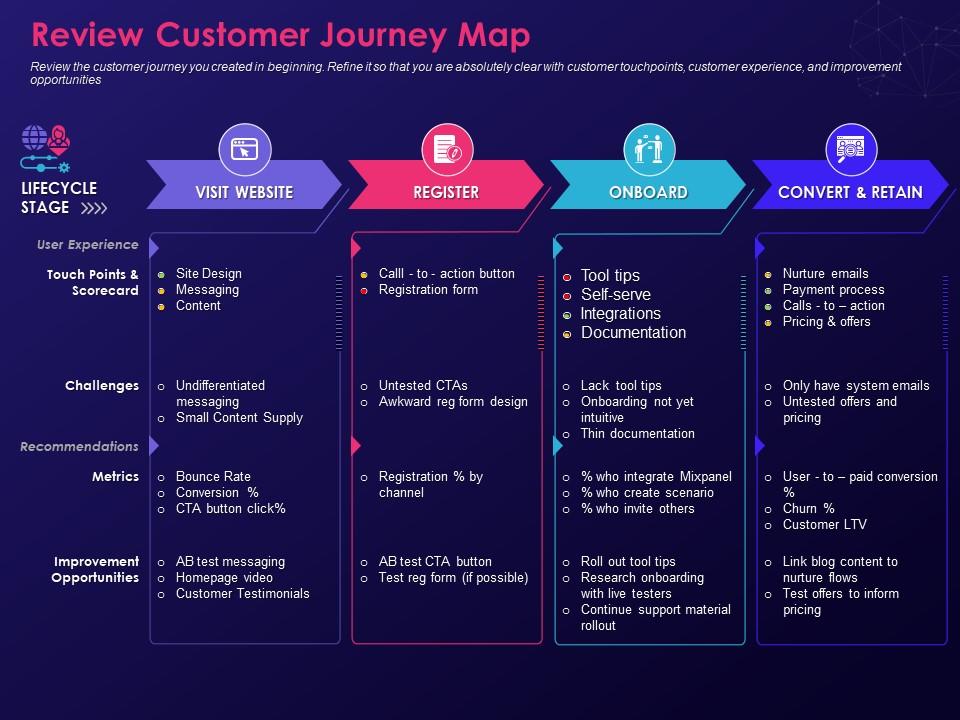
A customer journey map illustrating stages from visit website to convert retain
Slide 1 of 2

or

Favourites Favourites

Try Before you Buy Download Free Sample Product

Audience Impress Your
Audience
Editable 100%
Editable
Time Save Hours
of Time
The Biggest Sale is ending soon in
0
0
:
0
0
:
0
0
Rating:
80%
Review the customer journey you created in beginning. Refine it so that you are absolutely clear with customer touchpoints, customer experience, and improvement opportunities Introducing Review Customer Journey Map Step By Step Process Creating Digital Marketing Strategy Ppt Grid to increase your presentation threshold. Encompassed with four stages, this template is a great option to educate and entice your audience. Dispence information on Lifecycle Stage, Challenges, Registration, Integrations, using this template. Grab it now to reap its full benefits.
FAQs for Review customer journey map step by step process creating digital marketing

You'll want to map out every single touchpoint - from when they first hear about you to way after they buy. Layer in their emotions at each step, plus where things get annoying for them. Those "moments of truth" are huge - basically the interactions that make or break how they see you. Oh, and definitely create different maps for different customer types since a 25-year-old shops totally differently than someone who's 55. Make it visual and get your whole team to help build it. That way people actually refer back to it instead of letting it collect dust.

Honestly, customer journey mapping is a game-changer for figuring out where people get stuck or annoyed with your business. Think of it as seeing the whole picture - from when someone first hears about you to buying (and hopefully loving) your stuff. You'll catch those awkward gaps between what you assume happens versus reality. Plus your team stops arguing about what to prioritize first, which is honestly half the battle. I'd start simple though - just pick one type of customer and trace their path from discovery to purchase. Trust me, you'll find weird stuff you never noticed.

Miro and Mural are probably your best bets for journey mapping - super collaborative and they've got templates so you don't start from scratch. Lucidchart's solid too if your team's already using it. Honestly though? I've seen people make killer maps in Figma or even PowerPoint when money's tight. The tool really doesn't matter that much. What actually matters is talking to real customers first - like, actually getting on calls with them. Oh, and don't get caught up making it look perfect. Just use whatever you can get your hands on and focus on gathering real insights instead.

Honestly, just dive into your actual customer data first - analytics, sales records, support tickets, all that stuff. Survey your existing customers too. I'd interview maybe 5-6 people to really get their pain points and what they're trying to accomplish. Here's the thing though - don't go crazy trying to map out every single customer type you can think of. Stick to 2-3 main personas, focusing on whoever brings in the most money or volume. More than that and your journey maps turn into useless generic fluff. You can always add more later once you've nailed the core ones.

Honestly, the worst thing you can do is assume you know what customers are thinking without actually asking them. Start with just one customer type and one specific journey - trust me, trying to map everything at once is a nightmare. Your internal team probably has zero clue what the real experience is like (we're all guilty of this). Skip the tiny details on your first go and definitely don't ignore the emotional stuff - that's where the gold is. Oh, and this isn't something you do once and forget about. Get real feedback, then tweak it.

Dude, data analytics is a game-changer for customer journey mapping. You stop guessing what people do and actually see their real behavior - website clicks, purchases, support calls, all of it. Honestly, the first time I saw actual data vs what we thought customers were doing... total mind-blow. You'll spot exactly where people bail out, which parts of your process actually matter, and find problems you never knew existed. Oh and definitely mix the hard numbers with customer feedback surveys - that combo gives you the real story of what's going wrong (or right).

Look, customer feedback is what makes journey mapping actually work instead of just being a fancy guessing game. Without it, you're basically creating fiction. Surveys and interviews show you the real pain points - not what you think they are. I've watched teams spend weeks on beautiful maps that were totally wrong because they never talked to actual customers. The trick is collecting feedback regularly, not just doing it once and calling it done. Oh, and don't try to get feedback on everything at first - just focus on where you know the least. That's where you'll get the biggest surprises.

Honestly? Every 6-12 months is the sweet spot, but it really depends on your business. Launching new stuff or seeing weird customer behavior shifts? Time to update them sooner. I usually tell people to do quarterly check-ins - even just a quick scan to catch outdated info. Major website changes or new touchpoints are obvious triggers too. Oh, and definitely set a calendar reminder because I've seen too many teams working with maps that are like a year old and wondering why nothing makes sense anymore. Market changes can sneak up on you fast.

So basically, journey mapping forces everyone to stare at the exact same customer experience. Sales stops blaming marketing. Support actually talks to product about what's breaking. It's wild how much changes when departments realize they're all connected - instead of just tossing stuff over the wall and hoping for the best. Teams start sharing intel and coordinating campaigns way better. Honestly, the biggest breakthrough happens during cross-functional workshops where everyone maps their piece together. You'll be shocked at how many "oh shit" moments people have.

Honestly, start with conversion rates at each step - that'll show you where people are actually dropping off. Customer satisfaction scores and NPS are solid too. Time-to-resolution for support stuff matters more than most people think. Oh, and customer effort score is weirdly revealing about where things get annoying for users. Retention rates and lifetime value give you the full story, but don't go crazy measuring everything at once. Pick maybe 3-4 that match your biggest headaches right now. You can always add more later once you've got a rhythm going with the basics.

So emotional touchpoints are just the moments that hit your customers in the feels - good or bad. Could be excitement when they're unboxing something, or total rage at your broken checkout page. Here's the thing though - people make decisions with their emotions way more than logic. The tricky part? Bad feelings stick around forever while good ones fade fast. That's why those frustrating moments can totally wreck someone's experience with your brand. I'd start by finding your biggest emotional highs and lows first. Those spots will give you the best bang for your buck when you're fixing things.

Ditch the boring flowchart thing - nobody wants to stare at boxes and arrows. What I'd do is make it visual, like a comic strip showing someone's actual day or use real customer photos on a timeline. Some teams get creative with subway maps or roller coaster designs (sounds cheesy but it totally works). Interactive stuff is clutch too - sticky notes on poster boards where people can actually move things around, or clickable prototypes. Oh, and don't forget the emotional stuff - you've gotta show where people get frustrated vs. excited. Match whatever format you pick to who's gonna see it.

Honestly, journey maps are game-changers for this stuff. Map out every touchpoint your customers hit and track their emotions throughout. Negative feelings? That's where you're screwing up. Look for spots where expectations don't match reality - those disconnects are your biggest red flags. The visual aspect is clutch because even people who hate data can instantly see what's broken. I'd start with just one customer type (don't try to boil the ocean here) and tackle the worst emotional low points first. It's like having a roadmap to exactly what needs fixing.

Get everyone together - either in person or on a video call - and go through the whole customer journey step by step. Pull in people from sales, marketing, support, product, whoever actually deals with customers. There's always someone who'll be like "wait, that's totally wrong" and those moments are gold. Set up a shared doc where people can drop comments and updates as you go. Don't just present some polished map - make it messy and collaborative. Oh, and schedule check-ins every few months because things change fast and you don't want your map getting stale.

B2B journeys are basically chaos compared to B2C. With consumers, you're tracking one person for maybe a few weeks max. But B2B? Good luck - you've got procurement people, actual users, executives all weighing in over months. Sometimes years, honestly. B2C customers might impulse buy or decide pretty quickly. B2B folks will read every white paper, sit through demos, form committees to discuss your product. It's wild. Focus on emotions for B2C mapping. For B2B, figure out who actually has decision-making power first - that's half the battle right there.

Ratings and Reviews

80% of 100
Review Form
Write a review
Most Relevant Reviews
  1. 80%

    by Deon Warren

    Innovative and attractive designs.

1 Item

per page: