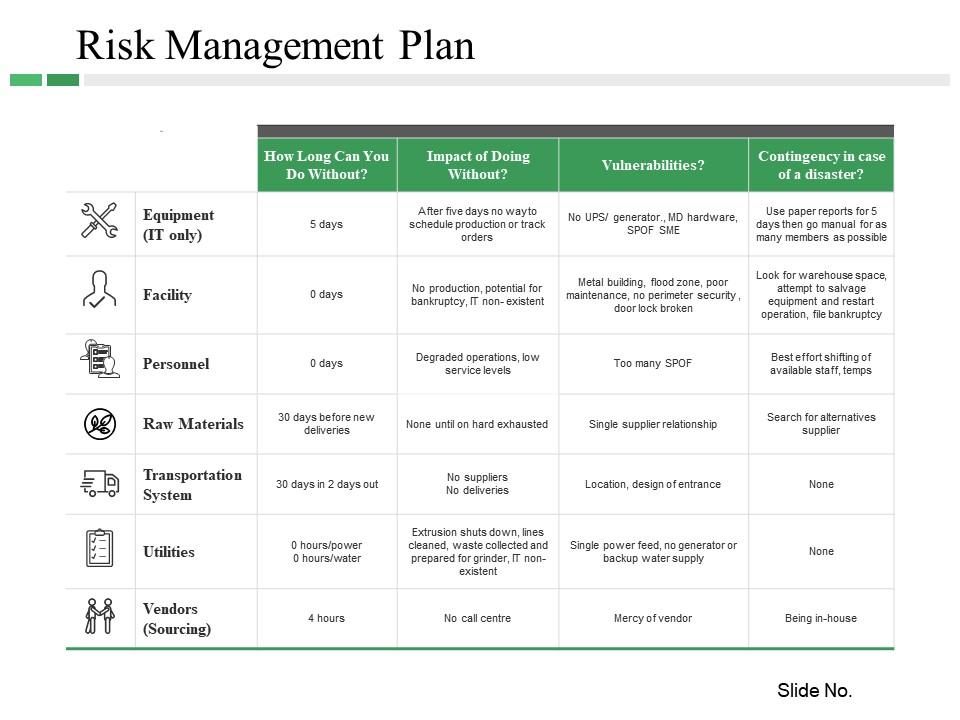
Risk management plan slide3 ppt design
Try Before you Buy Download Free Sample Product
Audience
Editable
of Time
Address internal dissent with our Risk Management Plan Slide3 Ppt Design. Intelligently handle doubts expressed by a few.
People who downloaded this PowerPoint presentation also viewed the following :
Risk management plan slide3 ppt design with all 5 slides:
Entice your audience with our Risk Management Plan Slide3 Ppt Design. They will soon be eating out of your hands.
FAQs for Risk management plan
Key components include risk identification, assessment and prioritization, mitigation strategies, monitoring systems, and contingency planning. These elements work together by systematically cataloging potential threats, evaluating their impact and probability, implementing preventive measures, and establishing response protocols, with many organizations finding that comprehensive plans significantly reduce operational disruptions while enhancing strategic decision-making capabilities.
Organizations assess project risks through comprehensive risk identification workshops, stakeholder interviews, historical data analysis, SWOT analysis, and expert consultations to uncover potential threats. These systematic approaches enable project teams to evaluate probability and impact matrices, conduct scenario planning, and develop mitigation strategies, with many finding that early risk assessment ultimately delivers better resource allocation, reduced project delays, and enhanced stakeholder confidence.
Effective risk identification methods include comprehensive stakeholder interviews, scenario analysis workshops, industry benchmarking studies, historical data review, and cross-functional brainstorming sessions. These approaches streamline risk assessment by engaging diverse perspectives, analyzing past incidents, and evaluating sector-specific threats, with many organizations finding that combining multiple methods delivers more thorough risk visibility and stronger strategic preparedness.
A risk management plan integrates into strategic planning by aligning risk assessments with business objectives, embedding risk considerations into decision-making processes, and establishing governance frameworks that connect risk oversight to strategic initiatives. This integration enables organizations to anticipate potential disruptions, allocate resources more effectively, and make informed strategic choices, with many enterprises finding that proactive risk integration ultimately delivers competitive advantage and operational resilience.
Stakeholder involvement provides critical insights into potential risks, risk tolerance levels, resource constraints, and operational priorities that shape comprehensive risk management strategies. Through collaborative input from departments, executives, and external partners, organizations develop more accurate risk assessments, gain broader buy-in for mitigation measures, and ensure implementation aligns with business objectives, ultimately delivering stronger organizational resilience.
Risk prioritization involves evaluating identified risks based on probability of occurrence, potential impact severity, timing constraints, and available mitigation resources. Organizations typically use risk matrices or scoring systems to rank threats systematically, with financial services and healthcare sectors finding that focusing on high-probability, high-impact risks first enables more strategic resource allocation and ultimately delivers stronger operational resilience.
High-priority risk mitigation strategies include risk avoidance, risk transfer through insurance or outsourcing, risk reduction via process improvements and controls, risk acceptance with contingency planning, and diversification across multiple areas. These approaches work together by eliminating exposure, sharing liability, minimizing impact probability, and preparing response protocols, ultimately delivering operational resilience and competitive advantage.
Regulatory requirements significantly shape risk management plans by mandating specific compliance frameworks, reporting standards, and risk assessment protocols across industries. Financial services must address Basel III requirements, healthcare organizations follow HIPAA guidelines, and manufacturing companies adhere to safety regulations, with many organizations finding that regulatory alignment ultimately delivers enhanced operational transparency, reduced legal exposure, and stronger stakeholder confidence.
Common pitfalls include inadequate risk assessment, poor communication across departments, insufficient stakeholder buy-in, lack of regular plan updates, and failure to integrate risk management into daily operations. Organizations often underestimate implementation costs and timelines, while neglecting employee training, ultimately compromising their ability to respond effectively to emerging threats and market volatility.
Risk management plans should be reviewed quarterly at minimum, with updates triggered by significant organizational changes, new projects, regulatory shifts, or emerging threats. Many enterprises find that combining scheduled quarterly assessments with event-driven reviews ensures comprehensive coverage, while sectors like financial services and healthcare often implement monthly evaluations to maintain compliance and operational resilience in increasingly dynamic business environments.
Popular risk management tools include GRC platforms like MetricStream and ServiceNow, project management software such as Microsoft Project and Smartsheet, specialized solutions like LogicGate and Resolver, and enterprise tools including SAP GRC and Oracle Risk Management. These platforms streamline risk identification, assessment, and monitoring by automating workflows, providing real-time dashboards, and enabling cross-departmental collaboration, with many organizations finding that integrated systems deliver enhanced visibility and faster response times.
Organizations effectively communicate their risk management plans through comprehensive training sessions, regular workshops, clear documentation accessible via company portals, and interactive simulations that demonstrate real-world scenarios. These approaches enhance employee understanding by establishing clear protocols, fostering proactive risk awareness, and creating accountability frameworks, with many companies finding that multi-channel communication strategies significantly improve compliance and response times during actual risk events.
Risk management plan success metrics include risk occurrence rates, financial impact reduction, incident response times, mitigation effectiveness ratios, and compliance audit scores. These measurements enable organizations to track cost savings, operational efficiency improvements, and regulatory adherence, with many financial institutions and healthcare systems finding that comprehensive metrics deliver enhanced stakeholder confidence and competitive advantage.
A risk management plan enhances organizational resilience by establishing proactive threat identification, response protocols, and recovery frameworks that minimize operational disruptions. Through systematic risk assessment and mitigation strategies, organizations can maintain business continuity during crises, adapt quickly to changing conditions, and ultimately deliver sustained performance while competitors struggle with unforeseen challenges.
Case studies showcasing successful risk management include JPMorgan Chase's comprehensive stress testing protocols, Johnson & Johnson's crisis management during product recalls, Toyota's supply chain diversification strategies, and Microsoft's cybersecurity frameworks. These organizations demonstrate how proactive risk assessment, contingency planning, and stakeholder communication deliver operational resilience, while maintaining customer trust and competitive advantage across volatile market conditions.
-
Nice and innovative design.
-
The Designed Graphic are very professional and classic.