Risk management sheet with risk and mitigation strategy

Rating:
100%
Risk management sheet with risk and mitigation strategy
Slide 1 of 2
Favourites Favourites

Try Before you Buy Download Free Sample Product

Audience Impress Your
Audience
Editable 100%
Editable
Time Save Hours
of Time
The Biggest Sale is ending soon in
0
0
:
0
0
:
0
0
Rating:
100%
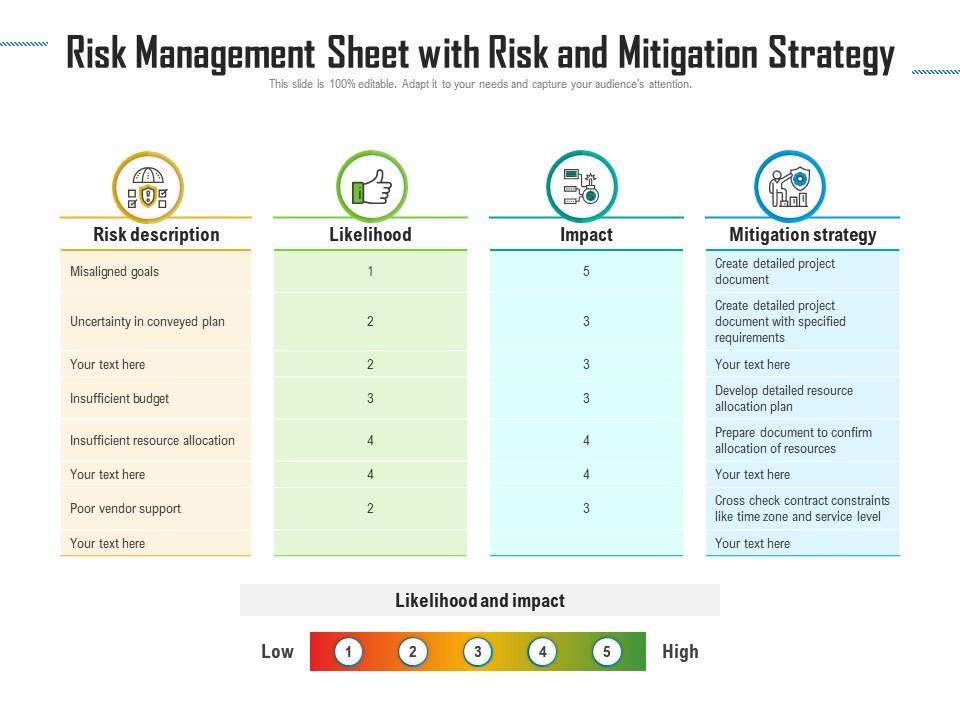
Introducing our Risk Management Sheet With Risk And Mitigation Strategy set of slides. The topics discussed in these slides are Risk Management, Sheet Risk, Mitigation Strategy. This is an immediately available PowerPoint presentation that can be conveniently customized. Download it and convince your audience.

People who downloaded this PowerPoint presentation also viewed the following :

FAQs for Risk management sheet with risk

Key components of an effective risk management sheet include risk identification, probability assessment, impact analysis, mitigation strategies, and ownership assignment. These elements work together by providing comprehensive visibility into potential threats, enabling organizations to prioritize resources strategically, implement targeted responses, and maintain operational continuity, ultimately delivering enhanced decision-making capabilities and competitive resilience.

A risk management sheet helps identify potential project risks by systematically documenting threat categories, probability assessments, impact levels, and vulnerability areas across all project phases. Through structured risk registers, project managers can proactively analyze financial, operational, and timeline risks, enabling early detection and mitigation strategies that ultimately reduce project failures and enhance delivery success rates.

Risk assessment techniques include probability analysis, impact scoring, historical data review, expert judgment, and scenario planning. These methodologies enable organizations to systematically evaluate threats by examining frequency patterns, severity levels, and potential outcomes, with many financial institutions and healthcare organizations finding that structured assessment frameworks significantly enhance decision-making accuracy and strategic resource allocation.

Risk prioritization involves assessing probability, impact severity, detection likelihood, timeline urgency, and resource requirements for mitigation. Organizations typically use scoring matrices combining these factors, with high-probability, high-impact risks receiving immediate attention, while banks and healthcare institutions often prioritize regulatory compliance risks alongside operational threats, ultimately enabling strategic resource allocation and proactive management approaches.

A risk management sheet serves as a centralized communication tool that provides stakeholders with clear visibility into potential threats, mitigation strategies, and current risk status across projects or operations. It facilitates transparent discussions between project managers, executives, and team members by presenting standardized risk assessments, ultimately enabling informed decision-making and coordinated responses.

Risk management sheets should be reviewed quarterly at minimum, with updates triggered by significant organizational changes, new project phases, regulatory shifts, or emerging threats. Many organizations find that monthly reviews work best for dynamic environments like financial services or healthcare, while stable industries may extend to semi-annual updates, ultimately ensuring risk mitigation strategies remain current and effective.

Best practices for including risk mitigation strategies include clearly defining each risk's impact level, assigning specific owners and timelines, documenting both preventive and contingency measures, establishing measurable success metrics, and regularly updating response protocols. These strategies enable organizations to proactively address vulnerabilities through systematic planning, resource allocation, and stakeholder accountability, ultimately delivering improved operational resilience and competitive advantage.

Visual aids in a risk management sheet enhance understanding by transforming complex data into intuitive charts, color-coded matrices, heat maps, and graphical dashboards that quickly communicate risk levels and priorities. These visual elements streamline decision-making processes by enabling stakeholders to rapidly identify high-priority risks, track mitigation progress, and allocate resources more effectively, ultimately delivering faster response times and improved organizational risk awareness.

Risk management tools include GRC platforms like MetricStream and ServiceNow, spreadsheet applications such as Excel and Google Sheets, project management software like Monday.com, and specialized solutions including RiskWatch and LogicGate. These technologies streamline risk assessment by automating data collection, enabling real-time collaboration, and providing centralized dashboards, with many organizations finding that integrated platforms significantly enhance operational efficiency while delivering faster reporting and improved compliance tracking.

Ensuring compliance with industry standards involves incorporating regulatory requirements, conducting regular audits, maintaining detailed documentation, and establishing clear accountability measures within your risk management sheet. Through systematic compliance tracking and standardized assessment criteria, organizations streamline regulatory adherence while enhancing operational transparency, with many financial services and healthcare institutions finding that structured compliance frameworks ultimately deliver reduced penalties and stronger stakeholder confidence.

Common pitfalls include incomplete risk identification, vague descriptions without quantifiable impacts, inconsistent rating scales, and neglecting regular updates. These oversights undermine effectiveness by creating false security, with many organizations finding that thorough stakeholder consultation, standardized assessment criteria, and quarterly reviews deliver more accurate risk visibility and proactive mitigation strategies.

Historical data enhances risk management sheet accuracy by identifying patterns, calculating probability distributions, and establishing baseline metrics for various risk scenarios. Through trend analysis and statistical modeling, organizations can quantify potential impacts more precisely, refine risk likelihood assessments, and develop more robust mitigation strategies, ultimately delivering better predictive capabilities and strategic decision-making frameworks.

Risk management sheets can be customized through industry-specific risk categories, regulatory compliance frameworks, assessment methodologies, and mitigation strategies tailored to sector needs. For example, healthcare organizations focus on patient safety and HIPAA compliance, while manufacturing emphasizes operational hazards and supply chain disruptions, with many industries finding that sector-specific templates streamline identification processes and enhance regulatory alignment.

Team collaboration is essential for developing comprehensive risk management sheets, as it brings together diverse perspectives, expertise from different departments, and firsthand knowledge of operational vulnerabilities that individual contributors might miss. Through collaborative input, organizations can identify cross-functional risks, validate mitigation strategies, and ensure buy-in for implementation, with many companies finding that team-developed frameworks deliver more robust protection and faster incident response.

Key metrics include risk identification rates, mitigation timeline adherence, incident frequency reduction, cost impact analysis, and control effectiveness scores. These measurements enable organizations to assess their risk frameworks by tracking preventive success, response efficiency, and financial protection, with many financial services and healthcare institutions finding that consistent metric monitoring ultimately delivers improved operational resilience and regulatory compliance.

Ratings and Reviews

100% of 100
Write a review
Most Relevant Reviews
  1. 100%

    by Cleveland Foster

    Awesome use of colors and designs in product templates.

1 Item

per page: