Roadmap For Business Transition Strategic Framework
Try Before you Buy Download Free Sample Product
Audience
Editable
of Time
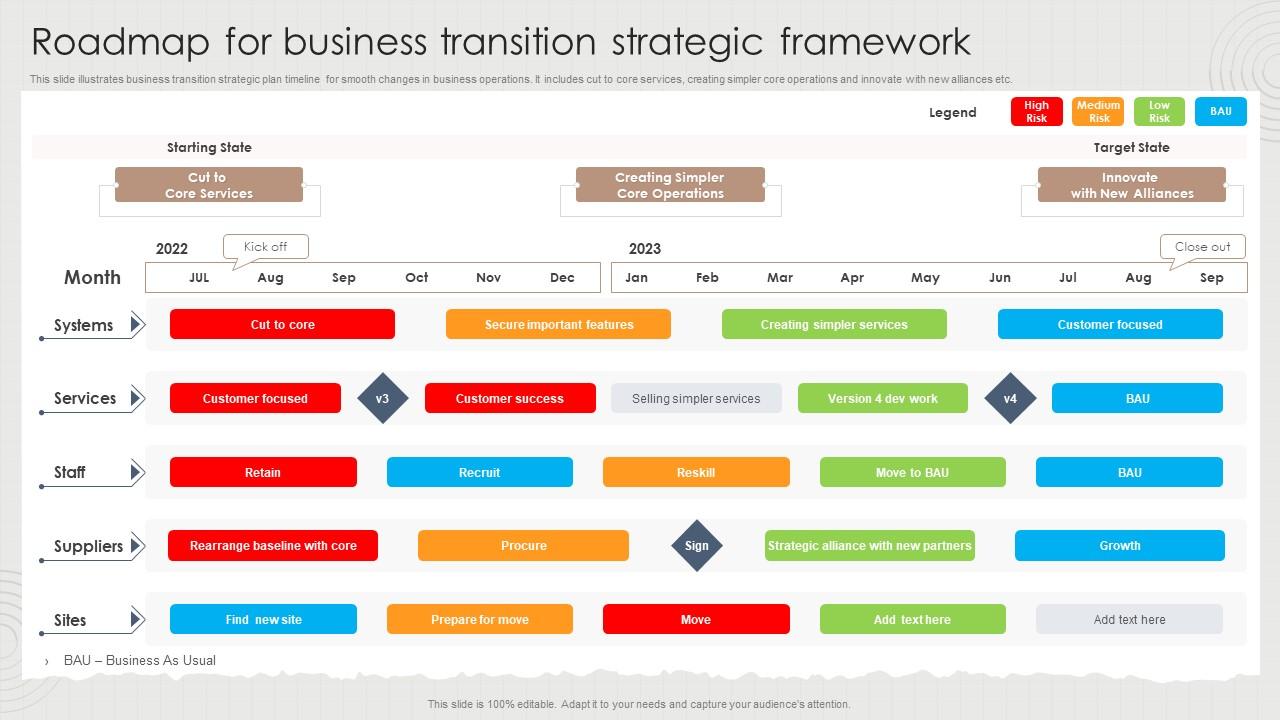
This slide illustrates business transition strategic plan timeline for smooth changes in business operations. It includes cut to core services, creating simpler core operations and innovate with new alliances etc.
People who downloaded this PowerPoint presentation also viewed the following :
Roadmap For Business Transition Strategic Framework with all 6 slides:
Use our Roadmap For Business Transition Strategic Framework to effectively help you save your valuable time. They are readymade to fit into any presentation structure.
FAQs for Roadmap For Business
Key components of an effective business transition strategy include comprehensive stakeholder communication, detailed operational roadmaps, risk assessment frameworks, resource allocation plans, and timeline management systems. These elements work together by ensuring seamless knowledge transfer, maintaining customer relationships, and preserving operational continuity, with many organizations finding that structured transition planning ultimately delivers reduced disruption and accelerated implementation success.
Assessing company transition readiness involves evaluating financial stability, organizational culture, leadership capability, operational flexibility, and market positioning. Through comprehensive audits and stakeholder assessments, organizations can identify potential obstacles while measuring change management capacity, ultimately ensuring strategic alignment and minimizing risks during critical business transformations.
Leadership drives successful business transitions by establishing clear vision, communicating transparently with stakeholders, managing change resistance, and maintaining operational continuity throughout the process. Strong leaders navigate uncertainty by making decisive strategic decisions, empowering teams with necessary resources, and fostering adaptability, with many organizations finding that engaged leadership significantly reduces transition risks while accelerating implementation timelines.
Companies ensure employee engagement during transitions through transparent communication, involving staff in planning processes, providing comprehensive training programs, and recognizing contributions throughout the change. Organizations like healthcare systems and financial institutions find that regular feedback sessions, clear role definitions, and celebrating small wins maintain morale, while offering career development opportunities and addressing concerns proactively ultimately delivers higher retention and smoother operational continuity.
Common pitfalls include inadequate succession planning, poor financial preparation, insufficient stakeholder communication, underestimating timeline requirements, and neglecting cultural integration aspects. These challenges often derail transitions in family businesses, corporate acquisitions, and leadership changes, with many organizations finding that early planning, transparent communication, and phased implementation ultimately deliver smoother transitions and sustained operational continuity.
Technology supports business transitions by automating workflows, enhancing data analytics, streamlining communication channels, and enabling real-time monitoring of key performance indicators. Through cloud-based platforms and integrated systems, organizations can minimize operational disruptions, accelerate decision-making processes, and maintain customer service continuity, ultimately delivering smoother transitions and competitive advantages.
Key transition metrics include timeline adherence, budget variance, employee retention rates, customer satisfaction scores, and operational efficiency indicators. These measurements enable organizations to track progress across financial, operational, and human dimensions, with many companies finding that balanced scorecards combining quantitative performance data with qualitative stakeholder feedback ultimately deliver the most comprehensive assessment of transition success.
Stakeholder communication is critical in business transition strategy, serving as the foundation for successful change management, employee engagement, and organizational alignment. Through transparent updates, regular feedback sessions, and strategic messaging, organizations minimize resistance, maintain productivity, and build trust, with many companies finding that proactive communication reduces transition costs by 30-40% while accelerating implementation timelines.
Managing customer expectations during transitions requires proactive communication, transparent timelines, and regular progress updates throughout the process. Organizations employ phased rollouts, dedicated support channels, and clear benefit explanations, with many companies finding that early stakeholder engagement and consistent messaging minimize resistance while maintaining trust and loyalty during periods of change.
A business transition strategy aligns with long-term organizational goals by establishing clear milestones, resource allocation frameworks, and performance metrics that support strategic objectives. Through systematic planning and stakeholder engagement, organizations streamline operational changes while maintaining focus on growth targets, with many companies finding that structured transition processes ultimately deliver enhanced competitive advantage and sustainable business outcomes.
Staff training methods for post-transition adaptation include hands-on workshops, mentorship programs, digital learning platforms, cross-functional shadowing, and phased skill-building sessions. These approaches streamline knowledge transfer by combining practical experience with structured guidance, enabling organizations across industries like manufacturing and financial services to maintain operational efficiency while building employee confidence in new systems.
Risk management can be integrated into business transition strategy through comprehensive risk assessment, scenario planning, contingency protocols, stakeholder communication frameworks, and phased implementation approaches. These strategic elements enable organizations to identify potential disruptions early, minimize operational vulnerabilities, and maintain business continuity, with many companies finding that proactive risk integration ultimately delivers smoother transitions and competitive advantage.
Financial considerations during business transition include cash flow management, funding requirements, valuation accuracy, tax implications, and cost-benefit analysis of transition activities. These assessments enable organizations to maintain operational stability, secure adequate resources, and minimize financial risks, with many companies finding that strategic financial planning ultimately delivers smoother transitions and enhanced competitive positioning.
Corporate culture significantly influences business transition success by shaping employee adaptability, communication patterns, decision-making processes, and change acceptance throughout organizations. Companies with collaborative cultures typically navigate transitions more smoothly, while hierarchical structures may face resistance, with many financial services and healthcare institutions finding that cultural alignment accelerates implementation and ultimately delivers sustainable competitive advantage.
Market analysis serves as the foundation for business transition strategy by identifying opportunities, assessing competitive landscapes, evaluating customer demands, and revealing market gaps or emerging trends. Through comprehensive market research, organizations can make data-driven decisions about timing, resource allocation, and strategic positioning, ultimately minimizing transition risks while maximizing competitive advantage in their target markets.
-
I was able to find the right choice of PPT template for my thesis with SlideTeam. Thank you for existing.
-
“Ample and amazing variety of templates available, really helpful for making professional PPT for day to day workings.”