Roadmap For Successful Employee Training Program Employee Guidance Playbook

Rating:
90%
Roadmap For Successful Employee Training Program Employee Guidance Playbook
Slide 1 of 6

or

Favourites Favourites

Try Before you Buy Download Free Sample Product

Audience Impress Your
Audience
Editable 100%
Editable
Time Save Hours
of Time
The Biggest Sale is ending soon in
0
0
:
0
0
:
0
0
Rating:
90%
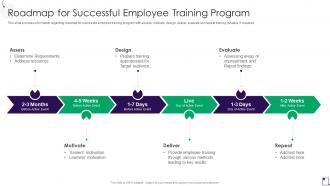
This slide provides information regarding roadmap for successful employee training program with assess, motivate, design, deliver, evaluate and repeat training initiative, if required. Introducing Roadmap For Successful Employee Training Program Employee Guidance Playbook to increase your presentation threshold. Encompassed with six stages, this template is a great option to educate and entice your audience. Dispence information on Roadmap, Successful, Evaluate, using this template. Grab it now to reap its full benefits.

FAQs for Roadmap For Successful Employee Training Program

Effective employee training program roadmaps include comprehensive needs assessment, structured learning pathways, skill-based competency frameworks, measurable performance metrics, and continuous feedback mechanisms. These components work together by identifying knowledge gaps, delivering targeted content, and tracking progress outcomes, with many organizations finding that strategic roadmaps enhance employee retention, accelerate skill development, and ultimately deliver improved productivity and competitive advantage.

Organizations assess training needs through skills gap analyses, employee surveys, performance reviews, manager feedback, and business objective alignment. This comprehensive evaluation enables companies across sectors like healthcare, manufacturing, and financial services to identify specific competency requirements, prioritize development areas, and create targeted roadmaps that ultimately deliver improved performance and competitive advantage.

Technology enhances employee training program effectiveness by enabling personalized learning paths, delivering interactive multimedia content, and providing real-time progress tracking and analytics. Through learning management systems and AI-powered platforms, organizations streamline training delivery, reduce costs, and improve knowledge retention, with many companies finding that technology-driven approaches ultimately deliver faster skill development and measurable performance improvements.

Measuring training program success involves tracking completion rates, knowledge retention assessments, performance improvements, employee engagement scores, and business impact metrics like productivity gains. Organizations monitor these indicators through quarterly reviews, 360-degree feedback, skill assessments, and ROI calculations, with many companies finding that comprehensive measurement frameworks ultimately deliver enhanced performance visibility and strategic workforce development advantages.

Employee feedback on training programs can be gathered through post-training surveys, focus groups, one-on-one interviews, pulse surveys, and digital feedback platforms. These methods enable organizations to assess training effectiveness, identify knowledge gaps, and refine content delivery, with many companies finding that strategic feedback collection ultimately enhances employee engagement and delivers measurable improvements in performance outcomes.

Training programs should be updated quarterly for rapidly evolving industries like technology and finance, while more stable sectors may require semi-annual or annual reviews. Organizations increasingly adopt continuous feedback loops, monitoring industry trends, regulatory changes, and employee performance metrics to determine update frequency, with many finding that agile, modular training approaches enable faster adaptation and maintain competitive advantage.

Key metrics include training costs per employee, productivity improvements, employee retention rates, promotion rates, and revenue per employee. These measurements enable organizations to assess performance gains, reduced turnover expenses, and skill development impact, with many companies finding that comprehensive tracking delivers measurable competitive advantage and justifies continued investment in strategic workforce development.

Companies ensure alignment by conducting strategic needs assessments, mapping training outcomes to specific business goals, involving leadership in curriculum design, and establishing measurable KPIs that connect employee development to organizational performance metrics. Through regular program evaluations and feedback loops, organizations in sectors like healthcare, finance, and manufacturing can adjust training initiatives to support revenue growth, operational efficiency, and competitive positioning, ultimately delivering enhanced workforce capabilities that directly advance business objectives.

Strategies include gamification elements, personalized learning paths, microlearning modules, peer-to-peer knowledge sharing, and leadership participation in training sessions. These approaches enhance engagement by creating interactive experiences, accommodating individual learning preferences, and fostering collaborative environments, with many organizations finding that combining multiple strategies significantly improves participation rates and knowledge retention.

A training program roadmap should incorporate visual, auditory, kinesthetic, and reading-based learning methods through diverse delivery formats like interactive workshops, video tutorials, hands-on simulations, and comprehensive guides. This multi-modal approach ensures broader engagement across departments, with many organizations finding that blended learning strategies improve knowledge retention rates and accelerate skill development, ultimately delivering enhanced performance outcomes.

Best practices for integrating onboarding training include establishing clear milestone checkpoints, creating role-specific learning pathways, implementing mentorship programs, utilizing interactive multimedia content, and scheduling regular feedback sessions throughout the first 90 days. These approaches streamline new hire integration by reducing time-to-productivity, enhancing retention rates, and building stronger team connections, with many organizations finding that structured onboarding ultimately delivers improved employee satisfaction and accelerated performance outcomes.

Organizations can incorporate mentorship and coaching by establishing structured mentor-mentee pairings, integrating peer coaching sessions, implementing reverse mentoring programs, creating cross-departmental guidance opportunities, and developing formal coaching frameworks with clear objectives. These approaches enhance knowledge transfer, accelerate skill development, and foster collaborative learning cultures, with many companies finding that strategic mentorship programs significantly improve employee retention and performance outcomes.

Common implementation challenges include resistance to change, budget constraints, time limitations, inconsistent delivery methods, and measuring effectiveness across diverse learning styles. Organizations overcome these obstacles by securing leadership buy-in early, phasing rollouts strategically, leveraging technology for scalable delivery, and establishing clear metrics, with many companies finding that consistent communication and flexible approaches ultimately enhance employee engagement and program success.

Cross-departmental collaboration enhances training effectiveness by sharing diverse expertise, identifying skill gaps across teams, and creating unified learning objectives that align with organizational goals. When departments like HR, IT, and operations collaborate, they develop comprehensive programs addressing real workplace challenges, streamline resource allocation, and ensure training directly supports business outcomes while fostering knowledge transfer.

Emerging trends in employee training include microlearning modules, AI-powered personalized learning paths, virtual reality simulations, social learning platforms, and skills-based competency mapping. These approaches streamline development by delivering bite-sized content, adapting to individual progress, and creating immersive experiences, with many organizations finding that strategic integration ultimately enhances employee engagement and accelerates capability building across diverse teams.

Ratings and Reviews

90% of 100
Review Form
Write a review
Most Relevant Reviews
  1. 80%

    by Daron Guzman

    Been using SlideTeam for some time now…can’t imagine why I wasted all that time in front of the screen trying to make the perfect presentation.
  2. 100%

    by Clifton Jenkins

    SlideTeam is my one-stop solution for all the presentation needs. Their templates have beautiful designs that are worth every penny!

2 Item(s)

per page: