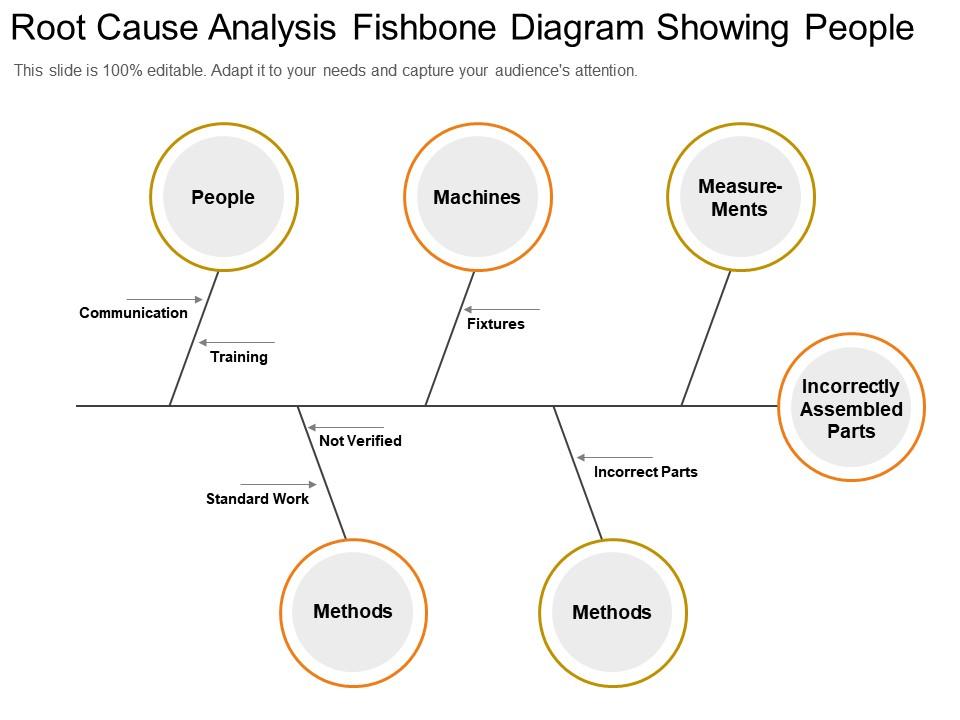
Root cause analysis fishbone diagram showing people

Rating:
90%
Root cause analysis fishbone diagram showing people
Slide 1 of 5
Favourites Favourites

Try Before you Buy Download Free Sample Product

Audience Impress Your
Audience
Editable 100%
Editable
Time Save Hours
of Time
The Biggest Sale is ending soon in
0
0
:
0
0
:
0
0
Rating:
90%
Presenting root cause analysis fishbone diagram showing people. This is a root cause analysis fishbone diagram showing people. This is a six stage process. The stages in this process are root, root cause, fishbone.

People who downloaded this PowerPoint presentation also viewed the following :

FAQs for Root cause analysis fishbone

The primary components of a fishbone diagram include the problem statement (fish head), major cause categories (main bones), and specific contributing factors (smaller bones branching from each category). These categories typically encompass people, processes, materials, methods, environment, and equipment, enabling organizations in manufacturing, healthcare, and service industries to systematically identify root causes, streamline problem-solving processes, and ultimately enhance operational efficiency while reducing recurring issues.

The fishbone diagram facilitates team collaboration by providing a structured visual framework where members contribute insights across different cause categories, ensuring comprehensive problem analysis and equal participation. This systematic approach enables teams to build on each other's perspectives, identify interconnected root causes they might miss individually, and reach consensus-driven solutions, with many organizations finding that this collaborative methodology significantly reduces problem-solving time while improving solution quality.

Fishbone diagrams excel at analyzing complex operational problems with multiple contributing factors, including quality defects, process inefficiencies, customer service failures, safety incidents, and project delays. These visual tools systematically examine causes across people, processes, materials, equipment, environment, and methods, with manufacturing teams, healthcare organizations, and service providers finding that this structured approach accelerates problem-solving and prevents recurring issues.

Fishbone diagrams can be customized by adapting the main cause categories to reflect industry-specific factors, regulatory requirements, operational processes, and sector terminology. For example, healthcare organizations might use categories like Patient Care, Medical Equipment, and Regulatory Compliance, while manufacturing focuses on Machine, Method, and Material categories, ultimately delivering more targeted root cause analysis and faster problem resolution.

Common pitfalls include rushing through brainstorming without diverse input, focusing on symptoms rather than root causes, creating overly complex diagrams, and failing to validate findings with data. Many organizations find that insufficient team involvement, skipping the investigation of identified causes, and treating the diagram as a final solution rather than an analytical starting point ultimately diminishes problem-solving effectiveness and strategic outcomes.

Determining causes for your fishbone diagram involves brainstorming sessions with cross-functional teams, reviewing historical data patterns, and analyzing current process documentation to identify potential contributors. Organizations typically categorize causes under the 6Ms framework—manpower, methods, materials, machines, measurements, and mother nature—while focusing on measurable factors that directly impact outcomes, ultimately enabling systematic root cause identification and targeted problem-solving strategies.

The "5 Whys" technique enhances fishbone diagrams by systematically drilling deeper into each potential cause identified on the diagram's branches, transforming surface-level observations into specific, actionable root causes. This strategic combination enables organizations across manufacturing, healthcare, and service industries to move beyond symptoms, ultimately delivering more precise problem-solving and sustainable solutions.

Digital tools streamline fishbone diagram creation through automated templates, collaborative editing features, real-time data integration, and instant sharing capabilities across teams. These platforms enable organizations to quickly populate cause categories, drag-and-drop elements seamlessly, and maintain version control, while facilitating remote team participation and ultimately delivering faster root cause identification and more efficient problem-solving processes.

Fishbone diagrams have driven major improvements across industries, including Toyota reducing manufacturing defects by 75% through systematic cause analysis, hospitals decreasing patient wait times by identifying staffing and process bottlenecks, and airlines minimizing flight delays by analyzing maintenance, weather, and operational factors. These structured approaches enable organizations to move beyond symptoms to address root causes, ultimately delivering enhanced operational efficiency, cost reduction, and improved customer satisfaction across manufacturing, healthcare, and service sectors.

Involving diverse stakeholders enhances fishbone diagram accuracy by bringing multiple perspectives, specialized knowledge, and varied experiences to identify comprehensive root causes across all contributing categories. Cross-functional teams from operations, quality, management, and frontline staff can reveal blind spots, validate assumptions, and uncover interconnected issues that single-perspective analysis might miss, ultimately delivering more thorough problem-solving solutions.

Fishbone diagrams differ from other root cause analysis tools through their visual branching structure, categorical organization of causes, and collaborative brainstorming approach, while tools like 5 Whys use sequential questioning and fault trees employ binary logic paths. This structured visualization enables teams to systematically explore multiple cause categories simultaneously, ultimately delivering more comprehensive problem analysis than linear methods, with many manufacturing and healthcare organizations finding that fishbone diagrams enhance team engagement during root cause investigations.

Cultural factors significantly influence fishbone analysis by affecting communication patterns, hierarchical respect, problem-solving approaches, and willingness to identify systemic issues. In organizations across healthcare, manufacturing, and financial services, cultural dimensions like power distance and uncertainty avoidance shape how teams surface underlying causes, ultimately determining whether analysis reveals surface-level symptoms or deeper organizational root causes.

**INPUT**: What methods can be employed to validate the root causes identified in a fishbone diagram? **OUTPUT**: Root cause validation methods include data analysis, statistical testing, process mapping, controlled experiments, and stakeholder interviews. These approaches enable organizations to confirm suspected causes through measurable evidence, systematic observation, and cross-functional verification, with many teams finding that combining quantitative data with qualitative insights ultimately delivers more accurate solutions and sustainable improvements.

Prioritizing fishbone diagram causes involves assessing impact severity, implementation feasibility, available resources, and data-driven evidence to rank root causes systematically. Organizations typically use scoring matrices, cost-benefit analysis, and stakeholder input to identify high-impact, low-effort solutions first, ultimately enabling focused problem-solving that delivers measurable improvements and optimal resource allocation.

Fishbone diagrams serve as foundational root cause analysis tools within Six Sigma's DMAIC framework, particularly during the Analyze phase, while also supporting Lean methodologies and Kaizen initiatives. These visual problem-solving templates enhance continuous improvement efforts by systematically identifying process inefficiencies, quality defects, and operational bottlenecks, with manufacturing, healthcare, and service organizations finding that structured cause analysis accelerates sustainable improvements and measurable results.

Ratings and Reviews

90% of 100
Write a review
Most Relevant Reviews
  1. 80%

    by Dick Ryan

    Great product with effective design. Helped a lot in our corporate presentations. Easy to edit and stunning visuals.
  2. 100%

    by Dante Wells

    Presentation Design is very nice, good work with the content as well.

2 Item(s)

per page: