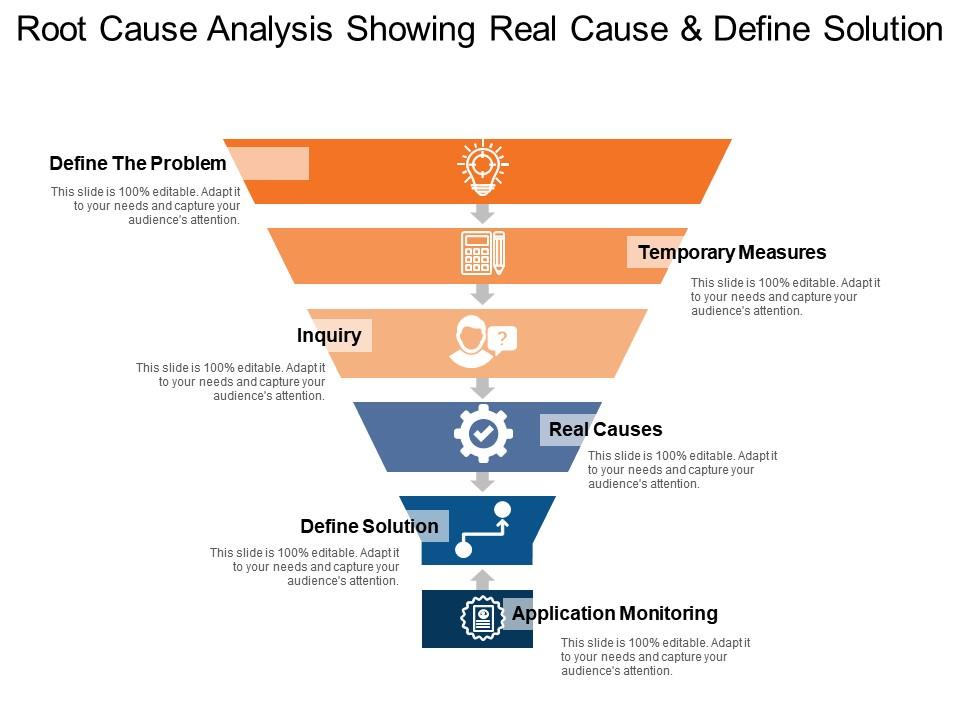
Root cause analysis showing real cause and define solution

Rating:
90%
Root cause analysis showing real cause and define solution
Slide 1 of 5
Favourites Favourites

Try Before you Buy Download Free Sample Product

Audience Impress Your
Audience
Editable 100%
Editable
Time Save Hours
of Time
The Biggest Sale is ending soon in
0
0
:
0
0
:
0
0
Rating:
90%
Presenting Root Cause Analysis Showing Real Cause And Defining Solution slideshow. The slideshow supports both the standard and widescreen sizes. It has compatibility with Google Slides and other office suites. The slide is effortless to download and can be saved in the popular image or document formats such as JPEG and PDF. Alter the style, size, and the background of the slides. High-quality graphics ensure that pixelation does not occur.

People who downloaded this PowerPoint presentation also viewed the following :

FAQs for Root cause analysis showing real cause

Primary Root Cause Analysis techniques include the 5 Whys method, fishbone diagrams, fault tree analysis, failure mode analysis, and statistical process control. These methodologies enable organizations to systematically identify underlying issues by tracing problems to their source, analyzing contributing factors, and implementing targeted solutions, with many companies finding that structured RCA approaches significantly reduce recurring operational failures.

Root Cause Analysis differs from other problem-solving methods by focusing on identifying underlying systemic issues rather than addressing surface-level symptoms, using structured investigative techniques like fishbone diagrams and five-whys methodology. While quick fixes target immediate problems, RCA prevents recurring issues by eliminating fundamental causes, with manufacturing and healthcare organizations finding significantly reduced operational disruptions and enhanced long-term efficiency.

Data collection serves as the foundation for effective Root Cause Analysis, providing objective evidence, historical patterns, performance metrics, incident reports, and stakeholder feedback needed for accurate problem identification. Through systematic data gathering, organizations can eliminate assumptions, validate hypotheses, and trace problems to their true origins, with many companies finding that comprehensive data collection reduces recurring issues by enabling targeted solutions rather than symptomatic fixes.

Teams can distinguish symptoms from root causes by implementing systematic questioning techniques, such as the "5 Whys" methodology, conducting thorough data analysis, and involving diverse perspectives from different departments. This structured approach helps organizations, particularly in manufacturing and healthcare sectors, move beyond surface-level issues to identify underlying systemic problems, ultimately delivering more effective solutions and preventing recurring operational challenges.

Common challenges during Root Cause Analysis include insufficient data collection, cognitive biases influencing investigations, time pressures from stakeholders, lack of cross-functional collaboration, and focusing on symptoms rather than underlying causes. These obstacles can derail analysis efforts, with many organizations finding that establishing structured methodologies, dedicated investigation teams, and systematic documentation processes ultimately delivers more accurate problem identification and sustainable solutions.

Root Cause Analysis adapts across industries by addressing sector-specific failure patterns, regulatory requirements, and operational challenges. In healthcare, hospitals use RCA for patient safety incidents, medication errors, and infection control, while manufacturing applies it to equipment failures, quality defects, and production bottlenecks, ultimately enhancing safety protocols and operational efficiency.

**INPUT**: What tools and software are most helpful for conducting Root Cause Analysis? **OUTPUT**: Root Cause Analysis tools include fishbone diagrams, 5 Whys analysis, fault tree analysis, Pareto charts, and software platforms like Minitab, Tableau, and specialized RCA applications. These technologies streamline problem identification by automating data collection, visualizing cause-and-effect relationships, and tracking corrective actions, with many organizations finding that integrated platforms ultimately deliver faster resolution times and enhanced operational efficiency. *[Word count: 60 words]*

Companies foster thorough Root Cause Analysis culture by encouraging open communication, psychological safety, and continuous learning over blame-focused approaches. Through structured training programs, dedicated analysis time, and leadership modeling, organizations like manufacturing firms and healthcare systems create environments where employees proactively identify issues, ultimately delivering improved operational efficiency and sustainable problem-solving capabilities.

Root Cause Analysis documentation best practices include creating detailed timelines, maintaining comprehensive evidence logs, documenting all investigative steps, recording stakeholder interviews, and establishing clear cause-and-effect relationships. These systematic approaches streamline future investigations by preserving institutional knowledge, enhancing accountability, and enabling pattern recognition, with many organizations finding that thorough documentation ultimately delivers faster problem resolution and prevents recurring issues.

Visual aids enhance Root Cause Analysis understanding by transforming complex data into clear, accessible formats through fishbone diagrams, flowcharts, timeline maps, and heat maps. These tools enable teams to identify patterns, trace problem sequences, and communicate findings more effectively across departments, with many organizations finding that visual presentations accelerate decision-making and ensure stakeholder alignment.

Organizations can measure RCA effectiveness through resolution time reduction, recurrence rates of similar incidents, cost savings from prevented issues, employee engagement scores in problem-solving activities, and implementation success rates of corrective actions. These metrics enable companies across manufacturing, healthcare, and financial services to track operational improvements, enhanced quality outcomes, and reduced downtime, ultimately delivering measurable ROI and competitive advantage through systematic problem resolution.

Root Cause Analysis integrates into continuous improvement frameworks through systematic problem identification, standardized investigation processes, corrective action implementation, and performance monitoring cycles. Organizations embed RCA into quality management systems, lean methodologies, and operational reviews, creating feedback loops that prevent recurring issues while driving sustainable improvements, with manufacturing and healthcare sectors finding this approach significantly reduces defects and enhances operational efficiency.

Regular Root Cause Analysis implementation delivers sustained operational excellence, enhanced decision-making capabilities, reduced recurring issues, improved team problem-solving skills, and stronger organizational resilience. These systematic approaches streamline processes by preventing future failures, minimizing costly disruptions, and building institutional knowledge, with many organizations finding that consistent RCA practices ultimately create competitive advantages through superior quality and reliability.

Organizations can train staff in Root Cause Analysis through structured workshops covering systematic investigation techniques, problem-solving methodologies, data collection protocols, and analytical frameworks like fishbone diagrams and 5-why analysis. Through hands-on simulations and real-world case studies, employees develop critical thinking skills, learn to identify underlying patterns, and master documentation processes, with many companies finding that cross-functional training sessions enhance collaboration and ultimately deliver faster problem resolution across departments.

Successful Root Cause Analysis implementations include Toyota's production system eliminating manufacturing defects, healthcare organizations reducing patient safety incidents, airlines preventing mechanical failures, and financial institutions minimizing system outages. These applications streamline operations by identifying underlying issues, implementing systematic corrections, and preventing recurrence, with many organizations finding that comprehensive RCA delivers significant cost reductions and enhanced operational efficiency.

Ratings and Reviews

90% of 100
Review Form
Write a review
Most Relevant Reviews
  1. 100%

    by Mason Thompson

    Helpful product design for delivering presentation.
  2. 80%

    by Dallas Medina

    Visually stunning presentation, love the content.

2 Item(s)

per page: