Sales contests and rewards
Try Before you Buy Download Free Sample Product
Audience
Editable
of Time
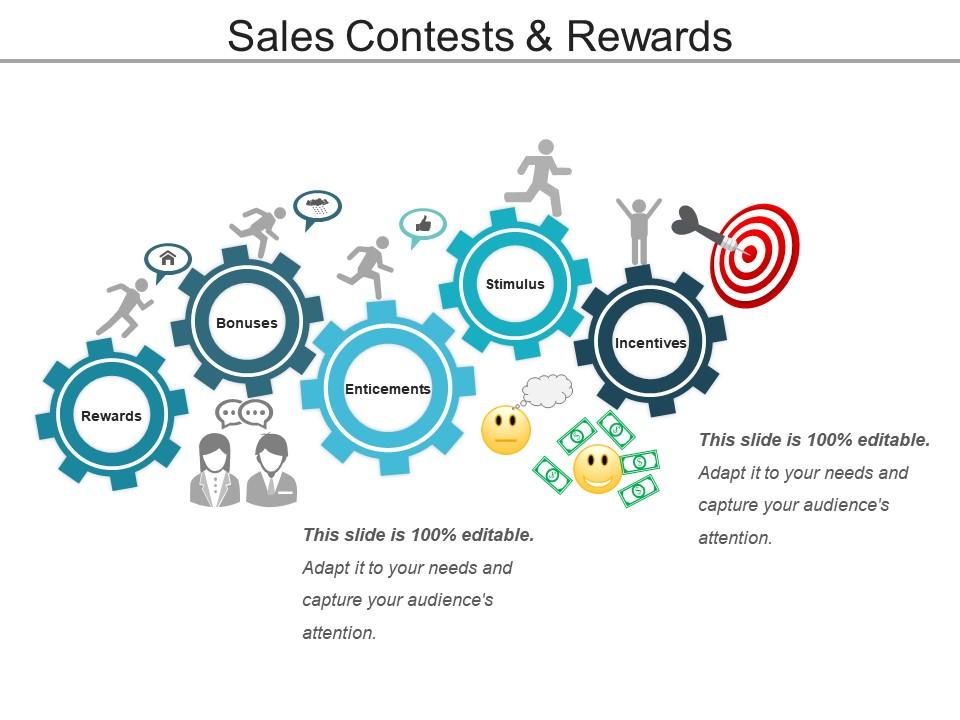
Keep your team motivated with this Sales Contests And Rewards slideshow. Mention three basic types of contests which are direct competition, team competition, and goal by using this motivational program PPT layout. Utilize this readily available PowerPoint graphic to highlight some creative sales contest ideas by showcasing the logic behind it. Motivate your employees to generate more sales by mentioning some low budget ways such as salesperson of the month, raffle prizes, win favor from a boss, etc. Employ the key elements of an effective sales contest by taking advantage of the reward PPT theme. Build strategies to motivate your sales team by employing our professionally designed sales management PowerPoint layout. Highlight the skills required in order to become a sales manager and make your presentation eye-catching. Also, showcase the ways by which you can improve your sales performance taking the assistance of this motivation infographic PowerPoint presentation. Hence plan your day to day sales by downloading this attention-grabbing organizational selling PowerPoint presentation.
People who downloaded this PowerPoint presentation also viewed the following :
Sales contests and rewards with all 5 slides:
Jettison the baggage with our Sales Contests And Rewards. Encourage folks to act in a contemporary fashion.
FAQs for Sales
The most effective sales incentives include monetary bonuses, commission increases, recognition awards, career advancement opportunities, and experiential rewards like trips or exclusive events. These incentives work by addressing different motivational drivers, creating healthy competition, and aligning individual achievements with company goals, with many organizations finding that combining multiple incentive types delivers sustained performance improvements and enhanced team engagement.
Businesses can tailor sales incentives by analyzing role-specific metrics, performance drivers, customer interaction types, and sales cycle lengths for each position. Account managers might receive retention bonuses while new business developers earn higher commission rates, with many organizations finding that customized incentive structures boost motivation, improve role clarity, and ultimately drive stronger overall sales performance.
Non-monetary sales incentives play a crucial role by enhancing job satisfaction, building team cohesion, and fostering long-term engagement through recognition programs, career development opportunities, flexible work arrangements, and public acknowledgment. These incentives complement monetary rewards by addressing intrinsic motivation, with many organizations finding that strategic combinations of both approaches ultimately deliver higher retention rates and sustained performance improvements.
Sales incentives can be structured through tiered commission rates, quarterly bonuses for immediate targets, annual rewards for customer retention, and multi-year equity compensation or profit-sharing plans. This strategic combination enables organizations to drive immediate revenue while building sustainable relationships, with many companies finding that balanced incentive structures ultimately deliver consistent performance and reduced turnover across sales teams.
Key metrics for measuring sales incentive effectiveness include revenue growth, conversion rates, average deal size, sales cycle length, and quota attainment rates. These indicators enable organizations to assess program ROI by tracking performance improvements, behavioral changes, and cost-per-acquisition ratios, with many companies finding that combining leading and lagging metrics delivers comprehensive insights into incentive program success and strategic impact.
Cultural differences significantly impact sales incentive effectiveness through varying motivations, recognition preferences, and communication styles across regions. While individualistic cultures often respond to personal rewards and public recognition, collectivistic cultures may prefer team-based incentives and private acknowledgment, with many multinational organizations finding that localized incentive strategies deliver higher engagement and ultimately stronger sales performance.
Poorly designed sales incentive programs can lead to unethical sales practices, short-term thinking over long-term customer relationships, internal competition that damages teamwork, and focus on quantity over quality. These issues often result in customer dissatisfaction, high employee turnover, and decreased overall performance, with many organizations finding that misaligned incentives ultimately hurt revenue and company culture.
Technology enhances sales incentive implementation through automated tracking systems, real-time performance dashboards, predictive analytics, and mobile accessibility platforms. These solutions streamline commission calculations, eliminate manual errors, and provide instant visibility into goal progress, with many organizations finding that automated systems reduce processing time by 70% while improving accuracy and sales team engagement.
**INPUT**: What strategies can be employed to ensure transparency in sales incentive programs? **OUTPUT**: Transparency in sales incentive programs requires clear communication of criteria, regular progress updates, accessible performance dashboards, standardized calculation methods, and open feedback channels. These strategies enhance trust and motivation by enabling sales teams to track their progress in real-time, understand exactly how commissions are calculated, and receive consistent recognition, ultimately delivering improved performance and reduced disputes across organizations.
Companies balance individual and team incentives by implementing hybrid compensation structures that reward both personal achievements and collective goals, typically allocating 60-70% to individual performance and 30-40% to team outcomes. This strategic combination encourages healthy competition while fostering collaboration, with many organizations finding that tiered bonus systems and shared revenue targets ultimately deliver enhanced productivity and stronger team cohesion.
Creative sales incentives include experiential rewards like exclusive retreats or masterclasses, personalized recognition programs, skill development opportunities, flexible work arrangements, and unique lifestyle perks such as concierge services or wellness packages. These approaches enhance team motivation and retention by addressing individual preferences and career aspirations, with many organizations finding that non-monetary incentives often deliver stronger long-term engagement and performance results than traditional commission structures.
Sales incentives significantly enhance employee retention and satisfaction by providing clear performance recognition, financial rewards, and career advancement opportunities that directly correlate with individual achievements. When structured effectively, these programs create competitive yet collaborative environments where top performers feel valued and motivated, with many sales organizations finding that well-designed incentive structures reduce turnover rates while simultaneously boosting team morale and overall productivity.
Organizations should consider compliance with labor laws, anti-discrimination regulations, fair compensation standards, and transparent communication of incentive terms. While incentives enhance performance, they must avoid creating conflicts of interest or encouraging unethical behavior, with many companies finding that clear guidelines and regular audits ultimately deliver sustainable sales growth and regulatory compliance.
Incorporating sales team feedback involves conducting regular surveys, focus groups, and one-on-one interviews to understand motivational preferences, performance barriers, and reward effectiveness. Through collaborative design sessions and pilot testing, organizations can create programs that align with actual field conditions and individual goals, ultimately delivering higher engagement rates and improved sales performance across diverse teams.
Gamification transforms sales incentive strategies by introducing competitive elements, real-time leaderboards, achievement badges, point systems, and interactive challenges that boost engagement and motivation. These digital approaches streamline performance tracking, enhance team collaboration, and deliver immediate recognition, with many organizations finding that gamified incentives increase sales productivity by 30-40% while creating more dynamic, results-driven cultures.
-
Unique research projects to present in meeting.
-
Much better than the original! Thanks for the quick turnaround.