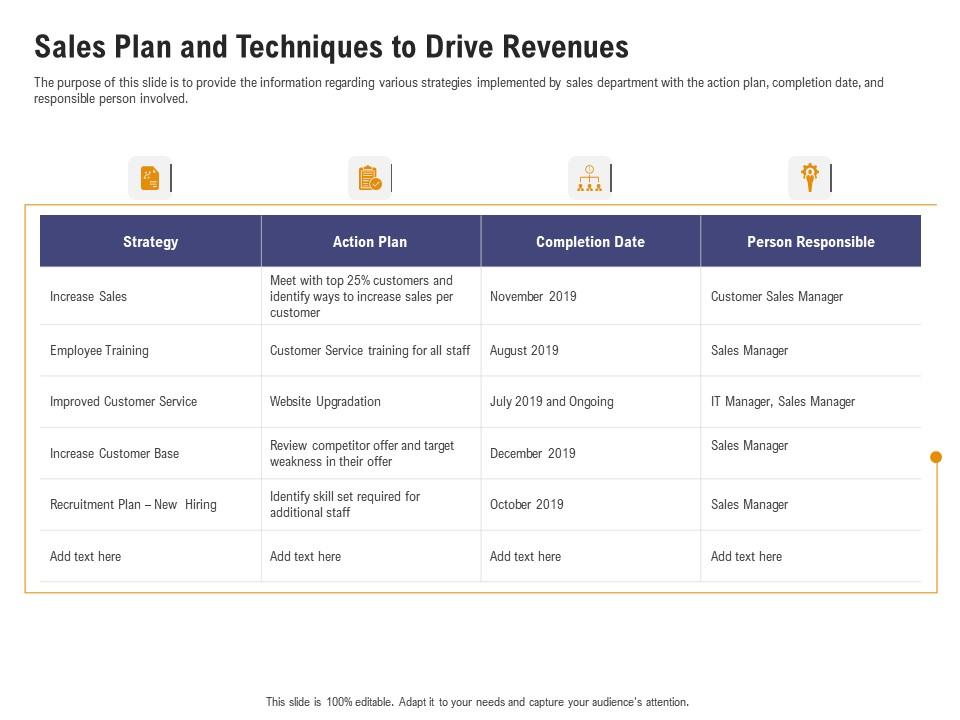
Sales plan and techniques to drive revenues sales department initiatives
Try Before you Buy Download Free Sample Product
Audience
Editable
of Time
The purpose of this slide is to provide the information regarding various strategies implemented by sales department with the action plan, completion date, and responsible person involved.
People who downloaded this PowerPoint presentation also viewed the following :
Sales plan and techniques to drive revenues sales department initiatives with all 2 slides:
Use our Sales Plan And Techniques To Drive Revenues Sales Department Initiatives to effectively help you save your valuable time. They are readymade to fit into any presentation structure.
FAQs for Sales plan and techniques to drive revenues
Key components include target market identification, value proposition development, sales process optimization, competitive positioning, and performance metrics tracking. These elements work together by aligning sales activities with customer needs, streamlining prospect engagement, and enabling data-driven decision making, with many organizations finding that strategic integration ultimately delivers higher conversion rates and sustainable revenue growth.
Businesses align sales strategy with marketing goals by establishing shared KPIs, creating integrated customer journey maps, coordinating messaging across touchpoints, and implementing unified lead scoring systems. This strategic combination enables sales teams to leverage marketing-qualified leads more effectively, while marketing can optimize campaigns based on sales feedback, ultimately delivering higher conversion rates and improved revenue growth.
Market research serves as the foundation for successful sales strategies by identifying target customer segments, analyzing competitor positioning, understanding market trends, and revealing customer pain points and preferences. Through comprehensive market analysis, organizations can tailor their sales approaches, optimize pricing strategies, and allocate resources more effectively, ultimately enabling sales teams to engage prospects with greater precision and deliver more compelling value propositions.
Sales teams can utilize customer feedback by analyzing purchasing patterns, identifying objections and pain points, adjusting messaging to address specific concerns, and personalizing approaches based on customer preferences. This strategic feedback integration enables sales professionals to refine their pitch timing, enhance product positioning, and streamline their sales process, ultimately delivering higher conversion rates and stronger customer relationships.
Consultative selling advantages include building stronger customer relationships, increasing deal sizes, shortening sales cycles, improving customer retention, and enhancing competitive differentiation. This approach enables sales teams to uncover deeper client needs, present tailored solutions, and establish trust-based partnerships, with many organizations finding that consultative methods ultimately deliver higher conversion rates and long-term customer loyalty.
Technology and automation enhance sales strategies by streamlining lead generation, personalizing customer interactions, and accelerating deal closures through predictive analytics and automated follow-ups. These tools enable sales teams to focus on high-value prospects while automated systems handle routine tasks, ultimately delivering faster conversion rates, improved customer experiences, and significant competitive advantage in increasingly digital markets.
Key sales strategy metrics include conversion rates, average deal size, sales cycle length, customer acquisition cost, and pipeline velocity. These metrics enable organizations to optimize performance by identifying bottlenecks, forecasting revenue accurately, and allocating resources strategically, with many companies finding that tracking these indicators delivers measurable improvements in sales efficiency and predictable growth.
Sales strategies can be adapted for different customer segments through targeted messaging, customized value propositions, personalized communication channels, segment-specific pricing models, and tailored sales processes. By leveraging customer data and behavioral insights, organizations streamline their approach across enterprise, mid-market, and SMB segments, ultimately delivering more relevant experiences and higher conversion rates.
Best practices for training sales teams on a new sales strategy include role-playing exercises, interactive workshops, mentorship programs, regular feedback sessions, and performance tracking systems. These approaches enhance skill development by providing hands-on experience, real-time coaching, and continuous improvement opportunities, with many organizations finding that combining multiple training methods accelerates adoption and ultimately delivers higher conversion rates and stronger customer relationships.
Storytelling integrates into sales strategies through customer success narratives, problem-solution case studies, and value demonstration stories that resonate emotionally with prospects. These narrative approaches enhance client engagement by building trust, simplifying complex solutions, and showcasing tangible outcomes, with many sales teams finding that strategic storytelling accelerates decision-making and strengthens competitive positioning.
Competitive analysis significantly shapes sales strategy by identifying market gaps, pricing opportunities, competitor weaknesses, and differentiation points that inform positioning and tactics. Through systematic competitor research, sales teams can develop targeted messaging, adjust pricing strategies, and refine value propositions, while many organizations find that regular competitive insights ultimately enhance win rates and accelerate deal closure.
Businesses can effectively leverage social media by building authentic relationships, sharing valuable content, engaging directly with prospects, utilizing targeted advertising, and monitoring customer conversations for sales opportunities. Through platforms like LinkedIn for B2B outreach and Instagram for product demonstrations, companies streamline lead generation, enhance customer trust, and ultimately accelerate sales cycles while reducing traditional marketing costs.
CRM software centralizes customer data, automates sales processes, tracks interactions, manages pipeline activities, and provides performance analytics to execute sales strategies effectively. Through automated lead scoring and personalized communication tools, sales teams streamline prospecting, enhance customer relationships, and accelerate deal closures, with many organizations finding significantly improved conversion rates and revenue growth.
Sales strategies can be adjusted through market analysis, customer feedback assessment, competitive intelligence gathering, pricing model revisions, and channel optimization. Through data-driven insights, organizations streamline their approach by realigning target segments, enhancing value propositions, and adapting sales processes, with many companies finding that flexible strategies ultimately deliver sustained revenue growth and competitive advantage.
Common pitfalls include neglecting customer research, setting unrealistic targets, inadequate sales team training, poor lead qualification processes, and insufficient performance tracking mechanisms. These oversights often result in misaligned messaging, wasted resources, and missed revenue opportunities, with many organizations finding that comprehensive strategy development ultimately delivers improved conversion rates and sustainable growth.
-
Much better than the original! Thanks for the quick turnaround.
-
Great designs, really helpful.