Self development planning with future goals

Self development planning with future goals
Slide 1 of 2
Favourites Favourites

Try Before you Buy Download Free Sample Product

Audience Impress Your
Audience
Editable 100%
Editable
Time Save Hours
of Time
The Biggest Sale is ending soon in
0
0
:
0
0
:
0
0
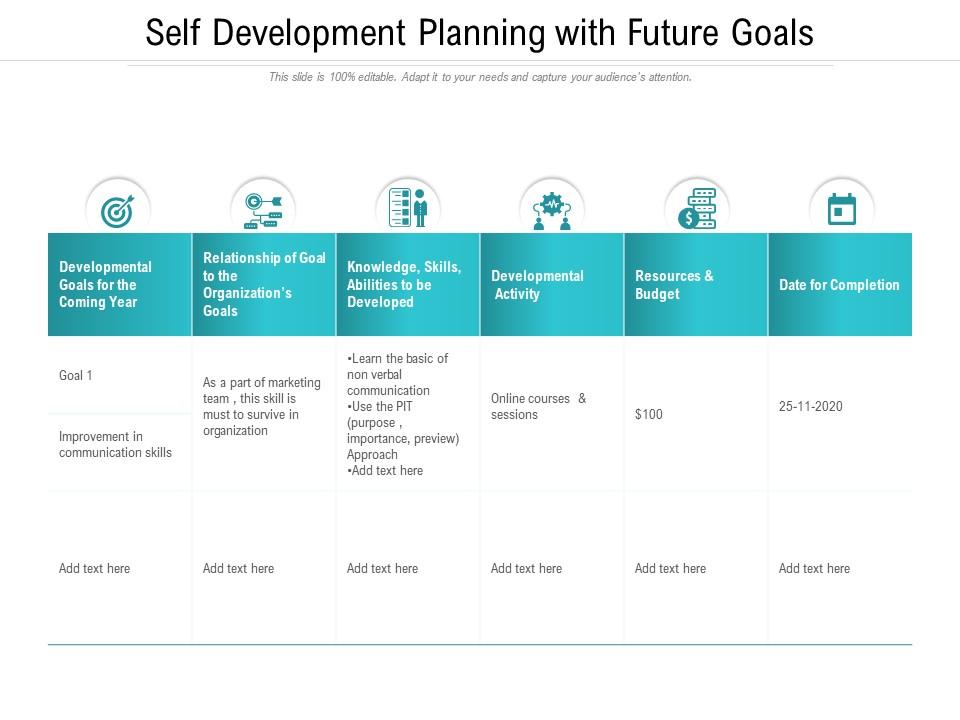
Presenting this set of slides with name Self Development Planning With Future Goals. The topics discussed in these slides are Self Development, Planning, Future Goals. This is a completely editable PowerPoint presentation and is available for immediate download. Download now and impress your audience.

FAQs for Self development planning

**INPUT**: What are the key components of a successful self-development plan? **OUTPUT**: Key components include clear goal setting, skill gap analysis, learning resource identification, timeline establishment, and progress tracking mechanisms. These elements work together by creating structured pathways for growth, enabling measurable advancement, and maintaining accountability, with many professionals finding that strategic self-development plans ultimately deliver enhanced career opportunities and competitive advantage. **Word count: 51 words**

Effective SMART goals for personal growth require making objectives Specific, Measurable, Achievable, Relevant, and Time-bound, with clear metrics like completing certifications, developing skills, or achieving performance targets. This structured approach enables professionals to track progress systematically, maintain accountability, and ultimately deliver measurable improvements in career advancement and personal effectiveness within defined timeframes.

Self-assessment serves as the foundational cornerstone of effective self-development planning, enabling individuals to identify strengths, weaknesses, skill gaps, and growth opportunities with clarity and objectivity. Through structured evaluation tools, feedback mechanisms, and reflective practices, professionals can strategically align their development goals with career aspirations, ultimately delivering enhanced performance and competitive advantage in increasingly dynamic workplace environments.

Individuals can identify their strengths and weaknesses through self-assessment tools, 360-degree feedback, performance reviews, personality tests, and regular reflection on achievements and challenges. These methods enable professionals to create targeted development plans, enhance career progression, and improve workplace effectiveness, with many organizations finding that structured self-awareness ultimately delivers better team performance and individual satisfaction.

Maintaining motivation during self-development requires celebrating small wins, setting milestone rewards, tracking visible progress, and connecting with accountability partners or mentors. These strategies create sustained momentum by breaking larger goals into manageable achievements, with many professionals finding that regular progress reviews and peer support systems ultimately deliver consistent growth and prevent the discouragement that derails long-term development efforts.

Self-development planning contributes to professional growth by identifying skill gaps, setting clear learning objectives, creating actionable improvement strategies, and establishing measurable progress milestones. Through strategic skill enhancement and continuous learning, professionals across industries like finance, healthcare, and technology accelerate promotions, increase earning potential, and build competitive advantages, ultimately positioning themselves for leadership roles and career advancement opportunities.

Common obstacles in self-development include lack of clear goals, inconsistent habits, fear of failure, time constraints, and insufficient accountability systems. These challenges can be overcome by setting specific measurable objectives, creating structured daily routines, reframing setbacks as learning opportunities, and establishing regular progress reviews, with many professionals finding that combining mentorship with systematic tracking ultimately delivers sustained personal growth and enhanced career advancement.

Self-development plans should be reviewed quarterly and updated annually, with major milestone assessments occurring every six months to track progress and adjust goals. Many professionals find that quarterly reviews enable timely course corrections, while annual updates incorporate new career objectives, skill requirements, and market changes, ultimately ensuring continuous growth and competitive advantage in an increasingly dynamic professional landscape.

Effective self-development methodologies include SMART goal setting, the 70-20-10 learning model, competency frameworks, personal SWOT analysis, and regular self-assessment tools. These approaches streamline growth by establishing measurable objectives, combining experiential learning with formal training, and enabling systematic skill tracking, with many professionals finding that structured frameworks ultimately deliver faster career advancement and enhanced performance outcomes.

Mindfulness and reflection enhance self-development planning by increasing self-awareness, clarifying personal values and goals, and identifying growth patterns more accurately. These practices enable professionals to make strategic decisions about skill development, career transitions, and leadership capabilities, with many organizations finding that mindful planning approaches ultimately deliver more sustainable growth and authentic professional advancement.

Self-development resources include books like "Atomic Habits" and "Mindset," apps such as Headspace and Duolingo, online courses from Coursera and LinkedIn Learning, and podcasts covering leadership and personal growth. These tools enhance skill-building by providing structured learning paths, tracking progress, and delivering personalized content, with many professionals finding that combining multiple formats accelerates their development outcomes.

Accountability partners and mentors enhance self-development plan success by providing consistent feedback, maintaining motivation during challenging periods, and offering objective perspectives on progress and setbacks. Through regular check-ins and strategic guidance, these relationships streamline goal achievement, accelerate skill development, and deliver sustained momentum, with many professionals finding that external accountability ultimately increases their commitment and success rates.

Time management ensures consistent progress in self-development by enabling structured learning schedules, dedicated skill-building sessions, and regular goal assessment. Effective time allocation helps professionals balance development activities with daily responsibilities, while prioritizing high-impact learning opportunities, ultimately accelerating career advancement and personal growth in increasingly competitive environments.

Feedback from peers and supervisors provides essential insights into blind spots, skill gaps, and growth opportunities that individuals might not recognize independently. This external perspective enables professionals to refine their development goals, prioritize learning areas, and adjust their approach based on real workplace observations, ultimately accelerating career progression and enhancing performance effectiveness.

Key indicators include skill acquisition metrics, behavioral change assessments, goal completion rates, feedback from peers and supervisors, and performance improvement measurements. These can be measured through regular self-assessments, 360-degree feedback surveys, milestone tracking systems, and objective performance data, with many professionals finding that combining quantitative metrics with qualitative insights delivers comprehensive progress visibility and sustained motivation.

Ratings and Reviews

0% of 100
Review Form
Write a review
Most Relevant Reviews

No Reviews