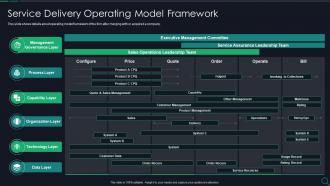
Service Delivery Operating Model Framework Due Diligence Checklist For M And A
Try Before you Buy Download Free Sample Product
Audience
Editable
of Time
This slide shows details about operating model framework of the firm after merging with or acquired a company.
People who downloaded this PowerPoint presentation also viewed the following :
Service Delivery Operating Model Framework Due Diligence Checklist For M And A with all 6 slides:
Use our Service Delivery Operating Model Framework Due Diligence Checklist For M And A to effectively help you save your valuable time. They are readymade to fit into any presentation structure.
FAQs for Service Delivery Operating Model Framework Due Diligence Checklist For
Key components include service strategy, governance frameworks, resource allocation, performance metrics, technology infrastructure, and customer feedback mechanisms. These elements work together by aligning operational capabilities with business objectives, streamlining service processes, and enabling continuous improvement, with many organizations finding that integrated models deliver enhanced customer experiences and operational efficiency.
Organizational goals directly shape Service Delivery Operating Model design by determining resource allocation priorities, performance metrics, technology investments, and process workflows. Strategic objectives like cost reduction, customer satisfaction enhancement, or market expansion drive specific model configurations, with healthcare organizations focusing on patient outcomes while financial services prioritize compliance and speed, ultimately ensuring operational alignment delivers competitive advantage.
Technology enhances Service Delivery Operating Models by automating routine tasks, enabling real-time monitoring, streamlining workflows, and facilitating seamless integration across departments and systems. Through AI-powered analytics and cloud platforms, organizations achieve faster response times, improved resource allocation, and enhanced customer experiences, with many financial services and healthcare institutions finding significant operational efficiency gains.
Businesses measure Service Delivery Operating Model success through key performance indicators like customer satisfaction scores, service level agreement compliance, operational efficiency metrics, cost per transaction, and first-call resolution rates. These measurements enable organizations across sectors like banking, healthcare, and retail to identify bottlenecks, optimize resource allocation, and ultimately deliver faster services while reducing operational costs and enhancing customer experiences.
Common challenges include inadequate change management, resistance from staff, insufficient stakeholder alignment, unclear service definitions, and technology integration complexities. Organizations often struggle with defining clear accountability structures, establishing effective measurement systems, and maintaining consistent service quality standards, while many find that addressing cultural transformation and ensuring adequate training resources ultimately determines successful implementation and long-term operational efficiency.
Service Delivery Operating Models can be adapted for remote and hybrid environments through cloud-based service platforms, virtual collaboration tools, automated workflow systems, digital performance dashboards, and flexible resource allocation frameworks. These adaptations enable organizations to maintain service quality while supporting distributed teams, with many companies in financial services and healthcare finding that strategic combination of technology and process redesign ultimately delivers enhanced operational efficiency and improved employee satisfaction.
Customer feedback informs Service Delivery Operating Model improvements by identifying service gaps, highlighting process inefficiencies, and revealing unmet customer expectations through surveys, reviews, and direct interactions. Organizations leverage this feedback to redesign workflows, enhance service quality standards, and optimize resource allocation, with many companies finding that customer-driven improvements ultimately deliver faster response times and significantly higher satisfaction rates.
Best practices for aligning service delivery with business strategy include establishing clear KPIs tied to strategic objectives, implementing regular cross-functional governance reviews, creating service portfolios that directly support business outcomes, and fostering continuous stakeholder communication. These approaches streamline organizational focus by connecting operational activities to strategic goals, enabling performance measurement, and ensuring resource allocation matches business priorities, ultimately delivering enhanced customer experiences and competitive advantage.
Cross-functional collaboration is essential for developing effective Service Delivery Operating Models, as it ensures alignment between IT, operations, customer service, and business units on shared objectives and processes. This collaborative approach enables organizations to identify interdependencies, streamline handoffs, and create unified service standards, with many enterprises finding that integrated teams deliver faster resolution times, improved customer experiences, and enhanced operational efficiency.
Organizations can streamline their Service Delivery Operating Model through process automation, cross-functional team integration, standardized workflows, performance analytics, and technology consolidation. These strategies enhance operational efficiency by reducing manual tasks, improving collaboration, and enabling real-time monitoring, with many enterprises finding that strategic automation ultimately delivers faster service responses and significant cost reductions.
Organizations balance standardization and flexibility by establishing core standardized processes for common functions while building modular components that adapt to specific client needs, regional requirements, and market variations. This hybrid approach enables consistent service quality and operational efficiency across the organization, while allowing customization for complex scenarios, with many enterprises finding that strategic flexibility within standardized frameworks delivers both cost reduction and enhanced customer experiences.
Employee training significantly enhances Service Delivery Operating Model effectiveness by improving service quality, reducing response times, and ensuring consistent delivery standards across all touchpoints. Well-trained teams in sectors like banking and healthcare demonstrate greater operational efficiency, enhanced customer satisfaction, and reduced error rates, ultimately delivering competitive advantage and enabling organizations to scale their service capabilities more effectively.
Organizations ensure scalability by implementing standardized processes, leveraging automation technologies, creating modular service frameworks, and establishing robust performance monitoring systems. These strategic approaches enable seamless resource allocation and capacity expansion, with many growing companies finding that cloud-based platforms and agile methodologies deliver operational flexibility while maintaining service quality across multiple locations and customer segments.
Regulatory compliance significantly influences Service Delivery Operating Model design through mandatory governance frameworks, standardized processes, audit trails, risk management protocols, and quality assurance mechanisms. These requirements shape operational workflows, documentation standards, and resource allocation strategies, with organizations in healthcare, financial services, and telecommunications finding that compliance-driven models ultimately deliver enhanced transparency, reduced operational risk, and stronger stakeholder confidence while maintaining competitive service delivery.
Cultural factors significantly influence Service Delivery Operating Models through communication styles, decision-making processes, customer expectations, and employee engagement approaches. Organizations with strong collaborative cultures often see enhanced service consistency and faster issue resolution, while those addressing cultural misalignments between teams and customers ultimately deliver more personalized experiences and improved satisfaction rates.
-
Amazing slides! Unique, attractive, and easy to understand.
-
I was really impressed with the presentation I created with their templates. I’ll be using their services moving forward.Â