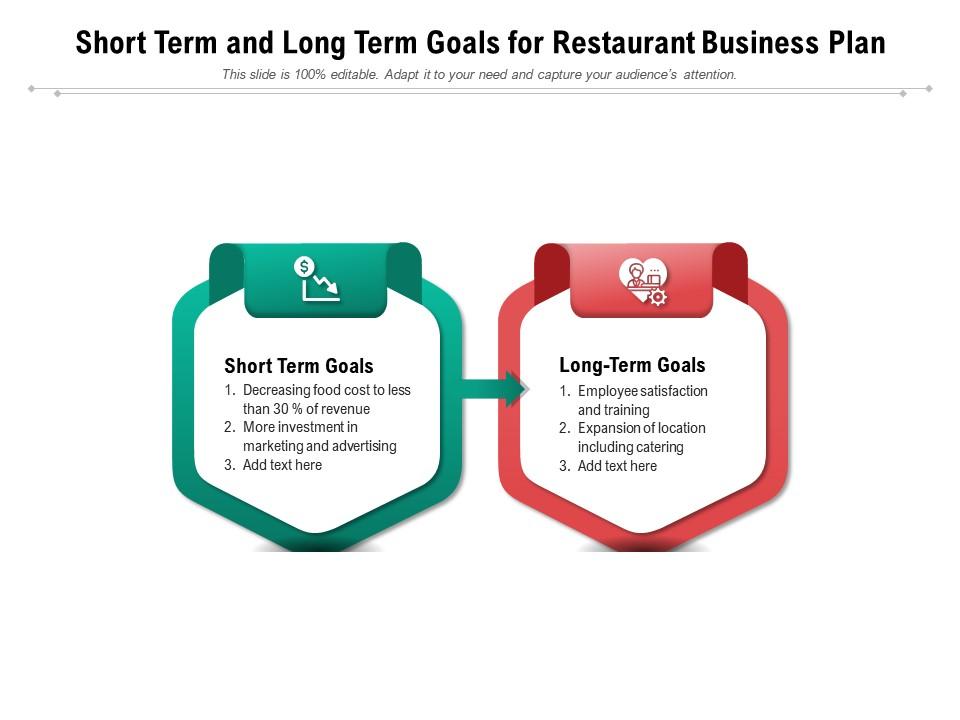
Short term and long term goals for restaurant business plan
Try Before you Buy Download Free Sample Product
Audience
Editable
of Time
Our Short Term And Long Term Goals For Restaurant Business Plan are topically designed to provide an attractive backdrop to any subject. Use them to look like a presentation pro.
People who downloaded this PowerPoint presentation also viewed the following :
Short term and long term goals for restaurant business plan with all 2 slides:
Use our Short Term And Long Term Goals For Restaurant Business Plan to effectively help you save your valuable time. They are readymade to fit into any presentation structure.
FAQs for Short term and long term goals for
Restaurant KPIs include revenue per seat, food cost percentage, labor cost ratio, table turnover rate, and customer satisfaction scores. These metrics enable restaurant owners to streamline operations by monitoring profitability, controlling expenses, and optimizing service efficiency, with many establishments finding that tracking these indicators ultimately delivers improved margins and enhanced customer experiences.
Restaurants can establish their USP by identifying distinctive elements like specialized cuisine, unique dining experiences, exceptional service standards, signature dishes, or specific target demographics. Successful differentiation often combines multiple factors, with many establishments finding that authentic storytelling around their concept, whether farm-to-table sourcing, cultural heritage, or innovative preparation methods, creates compelling customer attraction and lasting competitive advantage.
Restaurants can enhance customer loyalty through personalized dining experiences, consistent quality standards, loyalty reward programs, responsive customer service, and strategic social media engagement. These approaches streamline customer retention by creating emotional connections, recognizing repeat patrons, and addressing feedback promptly, with many establishments finding that personalized service and consistent experiences ultimately deliver higher revenue and competitive advantage.
Operational goals focus on internal efficiency like reducing food waste, optimizing staff scheduling, streamlining kitchen workflows, and maintaining consistent service quality. Marketing goals target external growth through brand awareness, customer acquisition, social media engagement, and revenue increases. While operational improvements enhance cost control and customer experiences, marketing initiatives drive traffic and sales, with successful restaurants finding that aligning both goal types creates sustainable competitive advantage.
Menu diversification enhances customer satisfaction, increases revenue streams, accommodates dietary preferences, and expands market reach by offering varied cuisines and options. This strategic approach enables restaurants to attract broader demographics, reduce seasonal dependency, and improve competitive positioning, with many establishments finding that diverse menus drive higher average spending and customer loyalty.
Restaurants can leverage technology through mobile ordering apps, kitchen display systems, inventory management software, contactless payment solutions, and customer relationship management platforms. These technologies streamline operations by reducing wait times, minimizing order errors, and optimizing staff allocation, while enhancing customer experiences through personalized service, faster transactions, and seamless digital interactions, ultimately delivering increased profitability and competitive advantage.
Restaurant owners should focus on food cost percentage, labor cost ratio, average transaction value, table turnover rate, and cash flow management for sustainable operations. These metrics enable strategic decision-making by optimizing menu pricing, staffing efficiency, and customer experience, with many successful establishments finding that consistent monitoring ultimately delivers improved profit margins and competitive advantage.
Seasonal trends significantly impact restaurant business goals by requiring flexible staffing models, adaptive menu planning, targeted marketing campaigns, and strategic inventory management throughout the year. Restaurants leverage seasonal patterns to optimize resource allocation and revenue streams, with many establishments finding that aligning promotional strategies and operational capacity with predictable demand fluctuations ultimately delivers enhanced profitability and customer satisfaction.
Staff training and development are fundamental to service excellence, encompassing product knowledge, customer service skills, operational procedures, conflict resolution, and continuous improvement practices. Well-trained restaurant teams deliver consistent experiences, reduce errors, and handle challenges professionally, with many establishments finding that ongoing development programs significantly enhance customer satisfaction, increase staff retention, and ultimately drive repeat business and positive reviews.
Sustainability initiatives align with restaurant business objectives by reducing operational costs through energy efficiency and waste reduction, enhancing brand reputation to attract environmentally conscious customers, and ensuring regulatory compliance. These practices streamline supply chain management, minimize food waste expenses, and create competitive differentiation, with many establishments finding that sustainable operations ultimately deliver improved profit margins and stronger customer loyalty.
Social media enhances restaurant brand visibility through targeted advertising, visual content showcasing, influencer partnerships, customer reviews management, and community building initiatives. These platforms enable restaurants to engage customers through interactive posts, real-time responses, and personalized promotions, ultimately delivering increased foot traffic and customer loyalty while building stronger brand recognition.
Effective cost management strategies include strategic supplier partnerships, inventory optimization, menu engineering, staff cross-training, and technology integration for operations. Restaurants achieve this balance by negotiating bulk purchasing agreements, reducing food waste through portion control, streamlining kitchen workflows, and implementing point-of-sale systems, ultimately delivering enhanced profitability while maintaining customer satisfaction and service standards.
Restaurants can measure promotional campaign effectiveness through sales data analysis, customer acquisition metrics, social media engagement rates, redemption tracking for offers, and customer feedback surveys. These measurement methods enable establishments to assess ROI, identify successful strategies, and optimize future campaigns, with many restaurants finding that comprehensive analytics ultimately deliver improved marketing efficiency and enhanced customer targeting capabilities.
Customer feedback serves as a critical foundation for restaurant business goals, directly informing menu development, service improvements, operational efficiency, and strategic expansion decisions. Through online reviews, surveys, and direct interactions, restaurants can identify specific areas needing enhancement, streamline operations based on customer preferences, and ultimately deliver improved dining experiences while building competitive advantage in an increasingly crowded marketplace.
Collaborations with local suppliers and businesses enhance restaurant goals by reducing operational costs, ensuring fresher ingredients, and strengthening community ties that drive customer loyalty. These strategic partnerships enable restaurants to streamline supply chains, create unique menu offerings, and build authentic brand stories, while many establishments find that local sourcing ultimately delivers competitive differentiation and sustainable growth.
No Reviews