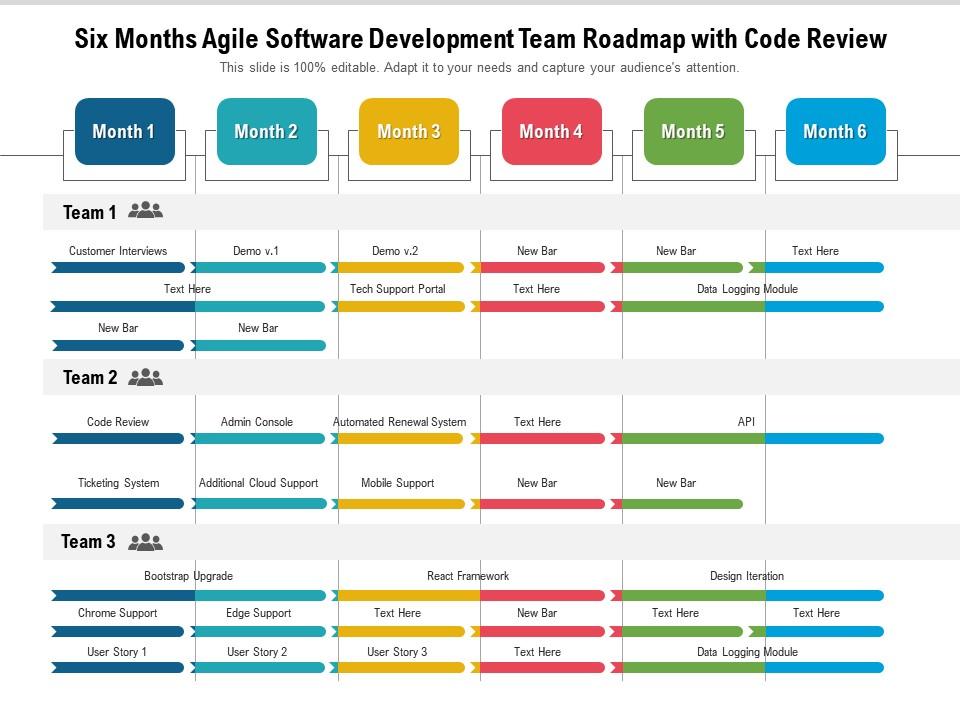
Six months agile software development team roadmap with code review
Try Before you Buy Download Free Sample Product
Audience
Editable
of Time
A well thought out action plan makes execution easier and increases the possibility of success significantly. Ensure hitting all the milestones within the deadlines by introducing our fully customizable Six Months Agile Software Development Team Roadmap With Code Review. Streamline the work related information, budget, timeframe, key deliverable, landmarks, and major steps involved, all in one place to give an organized overview of the project by utilizing our PowerPoint theme. Minimize time lag and increase work efficiency by providing insight into the process with our comprehensively researched roadmap PowerPoint layout. Color coding helps in highlighting the process and grabs the attention of the audience. Download our handy Six Months Agile Software Development Team Roadmap With Code Review to identify the possible problem areas in a much shorter time and propose solutions. Have a productive brainstorming session with your workforce by utilizing our action plan visualization tool.
People who downloaded this PowerPoint presentation also viewed the following :
Six months agile software development team roadmap with code review with all 2 slides:
Give your audience a fulfilling experience. They will find our Six Months Agile Software Development Team Roadmap With Code Review elevating.
FAQs for Six months agile software development team roadmap
Key components of an Agile roadmap include product vision, strategic themes, epics, user stories, sprint goals, and iterative milestones that emphasize customer value delivery. These elements align with Agile principles by prioritizing customer collaboration over rigid planning, enabling adaptive responses to change, and facilitating continuous delivery, with many organizations finding that flexible roadmapping enhances team productivity and market responsiveness.
Organizations effectively prioritize Agile roadmap features by combining customer feedback, business impact analysis, technical feasibility assessments, and market timing considerations with stakeholder input. Through frameworks like value-based prioritization and MoSCoW methods, teams streamline decision-making processes while balancing short-term deliverables with long-term strategic goals, ultimately enabling faster releases and enhanced competitive positioning in increasingly dynamic markets.
Teams can incorporate stakeholder feedback through regular roadmap review sessions, stakeholder surveys, user story workshops, sprint demos, and advisory boards with key customers. These engagement methods enable product teams to validate priorities, adjust feature requirements, and align development efforts with market needs, while maintaining agility to pivot based on evolving stakeholder insights and competitive positioning.
Key metrics include velocity tracking, sprint completion rates, customer satisfaction scores, time-to-market measurements, and feature adoption rates. These indicators enable organizations to assess delivery efficiency, stakeholder alignment, and business value creation, with many companies finding that combining quantitative sprint data with qualitative customer feedback ultimately delivers comprehensive insights into roadmap effectiveness and competitive positioning.
Agile roadmaps accommodate changes through flexible sprint planning, regular stakeholder feedback sessions, iterative priority reassessment, and continuous backlog refinement based on emerging data. Through these adaptive mechanisms, organizations in sectors like fintech and retail can pivot quickly when market demands shift, reallocating resources strategically while maintaining development momentum and competitive responsiveness.
**INPUT**: What tools are most effective for visualizing and communicating an Agile roadmap to stakeholders? **OUTPUT**: Effective Agile roadmap visualization tools include Jira Roadmaps, ProductPlan, Aha!, Azure DevOps, and Roadmunk, along with presentation platforms like PowerPoint and specialized templates. These solutions streamline stakeholder communication by providing real-time updates, customizable views, and progress tracking capabilities, with many organizations finding that visual roadmaps enhance alignment and accelerate decision-making across teams. [Word count: 58 words]
Agile roadmaps balance long-term vision with flexibility by establishing strategic themes and outcomes rather than fixed deliverables, using quarterly horizons with decreasing detail over time. This approach enables teams to maintain directional clarity while adapting to market changes, customer feedback, and emerging opportunities, with many organizations finding that theme-based planning delivers both strategic alignment and responsive execution.
Continuous improvement drives Agile roadmap evolution by enabling teams to refine priorities, adjust timelines, and incorporate stakeholder feedback through regular retrospectives and sprint reviews. This iterative approach allows organizations to respond to market changes, optimize resource allocation, and enhance delivery processes, with many development teams finding that systematic improvements ultimately deliver higher-quality products and increased customer satisfaction.
Cross-functional teams collaborate more effectively on Agile roadmaps by establishing shared communication channels, conducting regular alignment sessions, and creating transparent priority frameworks that balance technical feasibility with business objectives. Through collaborative workshops and iterative feedback loops, organizations streamline decision-making processes, enhance resource allocation, and accelerate delivery timelines, with many finding that integrated planning ultimately delivers improved product outcomes and stronger competitive positioning.
Common pitfalls include over-detailed long-term planning, rigid timeline commitments, stakeholder miscommunication, and insufficient feedback integration throughout development cycles. Teams can avoid these by maintaining flexible quarterly planning windows, establishing regular stakeholder review sessions, and implementing continuous user feedback loops, with many organizations finding that adaptive roadmapping approaches ultimately deliver faster product iterations and stronger market alignment.
Agile roadmaps in software development focus on technical sprints, code releases, and feature deployments, while marketing emphasizes campaign cycles, content calendars, and audience engagement metrics, and product management prioritizes market validation, user feedback integration, and strategic positioning. These industry-specific approaches streamline planning by aligning roadmap structures with operational realities, ultimately delivering faster iteration cycles and better stakeholder alignment across diverse business functions.
**INPUT**: What strategies can be implemented to ensure all team members are aligned with the Agile roadmap's goals and priorities? **OUTPUT**: Effective alignment strategies include regular sprint planning sessions, transparent backlog prioritization, cross-functional team collaboration, continuous stakeholder communication, and visual roadmap displays accessible to all members. These approaches streamline coordination by establishing clear priorities, facilitating real-time updates, and maintaining shared visibility, with many organizations finding that consistent retrospectives and daily standups ultimately deliver enhanced team cohesion and accelerated project outcomes.
An Agile roadmap supports technology and methodology integration by providing flexible planning frameworks, iterative implementation cycles, and continuous feedback loops that enable gradual adoption and risk mitigation. Through sprint-based rollouts, organizations can pilot new tools in controlled environments, gather stakeholder input, and adjust integration strategies dynamically, ultimately delivering smoother transitions and faster organizational adaptation.
Frequent reviews and iterations significantly enhance Agile roadmap relevance by enabling continuous alignment with changing market conditions, customer feedback, and business priorities. Through regular sprint reviews and retrospectives, organizations can quickly pivot strategies, incorporate emerging opportunities, and address evolving stakeholder needs, ultimately delivering more responsive product development and competitive advantage.
Organizations can train their teams through hands-on workshops, cross-functional collaboration exercises, real project simulations, and mentorship programs pairing experienced practitioners with newcomers. These approaches enable teams to understand roadmap prioritization, sprint planning, and stakeholder communication, while fostering agile mindsets that enhance project visibility, reduce delivery timelines, and ultimately improve customer satisfaction across departments.
No Reviews