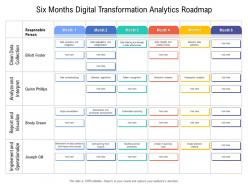
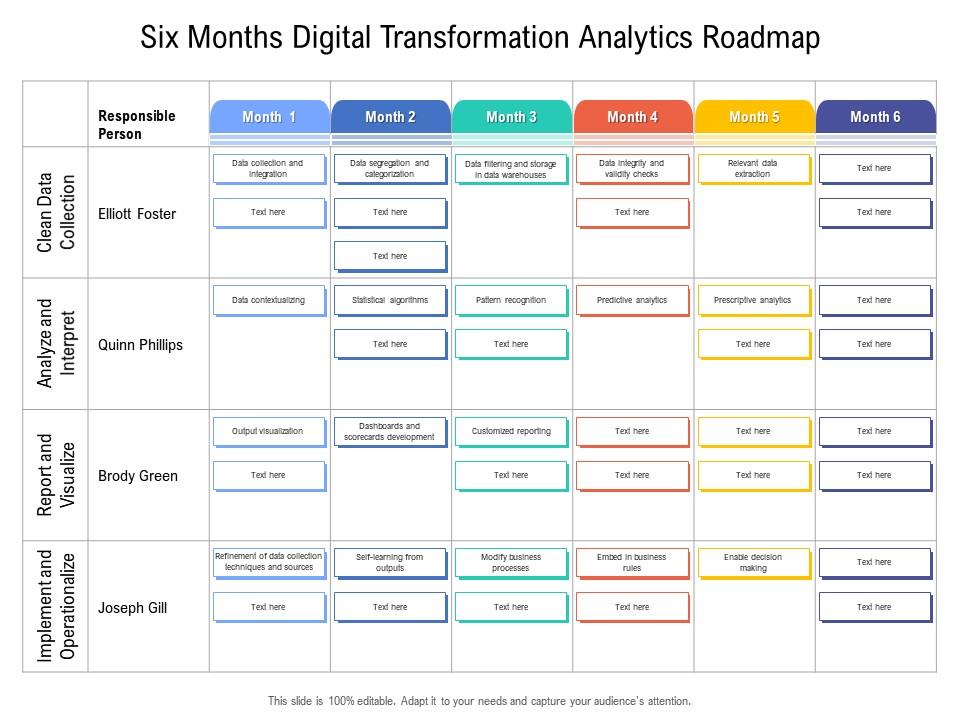
Six months digital transformation analytics roadmap
Try Before you Buy Download Free Sample Product
Audience
Editable
of Time
A well thought out action plan makes execution easier and increases the possibility of success significantly. Ensure hitting all the milestones within the deadlines by introducing our fully customizable Six Months Digital Transformation Analytics Roadmap. Streamline the work related information, budget, timeframe, key deliverable, landmarks, and major steps involved, all in one place to give an organized overview of the project by utilizing our PowerPoint theme. Minimize time lag and increase work efficiency by providing insight into the process with our comprehensively researched roadmap PowerPoint layout. Color coding helps in highlighting the process and grabs the attention of the audience. Download our handy Six Months Digital Transformation Analytics Roadmap to identify the possible problem areas in a much shorter time and propose solutions. Have a productive brainstorming session with your workforce by utilizing our action plan visualization tool.
People who downloaded this PowerPoint presentation also viewed the following :
Six months digital transformation analytics roadmap with all 2 slides:
Give your audience a fulfilling experience. They will find our Six Months Digital Transformation Analytics Roadmap elevating.
FAQs for Six months digital
Key components of a digital transformation analytics roadmap include data infrastructure assessment, analytics capability mapping, technology stack evaluation, governance frameworks, and performance metrics definition. These elements work together by establishing current state baselines, identifying capability gaps, and creating implementation timelines, with many organizations finding that structured roadmaps accelerate transformation while minimizing risks and costs.
Organizations can assess their current digital analytics capabilities through comprehensive data audits, technology stack evaluations, skill gap analyses, reporting effectiveness reviews, and ROI measurements across departments. These assessments reveal integration challenges, resource limitations, and optimization opportunities, with many companies finding that strategic capability mapping enables targeted investments, streamlined processes, and enhanced decision-making frameworks that drive competitive advantage.
Data quality serves as the foundation for digital transformation success, directly impacting decision accuracy, operational efficiency, and customer experience outcomes. Poor data quality can derail transformation initiatives through flawed insights and unreliable automation, while high-quality data enables organizations to streamline processes, enhance predictive capabilities, and deliver superior customer experiences, with many companies finding that investing in data governance frameworks early significantly accelerates their transformation timeline and competitive advantage.
Businesses can identify suitable analytics tools by assessing their data sources, defining specific objectives, evaluating integration capabilities, considering scalability requirements, and analyzing budget constraints. Through strategic evaluation processes, organizations in retail, healthcare, and manufacturing streamline vendor selection, enhance operational efficiency, and accelerate implementation timelines, ultimately delivering competitive advantage and measurable ROI.
Common challenges include data silos, legacy system integration, skills gaps, change management resistance, and unclear analytics objectives. Organizations often struggle with inconsistent data quality across departments, limited technical expertise, and cultural resistance to data-driven decision making, with many finding that successful implementation requires strong leadership commitment and comprehensive training programs.
Organizations integrate legacy systems with new analytics platforms through API development, data warehousing solutions, middleware implementation, and phased migration strategies. These approaches enable seamless data flow while maintaining operational continuity, with many financial institutions and healthcare organizations finding that strategic integration delivers enhanced reporting capabilities, reduced data silos, and improved decision-making speed.
Analytics project prioritization methodologies include value-based scoring, business impact assessment, resource requirement analysis, strategic alignment evaluation, and ROI modeling. These frameworks enable organizations to systematically evaluate initiatives across criteria like revenue potential, operational efficiency gains, and competitive advantage, with many enterprises finding that combining multiple methodologies delivers optimal resource allocation and accelerated transformation outcomes.
Stakeholder engagement is crucial for digital transformation analytics strategy success, ensuring alignment between business objectives, technical capabilities, and user requirements across departments. Through collaborative workshops and continuous feedback loops, organizations achieve higher adoption rates, more accurate data governance frameworks, and strategic buy-in, with many finding that early stakeholder involvement reduces implementation risks and accelerates measurable outcomes.
Techniques for measuring digital transformation analytics ROI include cost-benefit analysis, productivity metrics, customer satisfaction scores, revenue attribution models, and operational efficiency indicators. Through advanced tracking systems, organizations can quantify reduced processing times, enhanced decision-making speed, and improved customer experiences, with many financial services and retail companies finding 15-25% efficiency gains within the first year.
Businesses ensure analytics roadmap alignment by establishing clear KPIs tied to strategic objectives, involving stakeholders across departments in planning processes, and regularly reviewing metrics against business outcomes. Through collaborative governance frameworks, organizations streamline decision-making, enhance cross-functional integration, and ultimately deliver measurable ROI, with many enterprises finding that quarterly alignment reviews significantly improve strategic execution and competitive positioning.
Data governance best practices in digital transformation include establishing clear data ownership, implementing standardized quality frameworks, ensuring regulatory compliance, creating centralized access controls, and maintaining comprehensive documentation. These practices streamline operations by reducing data silos, enhancing decision-making accuracy, and accelerating transformation initiatives, with many organizations finding that robust governance ultimately delivers improved operational efficiency and competitive advantage.
User experience directly impacts analytics effectiveness by determining adoption rates, data interpretation accuracy, and decision-making speed across organizations. Intuitive dashboards with clear visualizations, responsive design, and customizable features enable faster insights, reduce training costs, and improve data-driven decision quality, with many financial services and retail companies finding that user-friendly analytics tools significantly enhance operational efficiency and competitive advantage.
Emerging trends in digital analytics include real-time data processing, predictive analytics, customer journey mapping, AI-powered insights, and privacy-first measurement approaches. These technologies streamline decision-making by enabling faster responses, predicting market shifts, and personalizing experiences, with many organizations finding that strategic analytics integration ultimately delivers competitive advantage and operational efficiency.
Machine learning and AI enhance digital transformation analytics by automating data processing, predicting future trends, and delivering real-time insights across complex datasets. These technologies enable organizations to identify patterns, optimize resource allocation, and accelerate decision-making processes, with many financial services and retail companies finding that AI-driven analytics ultimately streamlines operations while delivering competitive advantage.
Employee training and culture change are fundamental to analytics roadmap success, as they ensure workforce capability development, data-driven decision adoption, and organizational resistance mitigation. Through comprehensive upskilling programs and cultural transformation initiatives, companies across sectors like retail and healthcare enhance user adoption, improve data literacy, and accelerate insights implementation, ultimately delivering sustainable competitive advantage.
No Reviews