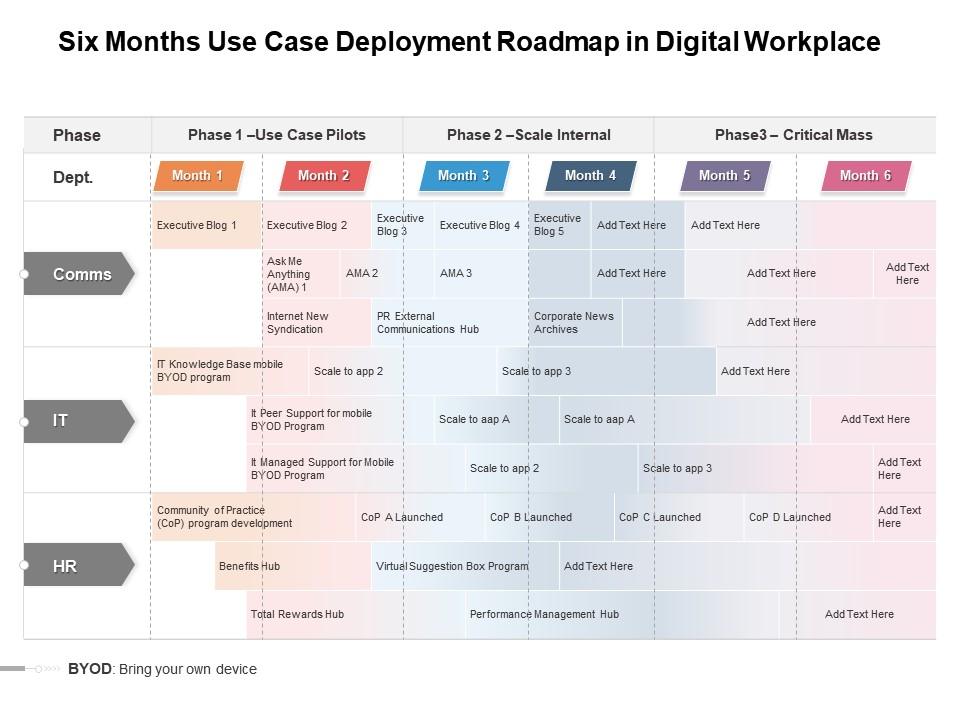
Six months use case deployment roadmap in digital workplace

Six months use case deployment roadmap in digital workplace
Slide 1 of 2
Favourites Favourites

Try Before you Buy Download Free Sample Product

Audience Impress Your
Audience
Editable 100%
Editable
Time Save Hours
of Time
The Biggest Sale is ending soon in
0
0
:
0
0
:
0
0
Presenting Six Months Use Case Deployment Roadmap In Digital Workplace PowerPoint slide. This PPT slide is available at 4,3 and 16,9 aspect ratios. You can download this PPT theme in various formats like PDF, PNG, and JPG. This PowerPoint template is completely editable and you can modify the font size, font type, and shapes as per your requirements. Our PPT layout is compatible with Google Slides.

FAQs for Six months use case deployment roadmap

Key components include stakeholder identification, technical requirements assessment, timeline milestones, resource allocation plans, and risk mitigation strategies. These elements streamline implementation by establishing clear accountability, defining infrastructure needs, and setting realistic expectations, with many organizations finding that comprehensive roadmaps ultimately deliver faster deployment cycles and higher success rates.

Organizations can prioritize use cases for deployment by evaluating business impact, technical feasibility, resource requirements, and strategic alignment with company objectives. Financial services and healthcare institutions often start with high-impact, low-complexity implementations like automated reporting or customer onboarding processes, ultimately building momentum and expertise before tackling more complex transformational initiatives.

Stakeholders provide critical input on business requirements, technical constraints, resource availability, and success metrics while ensuring alignment with organizational goals and user needs. Their diverse perspectives from IT, operations, finance, and end-users help prioritize deployment phases, identify potential risks, and validate that the roadmap delivers measurable value across departments, ultimately ensuring smoother implementation and adoption.

Success metrics for deployed use cases include operational efficiency indicators, user adoption rates, cost reduction measurements, performance benchmarks, and ROI calculations. These metrics enable organizations to track tangible outcomes like faster processing times, improved customer satisfaction scores, and reduced operational costs, with many companies finding that comprehensive measurement frameworks ultimately deliver competitive advantage and strategic insights for future deployments.

Feedback loops can be integrated through continuous monitoring systems, stakeholder review cycles, performance analytics, user testing phases, and automated data collection mechanisms. These approaches enable organizations to capture insights from banking, healthcare, and retail deployments, allowing teams to refine strategies, optimize outcomes, and accelerate future implementations while minimizing risks and enhancing operational efficiency.

Organizations face challenges including unclear success metrics, insufficient stakeholder alignment, inadequate data quality, resource constraints, and resistance to change management. While technical hurdles often dominate discussions, many companies find that cultural adoption and cross-functional coordination present greater obstacles, with successful deployments requiring strategic change management and executive sponsorship to ultimately deliver measurable business value.

A phased approach enhances use case deployment by enabling controlled testing, iterative refinement, and risk mitigation throughout implementation stages. This methodology allows organizations to validate functionality in smaller segments, gather stakeholder feedback, and make strategic adjustments before full-scale rollout, ultimately delivering reduced deployment risks and higher success rates across enterprise initiatives.

Tools supporting use case deployment roadmap creation include project management platforms like Microsoft Project and Asana, visualization software such as Lucidchart and Visio, and specialized roadmap tools like ProductPlan and Roadmunk. These technologies streamline planning by enabling timeline visualization, resource allocation tracking, and stakeholder collaboration, with many organizations finding that integrated platforms ultimately deliver better project coordination and faster implementation cycles.

Use case validation methods include proof-of-concept testing, pilot programs, stakeholder feedback sessions, technical feasibility assessments, and business impact modeling. These approaches enable organizations to identify potential issues, refine requirements, and measure expected outcomes before full deployment, with many companies finding that comprehensive validation reduces implementation risks while ensuring strategic alignment and maximizing return on investment.

Organizations should align their deployment roadmap with business goals by establishing clear success metrics, prioritizing use cases that deliver measurable ROI, and creating phased implementation timelines that match strategic objectives. Through regular stakeholder reviews and milestone assessments, companies can ensure deployment initiatives directly support revenue growth, operational efficiency, and competitive positioning, while maintaining flexibility to adapt roadmaps based on evolving business priorities and market conditions.

**INPUT**: What are the best practices for documenting use cases throughout the deployment process? **OUTPUT**: Best practices include maintaining version-controlled documentation, capturing stakeholder feedback at each phase, documenting technical requirements and dependencies, tracking performance metrics, and creating detailed implementation timelines. These approaches streamline project management by enhancing team collaboration, reducing deployment risks, and ensuring consistent knowledge transfer, with many organizations finding that structured documentation accelerates future implementations while delivering improved operational efficiency. [Word count: 60 words]

Training and support are addressed through structured knowledge transfer programs, hands-on workshops, documentation systems, ongoing mentorship, and dedicated support channels. These comprehensive approaches ensure seamless user adoption by providing role-specific training modules, real-time assistance, and continuous learning resources, with many organizations finding that strategic support frameworks significantly reduce deployment timelines while enhancing operational efficiency.

Agile methodologies influence use case deployment through iterative development cycles, continuous stakeholder feedback, adaptive planning, cross-functional collaboration, and rapid prototyping approaches. These frameworks enable organizations to refine requirements dynamically, respond quickly to changing business needs, and deliver incremental value, with many software teams and financial institutions finding that agile practices significantly reduce deployment risks while accelerating time-to-market.

Strategies include demonstrating clear ROI through pilot programs, involving key stakeholders in planning phases, providing comprehensive training and support, establishing transparent communication channels, and showcasing quick wins early in deployment. These approaches streamline adoption by addressing concerns proactively, building confidence through measurable results, and creating ownership among teams, with many organizations finding that early stakeholder engagement significantly accelerates implementation timelines and enhances long-term success.

Lessons learned from previous deployments inform future roadmaps by identifying implementation bottlenecks, resource allocation patterns, and stakeholder engagement strategies that enhance project success rates. Organizations leverage these insights to streamline deployment timelines, minimize technical risks, and optimize change management approaches, with many enterprises finding that documented lessons reduce future project costs by 20-30% while accelerating time-to-value.

Ratings and Reviews

0% of 100
Review Form
Write a review
Most Relevant Reviews

No Reviews