Six sigma process methodology chart with boxes and icons

Rating:
80%
Six sigma process methodology chart with boxes and icons
Slide 1 of 5
Favourites Favourites

Try Before you Buy Download Free Sample Product

Audience Impress Your
Audience
Editable 100%
Editable
Time Save Hours
of Time
The Biggest Sale is ending soon in
0
0
:
0
0
:
0
0
AI-Ready
Upload this template to AI and ask it to make any changes to content or color
100% editable Powerpoint Template for AI-assisted presentations. Finish your work in less time. Download Prompt Kit ​
Works with
Microsoft PowerPoint
Microsoft 365
Claude for PowerPoint
ChatGPT
Google Slides
Microsoft Copilot
Rating:
80%
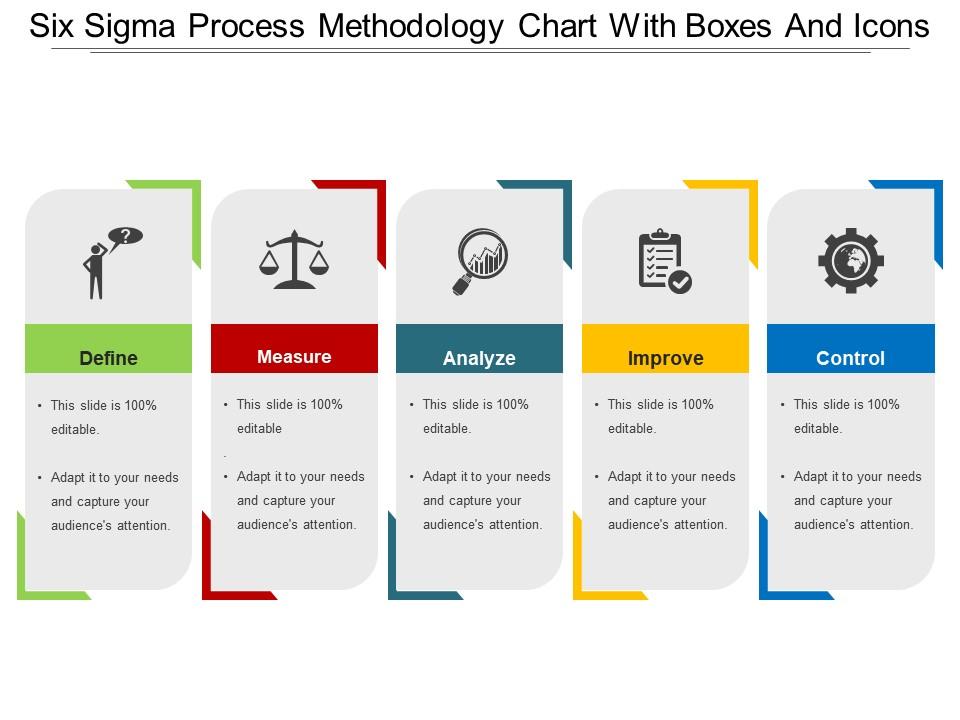
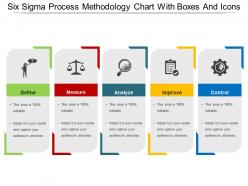
Presenting six sigma process methodology chart with boxes and icons. This is a six sigma process methodology chart with boxes and icons. This is a five stage process. The stages in this process are methodology chart, method hierarchy, flow chart.

People who downloaded this PowerPoint presentation also viewed the following :

FAQs for Six sigma process methodology chart with

Six Sigma's core principles include customer focus, data-driven decision making, process improvement through DMAIC methodology, defect reduction to near-zero levels, and employee engagement at all organizational levels. These principles guide improvement by systematically identifying variations, measuring performance gaps, and implementing targeted solutions, with manufacturing, healthcare, and financial services finding that this structured approach delivers enhanced quality, reduced costs, and improved operational efficiency.

Organizations effectively implement Six Sigma by establishing executive commitment, selecting qualified Black Belt leaders, focusing on data-driven problem solving, and creating cross-functional project teams. Through structured DMAIC methodology and comprehensive training programs, companies like General Electric and Motorola have streamlined operations, reduced defects by up to 99.99%, and delivered significant cost savings while enhancing customer satisfaction.

Six Sigma projects utilize statistical process control charts, fishbone diagrams, process mapping, failure mode analysis, and design of experiments. These methodologies streamline operations by identifying root causes, measuring process variations, and eliminating defects, with manufacturing companies, healthcare systems, and financial services finding significant cost reductions and improved customer satisfaction.

Six Sigma differs from other quality management methodologies through its rigorous statistical approach, data-driven decision making, and focus on achieving 99.99966% defect-free processes. While traditional quality methods emphasize continuous improvement, Six Sigma combines structured DMAIC methodology with advanced analytics, enabling organizations in manufacturing, healthcare, and financial services to achieve measurable cost reductions and operational excellence.

Data analysis serves as the foundation of Six Sigma initiatives, driving process improvements through statistical methods, root cause analysis, control charts, hypothesis testing, and variance reduction techniques. These analytical tools enable organizations to identify defects, measure process capabilities, and validate solutions with quantifiable results, ultimately delivering measurable quality improvements and cost savings across manufacturing, healthcare, and service industries.

Six Sigma methodologies enhance service delivery, financial processes, and customer experiences across healthcare, banking, retail, and technology sectors by reducing variability, eliminating waste, and optimizing workflows. Organizations leverage DMAIC frameworks to streamline patient care, accelerate loan processing, and improve call center operations, ultimately delivering measurable cost reductions and enhanced customer satisfaction.

Key performance indicators for Six Sigma projects include defect rates, cycle time reduction, cost savings, customer satisfaction scores, and process capability indices. These metrics enable organizations to track operational efficiency, quality improvements, and financial impact across manufacturing, healthcare, and service sectors, with many companies finding that comprehensive KPI monitoring ultimately delivers measurable ROI and competitive advantage.

Organizations face challenges including resistance to change, extensive training requirements, resource allocation demands, cultural transformation needs, and sustained leadership commitment when adopting Six Sigma practices. While these implementation hurdles can be significant, many companies in manufacturing, healthcare, and financial services find that structured change management, executive sponsorship, and phased rollouts ultimately deliver operational excellence and competitive advantage.

Fostering a Six Sigma culture requires leadership commitment, comprehensive training programs, clear communication of benefits, and integration into performance metrics and daily operations. Organizations achieve this by establishing champion networks, celebrating data-driven successes, rewarding continuous improvement behaviors, and consistently demonstrating how Six Sigma methodologies enhance operational efficiency, ultimately delivering sustainable competitive advantage across all business functions.

DMAIC provides a structured five-phase framework that guides Six Sigma projects through Define, Measure, Analyze, Improve, and Control stages, ensuring systematic problem-solving and sustainable results. This methodology enables organizations to reduce defects by up to 99.99966%, with manufacturing companies, healthcare systems, and financial services finding that DMAIC delivers measurable cost savings and operational efficiency improvements.

Six Sigma training and certification significantly enhance employee performance by developing analytical thinking, problem-solving capabilities, and process improvement skills that drive measurable results. Certified professionals demonstrate increased efficiency in identifying waste, reducing defects, and streamlining operations, with many organizations finding that these employees deliver faster project completion, improved quality outcomes, and ultimately contribute to substantial cost savings and competitive advantage.

Integrating Six Sigma with agile methodologies combines rigorous quality control with rapid iterative development, enhanced customer focus, reduced waste, and improved process efficiency. This strategic combination enables organizations to deliver higher-quality products faster while maintaining operational excellence, with many technology and manufacturing companies finding that hybrid approaches accelerate time-to-market while minimizing defects.

Customer feedback and voice of the customer directly shape Six Sigma projects by defining critical quality requirements, identifying process gaps, and establishing measurable performance standards that align with customer expectations. This customer-centric approach enables organizations to prioritize improvement initiatives strategically, focus resources on high-impact defects, and ultimately deliver enhanced satisfaction while reducing costs and operational inefficiencies.

Six Sigma and Lean principles form a strategic combination where Six Sigma focuses on reducing variation and defects through data-driven analysis, while Lean emphasizes eliminating waste and streamlining processes. Together, these methodologies enable organizations to enhance operational efficiency, accelerate production cycles, and deliver superior quality outcomes, with many manufacturing and service companies finding that this integrated approach significantly reduces costs while improving customer satisfaction.

Small businesses can leverage Six Sigma for competitive advantage by implementing simplified methodologies, focusing on high-impact processes, and training key personnel in basic problem-solving techniques. Through streamlined DMAIC approaches, small retailers, service providers, and manufacturers reduce waste, improve customer satisfaction, and enhance operational efficiency, ultimately delivering cost savings and quality improvements that compete with larger organizations.

Ratings and Reviews

80% of 100
Review Form
Write a review
Most Relevant Reviews
  1. 80%

    by Mason Thompson

    Unique design & color.
  2. 80%

    by Colton Fisher

    Unique design & color.

2 Item(s)

per page: