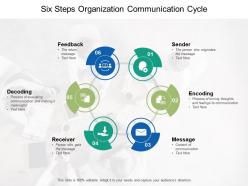
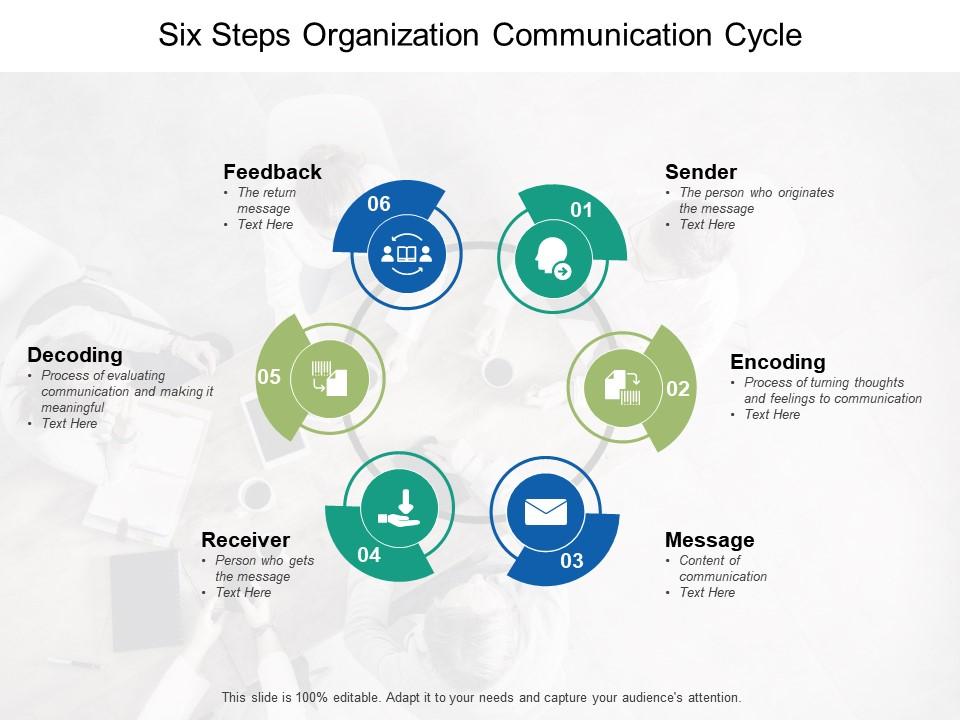
Six steps organization communication cycle
Try Before you Buy Download Free Sample Product
Audience
Editable
of Time
Drive innovation with our Six Steps Organization Communication Cycle. Create gadgets that are highly facilitating.
People who downloaded this PowerPoint presentation also viewed the following :
Six steps organization communication cycle with all 5 slides:
Create gadgets that are highly facilitating with our Six Steps Organization Communication Cycle. It helps drive innovation.
FAQs for Six steps
The communication cycle comprises sender, message, encoding, channel, receiver, decoding, feedback, and noise management. These components interact systematically through message transmission, interpretation, and response mechanisms, with organizations like hospitals, banks, and retail chains finding that effective cycle management streamlines operations, reduces miscommunication errors, and ultimately enhances customer experiences while improving internal efficiency.
Feedback significantly enhances communication effectiveness by enabling message clarification, reducing misunderstandings, and ensuring accurate information transfer between sender and receiver. Through real-time adjustments and confirmation mechanisms, organizations streamline decision-making processes, improve team collaboration, and accelerate project outcomes, with many businesses finding that structured feedback loops ultimately deliver improved operational efficiency and stronger stakeholder relationships.
Presentations enhance the communication cycle by providing structured feedback opportunities, enabling real-time audience engagement, and creating shared visual understanding through compelling narratives. Through interactive elements like Q&A sessions and polls, organizations streamline complex message delivery, minimize misunderstandings, and accelerate decision-making processes, with many teams finding that well-designed presentations ultimately deliver faster project approvals and stronger stakeholder alignment.
Nonverbal communication significantly influences the communication cycle by reinforcing, contradicting, or substituting for verbal messages through body language, facial expressions, tone of voice, and gestures. These nonverbal cues enhance message clarity, provide immediate feedback to senders, and help receivers interpret true intent, with many organizations finding that understanding nonverbal signals improves workplace collaboration and customer interactions.
Understanding the communication cycle improves conflict resolution by identifying breakdown points, ensuring complete message transmission, and facilitating active feedback loops between parties. Through structured listening, acknowledgment, and response phases, organizations streamline dispute resolution processes, reduce misunderstandings, and enhance workplace relationships, ultimately delivering faster conflict resolution and improved team collaboration across departments.
Clarity strategies include defining specific objectives, selecting appropriate channels, structuring messages logically, actively listening for understanding, and confirming receipt through feedback loops. These approaches enhance communication effectiveness by minimizing misinterpretation, reducing response times, and ensuring message alignment, with many organizations finding that systematic clarity protocols ultimately deliver improved collaboration, faster decision-making, and enhanced operational efficiency.
Cultural context significantly impacts the communication cycle by influencing encoding methods, message interpretation, feedback styles, and noise perception across different cultural frameworks. These cultural variations affect nonverbal cues, directness levels, and response expectations, with many multinational organizations finding that cultural awareness training enhances cross-cultural communication effectiveness, ultimately delivering improved collaboration and reduced misunderstandings.
Common barriers disrupting the communication cycle include noise interference, language differences, cultural misunderstandings, emotional states, information overload, and technological failures. Organizations overcome these challenges by implementing clear communication protocols, providing cultural sensitivity training, using multiple communication channels, and establishing feedback mechanisms, with many finding that structured approaches significantly enhance message clarity, reduce misinterpretation, and ultimately deliver improved collaboration and operational efficiency.
Technology enhances the communication cycle through AI-powered chatbots, video conferencing platforms, real-time collaboration tools, automated feedback systems, and mobile communication apps. These technologies streamline message delivery, enable instant feedback, and facilitate seamless multi-channel interactions, with many organizations finding that integrated communication systems significantly improve response times and customer engagement across all touchpoints.
Presenters can foster effective listening by using interactive polling, strategic pauses, eye contact, clear signposting, and audience engagement techniques like Q&A sessions. These approaches enhance comprehension by creating participatory environments, maintaining attention through varied delivery methods, and encouraging active participation, with many organizations finding that structured interaction and visual storytelling ultimately deliver better message retention and audience connection.
Acknowledging sender biases improves communication by increasing message clarity, reducing misinterpretation, and enhancing receiver understanding through more objective information delivery. When senders recognize their own perspectives and assumptions, they can adapt their messaging approaches, choose more neutral language, and provide balanced context, ultimately delivering more effective communication outcomes and stronger stakeholder relationships across diverse organizational environments.
In group settings, the communication cycle becomes more complex with multiple senders and receivers, varying feedback loops, increased noise and distractions, and diverse interpretation styles among participants. Teams often find that structured communication protocols, clear facilitation, and defined response mechanisms help streamline group dynamics, ultimately delivering more effective collaboration and reducing miscommunication across diverse organizational settings.
The communication cycle in remote environments requires enhanced digital encoding through video calls, instant messaging, and collaboration platforms, with feedback mechanisms becoming more deliberate and structured. Virtual teams increasingly rely on asynchronous communication tools like Slack or Microsoft Teams, with many organizations finding that clear documentation and regular check-ins significantly improve message clarity and reduce miscommunication barriers.
**INPUT**: What metrics can be used to assess the effectiveness of messages within the communication cycle? **OUTPUT**: Message effectiveness metrics include response rates, comprehension scores, engagement levels, feedback quality, and behavioral change indicators. These measurements enable organizations to streamline communication strategies by tracking audience understanding, measuring actionable outcomes, and identifying communication gaps, with many companies finding that systematic assessment ultimately delivers improved stakeholder engagement and operational efficiency. **Word count: 54 words**
Organizations can train employees to strengthen communication cycles through active listening workshops, feedback delivery training, conflict resolution sessions, and cross-cultural communication programs. These training initiatives enhance clarity, reduce misunderstandings, and improve collaboration across departments, with many companies finding that structured communication training ultimately delivers higher productivity, stronger team cohesion, and more effective project outcomes.
No Reviews