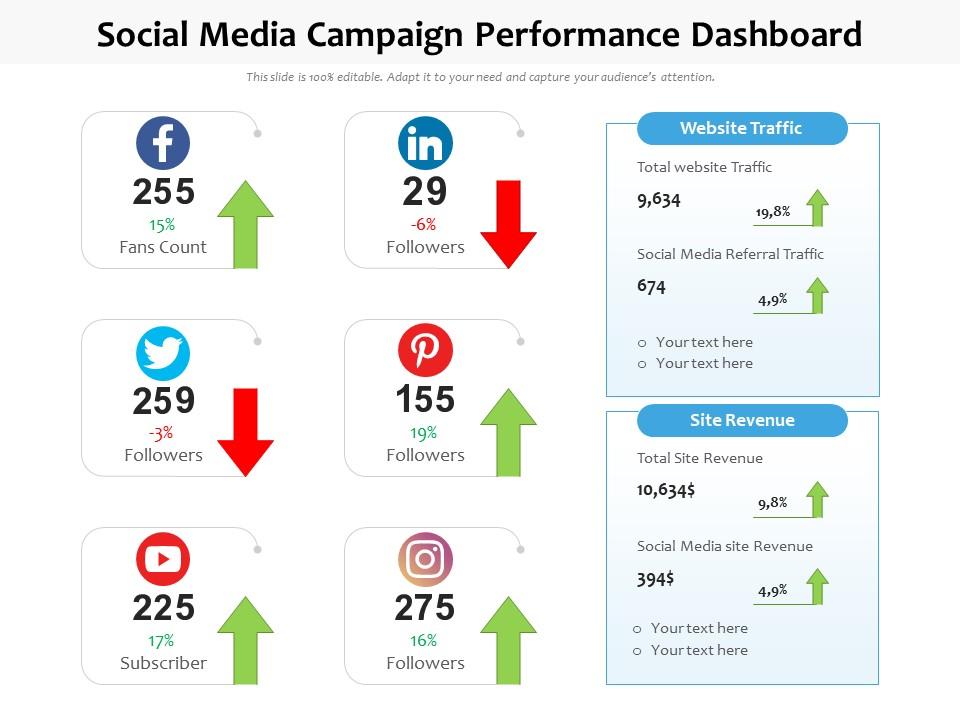
Social media campaign performance dashboard
Try Before you Buy Download Free Sample Product
Audience
Editable
of Time
Our Social Media Campaign Performance Dashboard are topically designed to provide an attractive backdrop to any subject. Use them to look like a presentation pro.
People who downloaded this PowerPoint presentation also viewed the following :
Social media campaign performance dashboard with all 2 slides:
Use our Social Media Campaign Performance Dashboard to effectively help you save your valuable time. They are readymade to fit into any presentation structure.
FAQs for Social media
Businesses should track engagement rates, reach and impressions, follower growth, click-through rates, conversion rates, and sentiment analysis across their social media platforms. These metrics enable organizations to optimize content strategies, measure ROI, and enhance customer relationships, with many companies finding that comprehensive analytics ultimately deliver improved brand awareness and increased sales performance.
Sentiment analysis enhances understanding by automatically categorizing audience emotions, identifying brand perception trends, tracking campaign effectiveness across platforms, and revealing content preferences through emotional responses. This technology enables marketers to gauge customer satisfaction, predict engagement patterns, and adjust messaging strategies in real-time, ultimately delivering more targeted content and improved customer relationships.
Engagement rate serves as a critical metric for measuring social media campaign effectiveness, indicating how actively audiences interact with content through likes, comments, shares, and clicks. This metric helps marketers assess content resonance, optimize posting strategies, and demonstrate ROI to stakeholders, with many brands finding that higher engagement rates correlate directly with increased brand awareness and conversion opportunities.
Social media analytics tools help identify target audience segments by analyzing demographic data, engagement patterns, content preferences, and behavioral insights across platforms. These tools enable businesses to discover audience characteristics like age groups, interests, and peak activity times, allowing marketers to create targeted campaigns, optimize content strategies, and ultimately deliver more personalized experiences that drive higher engagement and conversion rates.
Best practices for leveraging social media analytics include tracking engagement metrics, analyzing audience demographics, monitoring competitor performance, identifying optimal posting times, and measuring content reach across platforms. These insights streamline content strategy by revealing which formats resonate most, when audiences are most active, and what topics drive engagement, with many organizations finding that data-driven approaches ultimately enhance brand visibility and audience connection.
Post timing significantly influences engagement and reach by aligning content with audience activity patterns, platform algorithms, and time zone considerations. Through social media analytics, organizations can identify optimal posting windows that maximize visibility, with retail brands, financial services, and healthcare providers finding that strategic timing delivers higher engagement rates, broader reach, and ultimately stronger competitive advantage in increasingly crowded digital landscapes.
Tracking competitor performance through social media analytics enables businesses to identify market gaps, benchmark engagement strategies, and discover emerging trends before competitors capitalize on them. Through comprehensive competitive analysis, organizations can optimize their content timing, messaging approaches, and audience targeting strategies, while uncovering untapped market opportunities, ultimately delivering enhanced market positioning and strategic competitive advantage.
Brands can effectively use A/B testing by analyzing engagement rates, click-through rates, conversion metrics, and audience demographics to optimize content timing, messaging, and visual elements. Through systematic testing of post formats, captions, and targeting parameters, companies in retail, hospitality, and e-commerce streamline their social strategies, ultimately delivering higher ROI and stronger customer engagement across platforms.
Common social media analytics pitfalls include focusing solely on vanity metrics, ignoring audience context, cherry-picking data points, failing to align metrics with business objectives, and neglecting competitor benchmarking. These mistakes often lead businesses to misallocate resources and miss strategic opportunities, with many organizations finding that comprehensive analytics frameworks deliver more accurate insights, better ROI measurement, and ultimately stronger competitive positioning.
Social media listening tools complement traditional analytics by providing real-time sentiment analysis, brand perception insights, and customer conversation data that standard metrics miss. While traditional analytics track quantifiable engagement, listening tools capture qualitative feedback and emerging trends, with many companies finding that this strategic combination delivers deeper customer understanding and more responsive marketing strategies.
Influencer marketing significantly enhances social media analytics metrics by driving increased engagement rates, follower growth, reach expansion, and conversion tracking capabilities. Through strategic influencer partnerships, brands achieve measurable improvements in click-through rates, brand mention volume, and audience sentiment scores, while gaining access to detailed demographic insights, ultimately delivering enhanced ROI measurement and competitive market positioning.
Businesses measure social media advertising ROI by tracking conversion rates, cost-per-acquisition, and revenue attribution through platform analytics, UTM parameters, and customer journey mapping. Through tools like Facebook Ads Manager and Google Analytics, companies can monitor click-through rates, engagement metrics, and sales conversions, ultimately delivering measurable returns and optimized campaign performance.
Social media analytics requires careful attention to user privacy, informed consent, data minimization, and transparent disclosure of data collection practices. Organizations must balance valuable insights with responsible stewardship, ensuring compliance with regulations like GDPR while maintaining user trust, with many companies finding that ethical data practices ultimately enhance customer relationships and brand reputation.
Platform-specific algorithms significantly impact social media analytics accuracy by filtering content visibility, prioritizing engagement patterns, and creating sampling biases in data collection. These algorithmic variations mean that analytics tools often capture incomplete datasets, with many marketing teams finding that cross-platform comparison requires algorithmic adjustment factors to deliver meaningful insights and strategic decision-making capabilities.
Companies should prepare for AI-powered predictive analytics, real-time sentiment analysis, cross-platform integration tools, voice and video content analysis, and privacy-compliant data collection methods. These emerging technologies streamline audience insights, enhance customer targeting, and deliver competitive advantages, with many organizations finding that early adoption of these analytics trends significantly improves campaign effectiveness and customer engagement strategies.
-
Excellent template with unique design.
-
Easy to edit slides with easy to understand instructions.
-
Great quality product.
-
Innovative and attractive designs.
-
Easily Understandable slides.
-
Editable templates with innovative design and color combination.
-
Easily Editable.
-
Easy to edit slides with easy to understand instructions.
-
Design layout is very impressive.