


Social Media Post Management Proposal Powerpoint Presentation Slides
Instagram, youtube, Facebook, Twitter, Pinterest, and many more such networking sites have become a hub for all the commercial activities. Not only, they make the sales and purchase accessible, but it also eases the process of giving and receiving feedback. Therefore, it is important to ensure that you ace the digital marketing of your business. These Social Media Post Management Proposal PowerPoint Presentation Slides allow you to educate your clients about the online marketing services that your company provides. Create a positive impression on your clients by presenting a cover letter defining the key deliverables that your company promises with this social media campaign PPT template. Display the database of engaging content that you offer with this well-organized and attractive PPT slide. Assure your clients an increase in the traffic to their website that will lead to the generation of more customers and revenue by taking the aid of this media management PPT slideshow. Take advantage of this social media strategy PPT theme and map out a timeline for the successful completion of each task like project initiation, analysis, development, and execution. Illustrate the scope of media management services like research, content creation, network selection, and social media calendar by utilizing this internet marketing PPT proposal. Give a detailed account of all the additional services that you render like reporting, theme-based campaigns, influencer tie-ups, and copywriting by taking the assistance of this online marketing PPT deck. Use this media networking PPT design for demonstrating how your company expands the market presence to reach out everywhere with the products and services. Garner the attention of your customers by highlighting your company's background, achievements, and core values with the assistance of this e-commerce PowerPoint graphic. Make your proposal more convincing and trust-worthy by adding client testimonials, case studies, the statement of work, and contract in this completely customizable digital advertising PPT visual. Download our social media management proposal ppt to increase your credibility with an attractive presentation on the complex topic of marketing.

























-

- Google Slides is a new FREE Presentation software from Google.
- All our content is 100% compatible with Google Slides.
- Just download our designs, and upload them to Google Slides and they will work automatically.
- Amaze your audience with SlideTeam and Google Slides.
-

Want Changes to This PPT Slide? Check out our Presentation Design Services
-

- WideScreen Aspect ratio is becoming a very popular format. When you download this product, the downloaded ZIP will contain this product in both standard and widescreen format.
-

- Some older products that we have may only be in standard format, but they can easily be converted to widescreen.
- To do this, please open the SlideTeam product in Powerpoint, and go to
- Design ( On the top bar) -> Page Setup -> and select "On-screen Show (16:9)” in the drop down for "Slides Sized for".
- The slide or theme will change to widescreen, and all graphics will adjust automatically. You can similarly convert our content to any other desired screen aspect ratio.
Compatible With Google Slides

Get This In WideScreen
You must be logged in to download this presentation.


Do you want to remove this product from your favourites?
PowerPoint presentation slides
Presenting our Social Media Post Management Proposal PowerPoint Presentation Slides. This is a completely adaptable PPT slide that allows you to add images, charts, icons, tables, and animation effects according to your requirements. Create and edit your text in this 100% customizable slide. You can change the orientation of any element in your presentation according to your liking. The slide is available in both 4:3 and 16:9 aspect ratio. This PPT presentation is also compatible with Google slides.

People who downloaded this PowerPoint presentation also viewed the following :
Content of this Powerpoint Presentation
Slide 1: This slide introduces Social Media Post Management Proposal. State Client name, Submission date, User name and begin.
Slide 2: This slide displays Cover Letter.
Slide 3: This slide displays Table of Contents of the presentation.
Slide 4: This slide describes Project Context and Objectives.
Slide 5: This slide presents Project Context and Objectives for Social Media Post Services.
Slide 6: This slide displays Additional Service Offerings
Slide 7: This slide showcases Plan of Action for Social Media Post Services
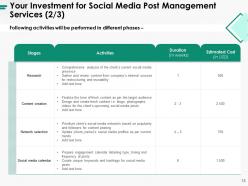
Slide 8: This slide describes Scope for Social Media Post Services.
Slide 9: This slide represents Timeframe for Social Media Post Services.
Slide 10: This slide showcases Additional Service Offerings.
Slide 11: This slide represents Deliverables for Social Media Post Services.
Slide 12: This slide represents Investment details.
Slide 13: This slide also presents Investment details.
Slide 14: This slide showcases Investment details.
Slide 15: This slide showcases Investment details for Social Media Post Services with- Additional Services, Price, (In USD)
Slide 16: This slide showcases Company Overview with- Why Us, About Us, Awards, Our Team.
Slide 17: This slide depicts reasons for choosing Us for Social Media Post Services.
Slide 18: This is About Us slide to showcase Company specifications.
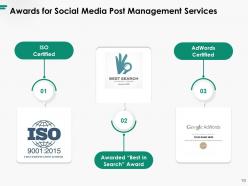
Slide 19: This slide presents Awards for Social Media Post Services.
Slide 20: This is Our Team slide with names and designations.
Slide 21: This is Our Team slide with names and designations.
Slide 22: This slide displays Client Testimonials for Social Media Post Proposal.
Slide 23: This slide showcases Client Testimonials.
Slide 24: This slide depicts Case Study for Social Media Post Services.
Slide 25: This slide represents Statement of Work and Contract.
Slide 26: This slide represents Statement of Work and Contract.
Slide 27: This slide shows the Next Steps with related information.
Slide 28: This slide depicts Next Steps for Social Media Post Services.
Slide 29: This is Contact Us slide with Email address, Contact number and address.
Slide 30: This is Social Media Post Planning Proposal Icons Slide.
Slide 31: This slide is titled as Additional Slides for moving forward.
Slide 32: This is About Us slide to showcase Company specifications.
Slide 33: This slide displays Vision, Mission and Goal.
Slide 34: This is 30 60 90 Days Plan slide.
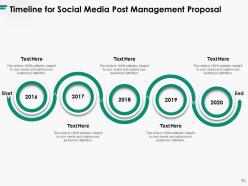
Slide 35: This slide depicts Timeline process.
Slide 36: This slide represents Roadmap For Process Flow of Social Media Post Planning Proposal.
Social Media Post Management Proposal Powerpoint Presentation Slides with all 36 slides:
Use our Social Media Post Management Proposal Powerpoint Presentation Slides to effectively help you save your valuable time. They are readymade to fit into any presentation structure.
-
Unique design & color.
