Sprint backlog with user story and review

Sprint backlog with user story and review
Slide 1 of 2
Favourites Favourites

Try Before you Buy Download Free Sample Product

Audience Impress Your
Audience
Editable 100%
Editable
Time Save Hours
of Time
The Biggest Sale is ending soon in
0
0
:
0
0
:
0
0
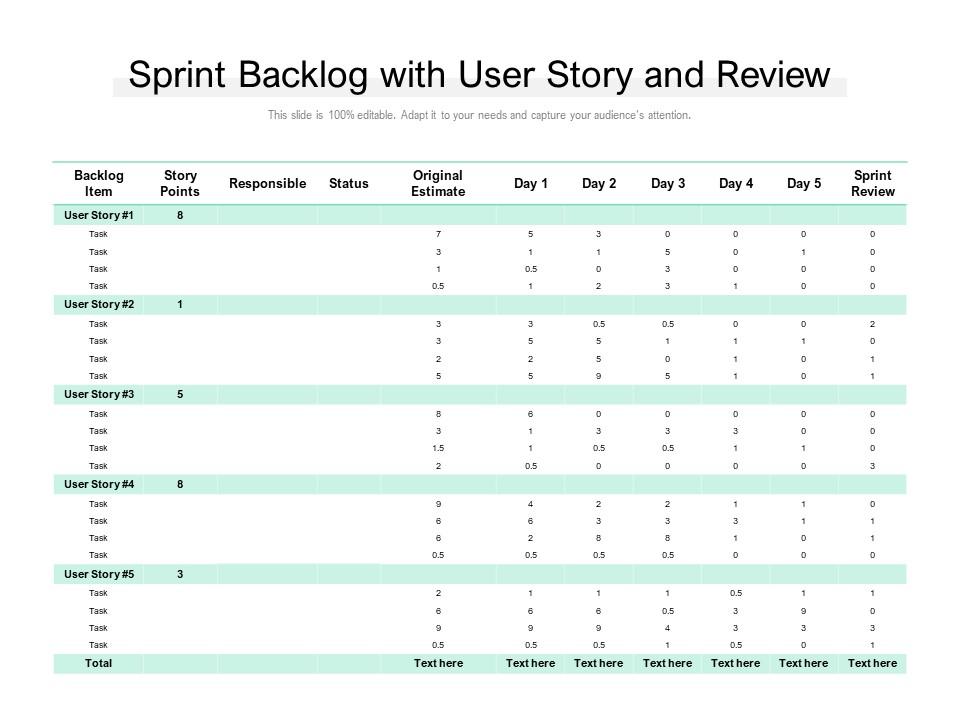
Presenting this set of slides with name Sprint Backlog With User Story And Review. The topics discussed in these slides are Backlog Item, Original Estimate, Sprint Review. This is a completely editable PowerPoint presentation and is available for immediate download. Download now and impress your audience.

FAQs for Sprint backlog with user

The sprint backlog serves as a detailed plan outlining specific tasks and user stories the development team commits to completing during a sprint, providing transparency into daily work and progress tracking. It enables teams to maintain focus, adapt to changes efficiently, and deliver incremental value, with many software development organizations finding that structured sprint backlogs enhance collaboration, accountability, and ultimately accelerate product delivery cycles.

The sprint backlog contains specific items selected from the product backlog for completion during a single sprint, while the product backlog encompasses all features and requirements for the entire project. Sprint backlogs focus on immediate deliverables with detailed tasks and time estimates, enabling teams to maintain focused execution and measurable progress, ultimately delivering incremental value.

A sprint backlog should include selected user stories from the product backlog, detailed task breakdowns for each story, acceptance criteria definitions, effort estimates, and task ownership assignments. These elements enable development teams to maintain clear project visibility, track daily progress effectively, and ensure deliverable quality, with many agile organizations finding that well-structured backlogs significantly enhance sprint productivity and stakeholder communication.

Teams effectively prioritize sprint backlog tasks by considering business value, technical dependencies, risk assessment, customer impact, and effort estimation. Through collaborative techniques like MoSCoW prioritization and story point analysis, development teams streamline workflow, minimize blockers, and maximize delivery outcomes, with many agile organizations finding that regular backlog refinement sessions ultimately enhance sprint velocity and stakeholder satisfaction.

Sprint backlog estimation strategies include story points, planning poker, t-shirt sizing, historical velocity analysis, and task decomposition into smaller units. These approaches streamline project planning by leveraging team consensus, past performance data, and relative complexity assessments, with many development teams finding that combining multiple estimation methods delivers more accurate sprint commitments and enhanced project predictability.

Sprint backlogs should be reviewed and updated daily during Daily Scrum meetings, with team members discussing progress, impediments, and any necessary adjustments to tasks or scope. This continuous monitoring enables agile teams to maintain project momentum, address blockers quickly, and ensure sprint goals remain achievable, while many development teams finding that frequent updates enhance collaboration and ultimately deliver more predictable outcomes.

The sprint backlog serves as the central reference point during daily stand-ups, enabling team members to report progress on specific tasks, identify blockers, and coordinate upcoming work. Through this structured approach, teams maintain transparency, quickly address impediments, and ensure sprint goals remain achievable, with many agile organizations finding that consistent backlog-focused discussions significantly enhance collaboration and delivery predictability.

A sprint backlog aids workload management by providing clear task visibility, enabling accurate capacity planning, and establishing realistic sprint commitments based on team velocity and availability. Through defined user stories and estimated effort points, teams can distribute work evenly, identify potential bottlenecks early, and adjust priorities dynamically, ultimately delivering consistent sprint outcomes while preventing team burnout.

Common sprint backlog pitfalls include overcommitting to unrealistic story points, frequently changing priorities mid-sprint, inadequate task breakdown, and poor communication between team members. While these challenges can derail project timelines, teams increasingly find that establishing clear scope boundaries, maintaining daily standups, and using collaborative tools ultimately delivers better sprint outcomes and enhances overall team productivity.

Teams ensure transparency and visibility by maintaining real-time digital boards, conducting regular sprint reviews, sharing daily progress updates, and providing stakeholder access to project management tools. Through platforms like Jira or Azure DevOps, organizations streamline communication, enhance accountability, and enable stakeholder engagement, with many finding that consistent visibility ultimately delivers improved project outcomes and stronger stakeholder confidence.

A sprint backlog enhances team collaboration by creating shared visibility into work priorities, fostering daily communication through stand-ups, and establishing clear accountability for deliverables. Through transparent task tracking and regular progress updates, development teams streamline coordination, minimize duplicate efforts, and maintain alignment on sprint goals, ultimately delivering faster project completion and improved cross-functional teamwork.

A well-maintained sprint backlog accelerates project delivery by providing clear task prioritization, realistic scope definition, and continuous progress tracking throughout development cycles. Through organized work breakdown and regular updates, teams minimize scope creep, identify bottlenecks early, and maintain consistent velocity, with many organizations finding that structured backlogs reduce delivery timelines by 20-30% while enhancing quality.

Effective sprint backlog management tools include Jira, Azure DevOps, Trello, Asana, and Monday.com, each offering task tracking, collaboration features, and sprint visualization capabilities. These platforms streamline workflow management by enabling real-time updates, automated reporting, and team coordination, with many development teams finding that integrated dashboards ultimately enhance productivity and delivery transparency.

A sprint backlog helps identify risks through daily visibility into task progress, dependencies, and potential blockers, while enabling proactive mitigation through regular stand-ups and sprint reviews. By breaking work into granular tasks, teams can quickly spot capacity issues, technical challenges, or scope creep, ultimately delivering more predictable outcomes and maintaining sprint commitments.

Sprint backlog metrics include velocity, burndown rates, story point completion, cycle time, and defect rates. These measurements enable teams to assess productivity, identify bottlenecks, and optimize workflow efficiency, with many organizations finding that consistent tracking delivers improved sprint planning, better resource allocation, and ultimately enhanced delivery predictability across development cycles.

Ratings and Reviews

0% of 100
Review Form
Write a review
Most Relevant Reviews

No Reviews