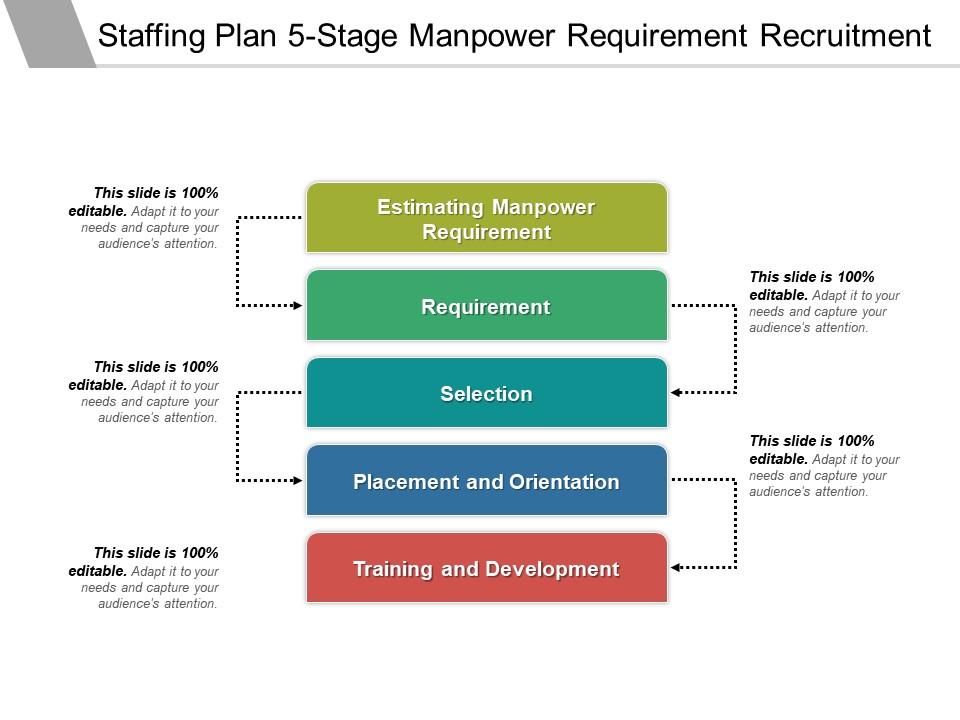
Staffing plan 5 stage manpower requirement recruitment
Try Before you Buy Download Free Sample Product
Audience
Editable
of Time
Our Staffing Plan 5 Stage Manpower Requirement Recruitment put your success first and foremost. Your achievements are their abiding concern.
People who downloaded this PowerPoint presentation also viewed the following :
Staffing plan 5 stage manpower requirement recruitment with all 5 slides:
Chalk out your future with our Staffing Plan 5 Stage Manpower Requirement Recruitment. Create a detailed chart to follow.
FAQs for Staffing plan 5 stage
**INPUT**: What are the key components of an effective staffing plan? **OUTPUT**: Effective staffing plans include workforce analysis, role definitions, recruitment strategies, budget allocation, and performance metrics. These components work together by identifying current gaps, streamlining hiring processes, and optimizing resource allocation, with many organizations finding that strategic workforce planning ultimately delivers enhanced operational efficiency and competitive advantage.
A staffing plan aligns with business goals by mapping workforce requirements to strategic priorities, ensuring optimal skill distribution across departments, and establishing clear performance metrics tied to organizational outcomes. Through strategic workforce planning, companies streamline resource allocation, enhance operational efficiency, and accelerate goal achievement, with many organizations finding that aligned staffing ultimately delivers competitive advantage and sustainable growth.
When forecasting staffing needs for growing organizations, consider revenue projections, market expansion plans, seasonal fluctuations, skill gap analysis, employee turnover rates, and regulatory requirements. These factors enable strategic workforce planning by aligning headcount with business objectives, optimizing resource allocation, and ensuring operational continuity, with many organizations finding that data-driven forecasting delivers competitive advantage and sustainable growth.
Organizations can assess staffing effectiveness by analyzing key metrics including turnover rates, time-to-fill positions, employee productivity scores, performance evaluations, and cost-per-hire ratios. Through comprehensive workforce analytics and regular performance reviews, companies streamline resource allocation, enhance operational efficiency, and identify skill gaps, with many finding that data-driven staffing assessments ultimately deliver improved employee retention and competitive advantage.
Employee skill mapping plays a crucial role in staffing plans by identifying current capabilities, revealing skill gaps, and aligning workforce competencies with strategic objectives and future project requirements. This systematic assessment enables organizations to make informed hiring decisions, develop targeted training programs, and optimize resource allocation, while many companies finding that comprehensive skill mapping reduces recruitment costs and accelerates project timelines significantly.
Technology streamlines staffing processes through AI-powered candidate screening, automated resume parsing, predictive analytics for workforce planning, and digital onboarding platforms. These solutions enhance recruitment efficiency by reducing time-to-hire, improving candidate matching accuracy, and enabling data-driven staffing decisions, with many organizations finding significantly lower costs and faster talent acquisition.
Key metrics include time-to-fill positions, employee retention rates, productivity per employee, cost-per-hire, and performance ratings against targets. These measurements enable organizations to assess recruitment efficiency, workforce stability, and operational effectiveness, with many companies finding that tracking these metrics simultaneously delivers improved resource allocation, reduced turnover costs, and enhanced competitive advantage.
Staffing plans should be reviewed quarterly and updated annually, with additional reviews triggered by significant business changes, budget cycles, or market shifts. Many organizations find that regular quarterly assessments enable proactive workforce adjustments, strategic resource allocation, and competitive advantage, while annual comprehensive updates ensure alignment with evolving business objectives and industry demands.
Employee retention strategies include competitive compensation packages, comprehensive benefits, flexible work arrangements, professional development opportunities, and recognition programs. These approaches enhance workplace satisfaction by addressing career growth, work-life balance, and employee engagement, with many organizations finding that strategic investment in retention ultimately reduces recruitment costs while building stronger, more experienced teams.
Diversity and inclusion can be integrated through targeted recruitment strategies, inclusive job descriptions, diverse interview panels, bias-free selection processes, and comprehensive onboarding programs. These approaches streamline talent acquisition by expanding candidate pools, enhancing team perspectives, and improving retention rates, with many organizations finding that diverse teams deliver better innovation and stronger financial performance.
Creating staffing plans for virtual workforces presents challenges including communication barriers, performance measurement difficulties, technology infrastructure gaps, cultural alignment issues, and time zone coordination complexities. These obstacles can be streamlined through strategic digital collaboration tools, structured remote onboarding processes, and flexible scheduling frameworks, with many organizations finding that proactive virtual management approaches ultimately deliver enhanced productivity and broader talent access.
Organizations address succession planning by identifying key roles, assessing internal talent pools, creating development pathways, and establishing mentorship programs to prepare high-potential employees. Through strategic talent mapping and cross-training initiatives, companies in sectors like healthcare and finance build leadership pipelines, ultimately reducing recruitment costs and ensuring business continuity during transitions.
Recruiting specialized talent involves targeted sourcing through industry networks, professional associations, specialized job boards, technical assessments, and competitive compensation packages aligned with market rates. Organizations increasingly partner with niche recruiting firms and leverage employee referrals, while offering flexible work arrangements and clear career progression paths, ultimately building talent pipelines that deliver sustained competitive advantage in specialized markets.
Temporary staffing solutions can be effectively incorporated by identifying seasonal demand patterns, skill gap areas, project-based needs, and trial-to-hire opportunities within your strategic workforce planning. These flexible arrangements enable organizations to maintain operational efficiency during peak periods, access specialized expertise for specific projects, and evaluate potential permanent hires, ultimately delivering cost-effective scalability while reducing long-term recruitment risks.
Employee engagement significantly impacts staffing plan effectiveness by reducing turnover rates, enhancing productivity levels, and improving recruitment success through positive workplace reputation. Engaged employees become brand ambassadors who attract quality candidates, while their higher retention rates reduce recruitment costs and maintain operational continuity, ultimately delivering stronger team performance and competitive advantage.
-
The Designed Graphic are very professional and classic.
-
Commendable slides with attractive designs. Extremely pleased with the fact that they are easy to modify. Great work!