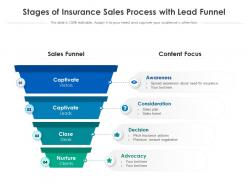
Stages of insurance sales process with lead funnel
Try Before you Buy Download Free Sample Product
Audience
Editable
of Time
Our Stages Of Insurance Sales Process With Lead Funnel are topically designed to provide an attractive backdrop to any subject. Use them to look like a presentation pro.
People who downloaded this PowerPoint presentation also viewed the following :
Stages of insurance sales process with lead funnel with all 2 slides:
Use our Stages Of Insurance Sales Process With Lead Funnel to effectively help you save your valuable time. They are readymade to fit into any presentation structure.
FAQs for Stages of insurance sales process
The essential steps in the insurance sales process include prospecting and lead generation, needs assessment and risk analysis, product presentation and customization, proposal development, objection handling, and policy finalization. These stages enable insurance professionals to build trust through consultative selling, match appropriate coverage to client requirements, and streamline conversion rates, ultimately delivering personalized protection solutions and sustainable revenue growth.
Understanding customer needs fundamentally transforms the insurance sales process by enabling personalized product recommendations, building stronger trust relationships, and reducing sales cycle times. When agents conduct thorough needs assessments, they can match clients with appropriate coverage levels and policy types, ultimately delivering higher customer satisfaction and improved retention rates while achieving more efficient sales conversions.
Personal branding establishes trust and credibility in insurance sales by showcasing expertise, client testimonials, and professional values across digital platforms and networking channels. Insurance agents with strong personal brands differentiate themselves in competitive markets, attract referrals more consistently, and build lasting client relationships, ultimately delivering higher conversion rates and sustainable business growth.
Technology enhances the insurance sales process by automating lead generation, streamlining quote comparisons, and enabling real-time policy customization through AI-powered platforms and digital tools. These innovations accelerate decision-making, reduce paperwork, and improve customer experiences, with many insurance agencies finding that automated underwriting and mobile applications ultimately deliver faster policy approvals and increased conversion rates.
Common insurance sales objections include concerns about cost, coverage necessity, policy complexity, trust in the provider, and timing of purchase decisions. These challenges can be overcome by demonstrating clear value propositions, providing transparent comparisons with competitors, simplifying policy explanations through visual aids, leveraging customer testimonials from similar demographics, and creating urgency through limited-time incentives, ultimately building trust and confidence that accelerates conversion rates.
Follow-up is critical in insurance sales, often determining conversion success, as it builds trust, addresses concerns, and maintains momentum through lengthy decision cycles. Best practices include scheduled touchpoints within 24-48 hours, personalized communication referencing specific client needs, value-added content like policy comparisons, and systematic tracking, with many agents finding that consistent follow-up increases closure rates significantly.
Vital communication skills include active listening, clear explanation of complex policies, empathy building, objection handling, and rapport establishment through authentic relationship building. These skills enable insurance professionals to understand client needs, simplify coverage options, and address concerns effectively, with many agents finding that strong communication ultimately delivers higher conversion rates and enhanced customer trust.
Agents build trust by demonstrating expertise through comprehensive needs assessments, providing transparent policy comparisons, maintaining consistent follow-up communication, and offering educational resources about coverage options. By actively listening to client concerns, explaining complex terms clearly, and prioritizing long-term relationships over quick sales, agents establish credibility that ultimately delivers higher conversion rates and stronger client retention.
Key insurance sales metrics include conversion rates, average policy value, customer acquisition cost, sales cycle length, and customer lifetime value. These metrics enable agencies to optimize lead qualification, streamline proposal processes, and enhance agent performance, with many insurance organizations finding that tracking these indicators delivers improved operational efficiency and sustained revenue growth.
The insurance sales process varies significantly across product types, with health insurance requiring extensive needs assessment and regulatory compliance, auto insurance focusing on quick quotes and coverage comparisons, and life insurance involving detailed financial planning and medical underwriting. These differences demand tailored approaches, with agents adapting their consultation length, documentation requirements, and follow-up strategies to match each product's complexity and customer expectations.
Insurance agents can create urgency through limited-time premium rates, highlighting immediate coverage gaps, emphasizing policy availability constraints, demonstrating competitor rate increases, and showcasing seasonal pricing advantages. These strategies work particularly well in health and auto insurance sectors, where agents find that combining time-sensitive offers with personalized risk assessments ultimately accelerates decision-making while building genuine client trust.
Insurance sales training programs enhance the overall sales process by developing consultative selling skills, improving product knowledge, teaching effective objection handling, and strengthening customer relationship management techniques. Through comprehensive training modules, insurance professionals can streamline lead qualification, accelerate policy conversions, and deliver more personalized customer experiences, ultimately reducing sales cycles while increasing retention rates and revenue growth.
Market research significantly impacts insurance strategies by identifying customer demographics, analyzing competitor pricing, assessing risk patterns, and revealing emerging coverage needs across different sectors. Through comprehensive market analysis, insurance companies can tailor their product offerings, optimize pricing models, and enhance customer acquisition strategies, with many insurers finding that data-driven approaches ultimately deliver higher conversion rates and improved customer retention.
Regulatory changes significantly reshape insurance sales processes by requiring updated compliance protocols, revised documentation procedures, and enhanced agent training programs. These modifications often streamline customer protections while introducing new verification steps, with many insurance companies finding that proactive regulatory adaptation ultimately delivers improved customer trust, reduced liability exposure, and stronger competitive positioning in increasingly regulated markets.
Storytelling humanizes insurance concepts by transforming complex policies into relatable scenarios, helping clients visualize coverage benefits through real-world examples and emotional connections. Insurance agents use compelling narratives to illustrate claim experiences, demonstrate policy value, and build trust, with many finding that story-driven presentations significantly enhance client engagement and accelerate decision-making processes.
-
Nice and innovative design.
-
Easy to edit slides with easy to understand instructions.
-
Content of slide is easy to understand and edit.
-
Perfect template with attractive color combination.
-
Unique and attractive product design.
-
Helpful product design for delivering presentation.