Stages of project management process improvement plan

Rating:
80%
Stages of project management process improvement plan
Slide 1 of 2

or

Favourites Favourites

Try Before you Buy Download Free Sample Product

Audience Impress Your
Audience
Editable 100%
Editable
Time Save Hours
of Time
The Biggest Sale is ending soon in
0
0
:
0
0
:
0
0
Rating:
80%
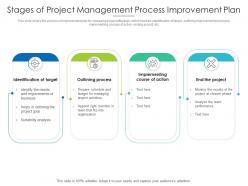
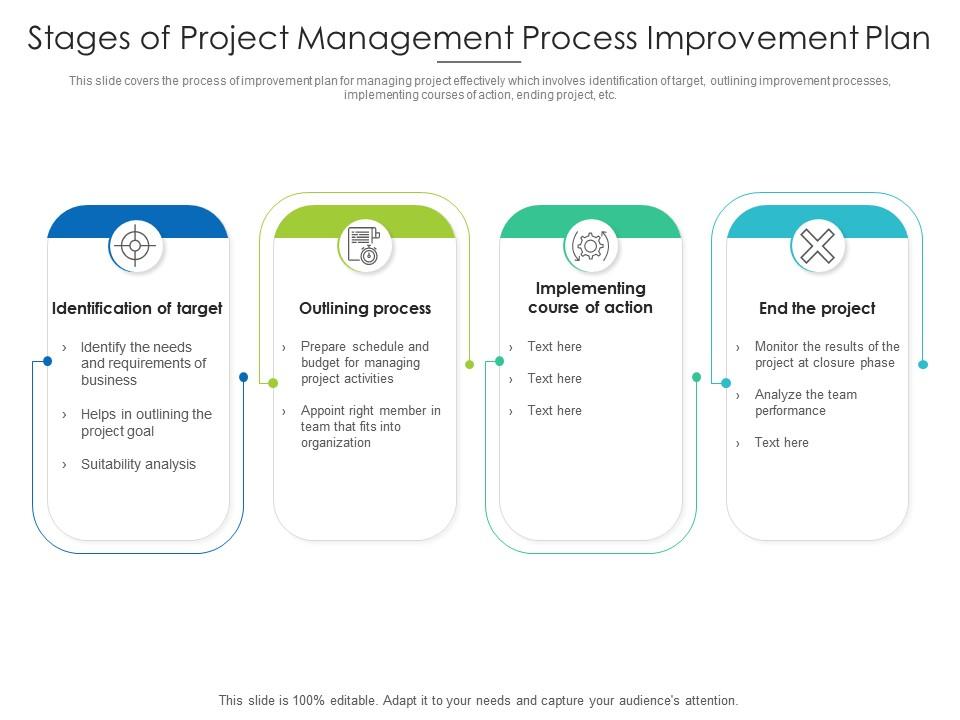
This slide covers the process of improvement plan for managing project effectively which involves identification of target, outlining improvement processes, implementing courses of action, ending project, etc. Presenting our set of slides with Stages Of Project Management Process Improvement Plan. This exhibits information on four stages of the process. This is an easy to edit and innovatively designed PowerPoint template. So download immediately and highlight information on Target, Outlining Process, Project, Implementing Course Of Action.
FAQs for Stages of project management

Honestly, the phases that matter most for process improvement are planning, execution, monitoring, and closing. Planning sets your baseline metrics and spots bottlenecks before they bite you. Execution shows what actually works vs what sounded brilliant in meetings. Monitoring's where you constantly check performance and make adjustments on the fly - this part's critical. Closing captures lessons learned, though here's the thing: don't wait until the end to document stuff. Keep notes as you go because you'll forget half the important details otherwise. Trust me on that one.

So agile is pretty great for process improvement because you're getting feedback constantly instead of waiting months to figure out what went wrong. Daily standups catch issues early. Weekly retrospectives let your team actually fix problems right away - way more effective than those massive post-project reports that sit in folders forever. Each sprint gives you real data to work with too. I'd honestly start with retrospectives focused on process stuff, not just deliverables. My old team used to skip these and we'd repeat the same mistakes over and over.

Your stakeholders are living in those broken processes every single day - they see stuff you'll never catch from up high. Talk to them first! They know exactly where things get stuck or frustrating. Honestly, some of their ideas will surprise you because they're dealing with the mess daily. Start with casual one-on-ones though, not formal meetings. People won't be real with you in a conference room. You need them comfortable enough to actually tell you what sucks. Then maybe do the official process mapping later once you've got the real story.

Honestly, you gotta look at both the numbers and how people feel about it. Track your cycle times and whether you're hitting deadlines - that stuff shows results fast. Defect rates matter too, obviously. Budget variance is probably the biggest one though. If your new process is bleeding money, something's wrong. Don't skip the team satisfaction surveys either. I've seen great processes tank because everyone hated using them - it's kinda predictable when you think about it. Customer feedback rounds things out nicely. Pick maybe 3-4 metrics that actually match what you're trying to fix first. You can always add more later once you've got baseline data.

Honestly, just set up a shared folder or simple database where you dump insights after each project wraps up. What worked, what bombed, process tweaks - all that stuff. But here's the thing everyone screws up: they build it then never look at it again. Add reviewing past lessons to your project kickoff checklist. Have someone dig through similar projects and figure out what applies to your current mess. Otherwise you'll keep making the same dumb mistakes. I've seen teams do this cycle like five times before they get it right.

Get a solid project management tool first - Asana or Monday.com work great for tracking metrics and baselines. Lucidchart's perfect for process mapping, though honestly Miro works just fine too if your team likes whiteboarding together. Don't sleep on basic stuff like Google Sheets for KPIs. Here's the thing though - I've watched so many teams go crazy with tools and end up using none of them properly. Pick maybe 2-3 max and stick with them. Oh, and start with whatever your team already knows how to use.

Look, risk management is basically your safety net when changing processes. I always start with a simple risk assessment - what could go wrong, how likely is it, what's the damage if it happens? Then you build backup plans. Can't tell you how many "easy" improvements I've watched blow up because someone skipped this step (learned that one the hard way). The tricky part is finding the sweet spot between being smart about risks and being so paranoid you never try anything new. Quick wins are great until they're not, you know?

Honestly, it's all about cutting out the stuff that wastes time and money. Map out what you're doing now - you'll spot so many redundancies and pointless steps. Catching problems early means way less rework later. Automate the boring repetitive tasks if you can. I swear, some teams burn through half their budget just trying to figure out who's doing what! Clean up your requirements from the start so you don't get hit with scope creep. Less confused people = less money down the drain. Oh, and ditch those unnecessary approval meetings - they're budget killers.

Oh man, scope creep will absolutely destroy you - seen it happen so many times. People get weirdly territorial about their workflows too, so expect pushback. Don't try fixing everything at once, that's a recipe for disaster. Your timelines are probably way too aggressive (mine always were). Training takes forever and costs more than you think. Honestly, executive buy-in is make-or-break here. Pick one small process first, nail some quick wins to get people excited, then expand from there. Communication breakdowns kill these projects faster than anything else.

Honestly, start with making people feel safe to speak up - nobody's gonna suggest fixes if they think they'll get roasted for it. Those retrospective meetings actually work if you follow through on what people say (otherwise it's just theater). I've seen cross-functional pairing catch stuff that teams miss when they're too close to their own work. Quick wins matter too - celebrate when someone streamlines something, even if it's small. Sounds corny but people need that validation. Just try asking "what slowed us down this week?" at your next meeting and go from there.

Honestly, it all comes down to how you handle the change. When you actually involve your team in figuring out what's broken and how to fix it, they're way more likely to stick with whatever you implement. I mean, nobody likes being told what to do without any explanation, right? The leaders I've worked with who explain the reasoning behind changes - like why we're switching systems or whatever - they always get better results. Sure, you could just demand compliance and people will probably go along with it initially. But the second you're not around, they'll slip back into old habits. My advice? Be upfront about what you're trying to achieve and actually listen when people give feedback.

Honestly, tech is a game-changer for cutting out all the boring admin work. Project management tools will track everything automatically and catch problems before they blow up. Plus AI can actually predict what might go wrong based on old project data - which sounds fancy but it's surprisingly useful. The trick is finding stuff that plays nice with however your team already works. Don't force everyone to learn a completely new system, that's just asking for pushback. I'd say pick one annoying process and fix that first, then expand from there once people see it actually helps.

First thing - get everyone on board with what you're actually trying to accomplish. Nobody wants to feel like they're being hunted down for mistakes. Watch how things really work, not just what's written in some manual somewhere. Talk to people at every level because the CEO's version is probably way different from what actually happens on the ground. Document stuff objectively without making anyone look bad. Oh, and definitely do regular check-ins during the process - surprises suck. Your final report better have realistic fixes people can actually implement. I've seen too many audits that just create fancy paperwork nobody ever touches again.

Oh man, cultural stuff can totally derail process improvements if you're not careful. Like, some team members won't speak up because of hierarchy respect, while others are pushing for changes yesterday. Germans might give super direct feedback that completely horrifies Japanese colleagues. Plus timing expectations are all over the place - some want long-term planning, others need quick wins now. I've watched projects just... stall out because nobody wanted to tackle these awkward cultural tensions. Set ground rules upfront, make sure everyone feels safe communicating their way, and honestly? Get someone to help translate between different work styles.

Honestly, there's a bunch of ways to get better at this stuff. Lean Six Sigma certs are solid - Green Belt or Black Belt depending how deep you wanna go. PMP's good too if you focus on the process side. ASQ has some decent specialized programs. For online stuff, Coursera and LinkedIn Learning are pretty reliable. Udemy can be hit or miss but has some gems. Oh, and definitely check out "The Lean Startup" and "Continuous Delivery" - both are actually readable unlike most business books. My take? Start with something free to figure out what you're into, then spend money on formal training once you know which approach fits your brain.

Ratings and Reviews

80% of 100
Review Form
Write a review
Most Relevant Reviews
  1. 80%

    by Jones Cook

    Good research work and creative work done on every template.
  2. 80%

    by Robert Young

    Easily Editable.
  3. 80%

    by Dwight Pena

    Qualitative and comprehensive slides.

3 Item(s)

per page: