Steps of root cause analysis for lean process ppt guide

Rating:
90%
Steps of root cause analysis for lean process ppt guide
Slide 1 of 7
Favourites Favourites

Try Before you Buy Download Free Sample Product

Audience Impress Your
Audience
Editable 100%
Editable
Time Save Hours
of Time
The Biggest Sale is ending soon in
0
0
:
0
0
:
0
0
Rating:
90%
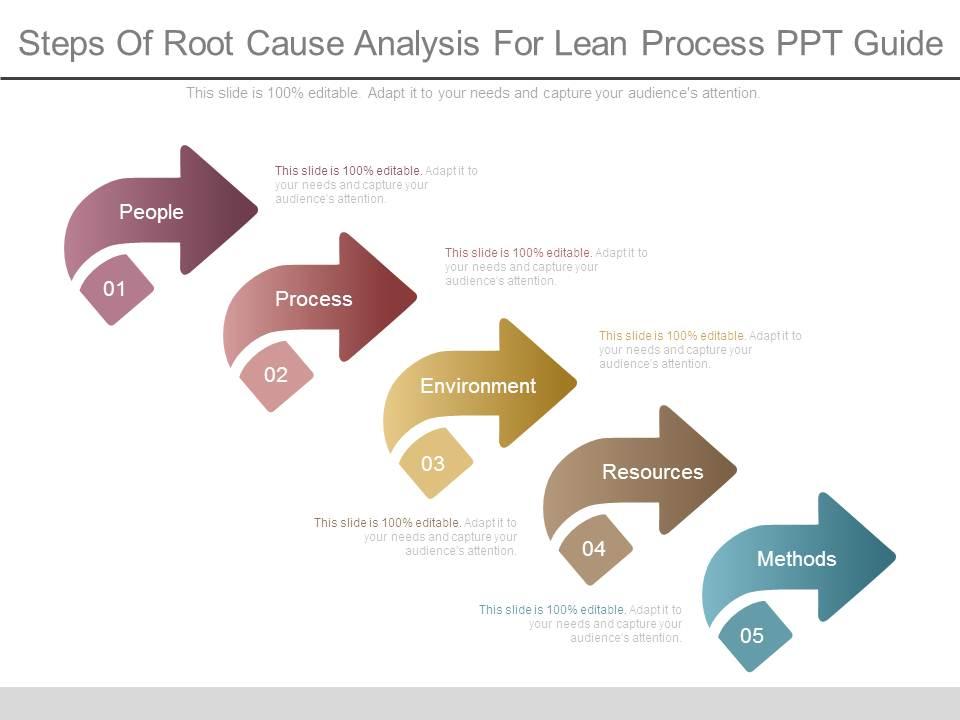
Presenting steps of root cause analysis for lean process ppt guide. Presenting steps of root cause analysis for lean process ppt guide. This is a steps of root cause analysis for lean process ppt guide. This is a five stage process. The stages in this process are people, process, environment, resources, methods.

FAQs for Steps of root cause analysis for lean

Root Cause Analysis involves defining the problem clearly, gathering comprehensive data, identifying potential causes through techniques like fishbone diagrams, analyzing cause relationships, and implementing corrective actions. These systematic steps enable organizations to address underlying issues rather than symptoms, with manufacturing companies, healthcare systems, and IT departments finding that thorough RCA reduces recurring problems and enhances operational efficiency.

Root causes represent fundamental issues that, if eliminated, would prevent problem recurrence, while contributing factors amplify or enable problems without being primary drivers. Effective differentiation involves asking "would removing this factor completely eliminate the problem" for root causes, versus "does this factor make the problem worse or more likely" for contributors, with many organizations finding that mapping these relationships systematically delivers clearer solutions and prevents future occurrences.

Effective manufacturing root cause analysis tools include fishbone diagrams, 5 Whys analysis, failure mode analysis, statistical process control, and Pareto charts. These methodologies streamline problem-solving by systematically examining equipment failures, quality defects, and process variations, with many manufacturing facilities finding that combining multiple techniques delivers faster resolution times and significantly reduced recurring issues.

RCA integrates into continuous improvement processes by establishing systematic feedback loops, embedding analysis protocols into quality management systems, and creating cross-functional review teams that examine recurring issues. Organizations streamline this integration through automated data collection, regular RCA training programs, and standardized documentation processes, with many manufacturing and healthcare institutions finding that consistent RCA application reduces repeat incidents while enhancing operational efficiency.

Data analysis enhances root cause identification by processing large datasets, identifying patterns and correlations, and providing statistical validation of hypotheses. Through advanced analytics and visualization tools, organizations can uncover hidden relationships, eliminate bias from subjective interpretations, and validate findings with quantitative evidence, ultimately delivering faster, more accurate problem resolution and sustainable solutions.

Root Cause Analysis adapts to service industries through systematic examination of process failures, communication breakdowns, resource constraints, and workflow inefficiencies that impact service delivery. Healthcare organizations use RCA to investigate patient safety incidents and treatment delays, while customer support teams analyze response time failures and resolution bottlenecks, ultimately enhancing service quality and operational efficiency.

Common pitfalls include stopping at symptoms rather than underlying causes, rushing the analysis process, relying on assumptions instead of data, and failing to involve cross-functional teams. Organizations often find that avoiding blame-focused approaches, ensuring adequate time allocation, and maintaining systematic documentation ultimately delivers more accurate insights and sustainable solutions.

Team dynamics and communication significantly impact RCA effectiveness by determining how openly issues are discussed, how diverse perspectives are shared, and whether blame-focused or solution-focused approaches prevail. Strong communication enables cross-functional teams to surface hidden problems, challenge assumptions constructively, and collaborate on comprehensive solutions, while poor dynamics can lead to defensive behaviors, missed insights, and incomplete analysis that fails to address underlying systemic issues.

Visual aids and presentation templates enhance RCA by standardizing analysis workflows, improving data visualization through fishbone diagrams and flowcharts, facilitating team collaboration, and ensuring consistent documentation across investigations. These tools streamline complex problem-solving processes by making root causes more identifiable and actionable, with many organizations finding that structured visual frameworks accelerate resolution timelines while improving stakeholder communication and decision-making effectiveness.

Organizations ensure effective RCA corrective action implementation through structured follow-up processes, clear accountability assignments, measurable performance indicators, and regular progress reviews with defined timelines. These systematic approaches enable continuous monitoring by establishing feedback loops, conducting periodic assessments, and maintaining documentation trails, with many companies finding that dedicated implementation teams and executive sponsorship ultimately deliver sustained improvements and prevent issue recurrence.

Root Cause Analysis has successfully resolved complex issues across industries, including Boeing's 737 MAX investigations, Toyota's accelerator recalls, and hospital infection control protocols. These comprehensive analyses streamline problem identification, enhance operational safety, and minimize recurring failures, with organizations finding that systematic RCA approaches ultimately deliver sustained improvements, regulatory compliance, and significant cost reductions while preventing future incidents.

Software tools for RCA significantly enhance efficiency compared to traditional methods by automating data collection, providing real-time analytics, and streamlining collaborative analysis across teams. These digital solutions enable organizations to reduce investigation time by 60-70%, improve pattern recognition through advanced algorithms, and maintain comprehensive audit trails, with many manufacturing and healthcare institutions finding that automated RCA delivers faster resolution and more actionable insights.

Ethical considerations in RCA include maintaining objectivity, protecting confidentiality, ensuring transparency with stakeholders, avoiding blame attribution, and prioritizing safety over organizational reputation. In high-stakes industries like healthcare, aviation, and nuclear energy, these principles become critical for patient safety, regulatory compliance, and public trust, with many organizations finding that ethical RCA practices ultimately enhance credibility and prevent future incidents.

Root Cause Analysis transforms into a proactive risk management tool by analyzing historical patterns, identifying systemic vulnerabilities, and implementing preventive controls before issues escalate. Organizations leverage predictive RCA methodologies to assess process weak points, supplier dependencies, and operational bottlenecks, ultimately enabling strategic risk mitigation, enhanced operational resilience, and competitive advantage through prevention-focused business strategies.

Training employees in RCA methodologies enhances organizational resilience by developing systematic problem-solving capabilities, fostering proactive thinking, creating shared analytical frameworks, and building institutional knowledge for future challenges. These skills enable teams to identify vulnerabilities before they escalate, adapt quickly to operational disruptions, and implement sustainable solutions, with many organizations finding that widespread RCA competency significantly reduces recurring issues while strengthening their competitive advantage.

Ratings and Reviews

90% of 100
Review Form
Write a review
Most Relevant Reviews
  1. 80%

    by Cody Bell

    The Designed Graphic are very professional and classic.
  2. 100%

    by Harry Williams

    Topic best represented with attractive design.

2 Item(s)

per page: