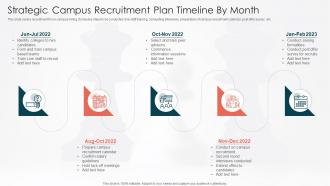
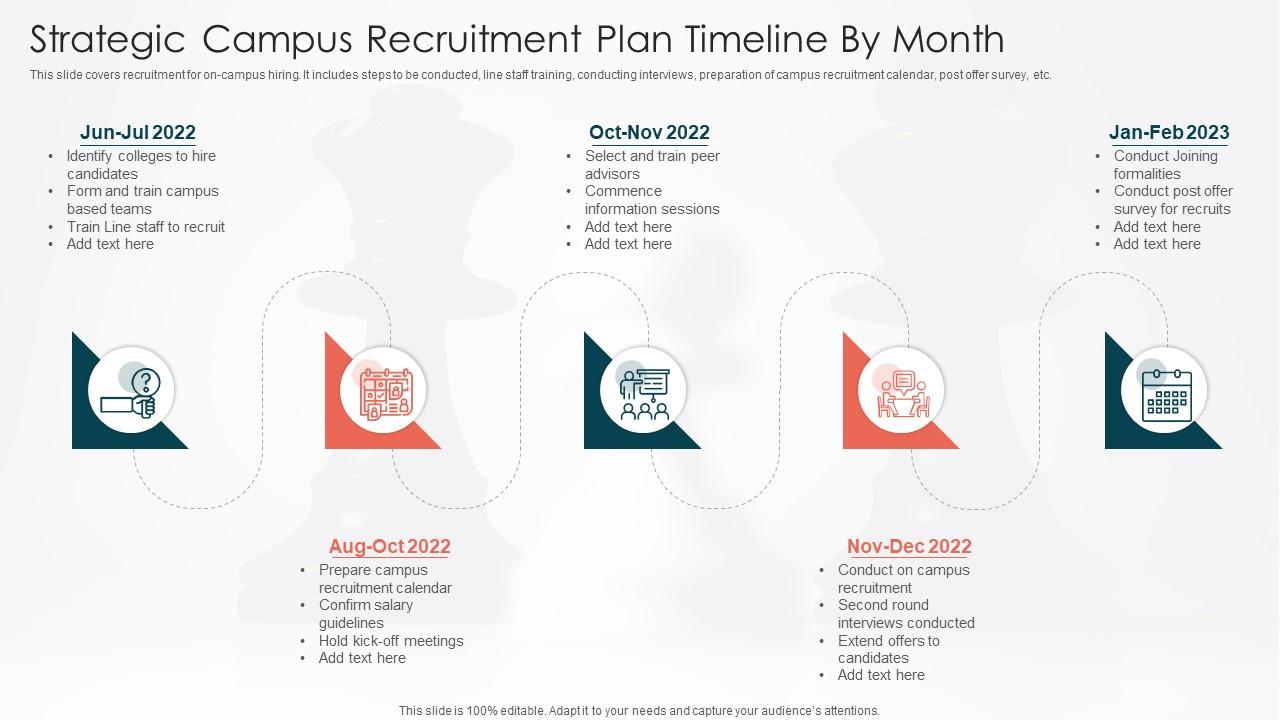
Strategic Campus Recruitment Plan Timeline By Month
Try Before you Buy Download Free Sample Product
Audience
Editable
of Time
This slide covers recruitment for on-campus hiring. It includes steps to be conducted, line staff training, conducting interviews, preparation of campus recruitment calendar, post offer survey, etc.
People who downloaded this PowerPoint presentation also viewed the following :
Strategic Campus Recruitment Plan Timeline By Month with all 6 slides:
Use our Strategic Campus Recruitment Plan Timeline By Month to effectively help you save your valuable time. They are readymade to fit into any presentation structure.
FAQs for Strategic Campus Recruitment Plan
So basically you want a steady stream of good entry-level hires while making your company look awesome to students. Campus recruiting is way cheaper and faster than regular hiring - plus you can actually plan ahead since graduation dates don't change, unlike the chaos of regular recruiting. The "strategic" part just means picking maybe 3-5 schools that actually make sense for what you need instead of randomly showing up places. Focus on ones where graduates match your roles and vibe. Honestly, once you get the rhythm down it's so much easier than scrambling to fill entry-level spots later.
Start by checking which schools actually graduate people in the majors you need. Career fair numbers matter too. Honestly, your best bet is looking at where your current rock stars went to school - that tells you everything. Don't just chase Harvard and Stanford like everyone else does. There's probably some random state school with an amazing program you've never heard of. Get tight with the career services folks early since they control access to students. Oh, and make yourself a simple scorecard thing - program quality, diversity stats, location, how your past hires worked out. Makes the whole decision way less of a guessing game.
Skip the boring corporate pitch - nobody cares about that stuff anyway. Have real conversations about what they actually want in their first job, career goals, industry drama, whatever. Interactive workshops crush those lecture-style presentations every time. Coffee chats work great too since students can ask the messy questions they're actually thinking. Your recruiters need to be honest about the good AND bad parts of working there. Oh, and follow up fast with anyone who seems interested - you'll get lost in their inbox otherwise. Case competitions are solid if you want something more structured.
Okay so definitely do structured interviews first - ask about specific situations they've handled. Technical tests are key too, obviously. Group discussions are actually pretty brilliant because you see their real personality come out, plus how they work with others. Students tend to be way more genuine on campus anyway, which is nice. Get some recent hires involved in the process since they just went through this themselves. Oh and create a scoring system beforehand or your team will rate people totally differently. Case studies work well too if that fits your role. The multi-pronged thing really helps you get the full picture.
Dude, employer branding is huge for campus recruiting. Students already know your company's vibe before they even think about applying - that's powerful stuff. Strong branding means top talent seeks YOU out instead of the other way around. Career fairs are basically popularity contests where everyone's fighting for the same people, so you need something that makes you memorable. Here's the thing though - students are constantly gossiping about which companies are actually cool to work for. Social media is where they live, so post real employee stories there. Skip the corporate fluff. Authenticity wins every time.
Honestly, tech can save you so much time with campus recruiting. Start with an ATS to track candidates better - way less manual work. Video interviews are huge too since you won't be flying everywhere constantly. AI screening helps sort through the resume pile faster (though sometimes it misses weird edge cases). Students live on their phones anyway, so hit them up through social media and those campus recruitment apps. The analytics part is actually pretty cool - you'll see which schools give you the best hires. I'd pick whatever's driving you crazy right now and automate that first. Don't try to fix everything at once.
Definitely track both quantity and quality stuff. Start with the basics - hires per campus, cost per hire, time-to-fill. Quality metrics are way more telling though. New hire performance ratings, retention at 6-12 months, promotion speed. Those tell the real story. Pipeline health matters too - offer acceptance rates and how candidates feel about your events. Oh, and don't go overboard initially. Pick maybe 3-4 key ones first or you'll drown in data. You can always add more later once you've got a rhythm going.
Don't just show up when you're hiring - that's where most companies mess up. Build real relationships with career services and professors throughout the year. Guest lectures work great, or sponsor some student projects. Honestly, the best companies I've seen are visible when students aren't even thinking about jobs yet. Host random info sessions, hit up career fairs consistently. Stay tight with university staff because they'll steer the good candidates your way. It's all about being there before recruiting season hits and everyone's scrambling for attention.
Hit up career fairs obviously, but social media works way better than people think. LinkedIn and Instagram are gold - wherever your students actually hang out. Partner with relevant clubs and departments too. Professors usually know who the real standouts are. Honestly, the best results I've seen come from having current interns share their actual experiences, not some polished corporate BS about "learning opportunities." Students can smell that fake stuff from miles away. Video testimonials work great too. Just be real about what you're offering. Oh, and start building those career services relationships early - like beginning of the year early.
So first thing - partner with diverse student orgs, HBCUs, women in STEM groups, those kinds of places. Your job postings matter too - I've seen companies totally bomb this by using super aggressive language that just scares people away. Train your recruiters on bias (trust me, everyone has it). Try to get diverse interview panels if you can swing it. Oh, and actually track your numbers! Set specific goals for each campus and watch your progress. You can't fix what you're not measuring, right? The metrics part is honestly where most companies get lazy.
Okay so compliance is huge - can't discriminate based on race, gender, age, disability, all that stuff. Your job posts and interview questions need to be bulletproof legally speaking. Background check laws vary by state which is honestly such a pain to keep track of. EEOC guidelines are confusing but definitely worth reading through. Document everything about your hiring decisions too. You never know when someone might challenge a decision later. Oh and definitely run your whole campus recruiting plan by HR or legal before you start. Trust me on that one.
Definitely dig into feedback from past cycles - see what bombed vs what actually worked. Check conversion rates by school and which events brought in solid candidates. Students will be brutally honest if you just ask them! Track where people dropped out of your process too. Timing screwups and communication gaps are usually the biggest issues, plus interview process complaints. Oh, and scope out what competitors did differently - that's always eye-opening. Just survey everyone who went through it, track your numbers, then tweak your campus visits and messaging for next time. Simple feedback loop but it works.
Honestly, skip the boring career fairs and meet students where they actually hang out. TikTok campaigns work surprisingly well - I know it sounds weird but I've seen it generate real buzz. Try hosting hackathons or VR campus tours that let them solve actual problems your company deals with. Partner with student orgs for events that don't feel like sales pitches. Micro-internships are huge right now too. Students want to experience your culture firsthand, not just hear about it. The whole point is making it interactive and authentic - nobody has time for marketing fluff anymore.
Dude, you NEED to work with career services - I can't stress this enough. They know which students are actually looking for jobs and have all the connections with professors. Getting good career fair spots? That's through them. I've watched companies try to skip this step and it's honestly painful to see how badly it goes. Build real relationships with these people early on. Don't treat them like they're just in your way - they'll handle tons of logistics you don't want to deal with anyway. Trust me on this one.
Dude, recruiting's brutal right now. You're fighting everyone for the same good candidates, and kids have zero realistic idea what entry-level pays. Career fairs are basically just resume dumps at this point - pretty useless honestly. Start schmoozing professors way before recruiting season hits. Build actual internship programs that feed into full-time roles. Don't sugarcoat the salary stuff - be upfront about what you can offer. Oh, and train your recruiting team to have real conversations instead of just grabbing resumes and bouncing. Quality beats quantity every time.
-
Great product with effective design. Helped a lot in our corporate presentations. Easy to edit and stunning visuals.
-
A big thanks to SlideTeam! An incredible and diverse library of templates helped me with my business project presentation.