Strategic Human Resources Action Plan

Rating:
90%
Strategic Human Resources Action Plan
Slide 1 of 6
Favourites Favourites

Try Before you Buy Download Free Sample Product

Audience Impress Your
Audience
Editable 100%
Editable
Time Save Hours
of Time
The Biggest Sale is ending soon in
0
0
:
0
0
:
0
0
Rating:
90%
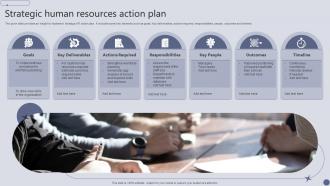
The given slide provides an insight to implement strategic HR action plan. It includes some key elements such as goals, key deliverables, actions required, responsibilities, people, outcomes and timeline. Introducing our premium set of slides with Strategic Human Resources Action Plan. Elucidate the seven stages and present information using this PPT slide. This is a completely adaptable PowerPoint template design that can be used to interpret topics like Goals, Key Deliverables, Actions Required, Responsibilities, Key People. So download instantly and tailor it with your information.

FAQs for Strategic Human

Key components of an effective human resources strategy include talent acquisition and retention, performance management systems, employee development programs, compensation and benefits structures, and workforce planning initiatives. These elements work together by aligning human capital with business objectives, fostering employee engagement, and building organizational capabilities, with many companies finding that strategic HR integration ultimately delivers competitive advantage and sustained growth.

Organizations align HR strategy with business goals by establishing clear workforce planning, developing talent acquisition frameworks that support growth objectives, implementing performance management systems tied to business outcomes, and creating compensation structures that drive desired behaviors. Through strategic workforce analytics, companies enhance operational efficiency, reduce turnover costs, and accelerate goal achievement, with many finding that integrated HR approaches ultimately deliver competitive advantage and sustainable growth.

Employer branding serves as a foundational element in HR strategy development, influencing talent acquisition, employee retention, cultural alignment, and competitive positioning in the job market. Through strategic branding initiatives, organizations enhance their reputation as employers of choice, streamline recruitment processes, and reduce turnover costs, while ultimately attracting higher-quality candidates who align with company values and long-term objectives.

Data analytics enhances HR decision-making by providing insights into employee performance, predicting turnover risks, and identifying skill gaps through comprehensive workforce data analysis. Through predictive modeling and performance metrics, organizations streamline recruitment processes, optimize compensation strategies, and improve retention rates, with many companies finding significantly better talent management and reduced hiring costs.

Best practices for talent acquisition in competitive markets include employer branding enhancement, strategic sourcing diversification, candidate experience optimization, competitive compensation benchmarking, and referral program implementation. These approaches streamline recruitment by building attractive company reputation, accessing broader talent pools, and accelerating hiring processes, with many organizations finding that combining multiple channels and maintaining authentic candidate relationships ultimately delivers faster placements and higher retention rates.

Companies foster diversity and inclusion through strategic recruitment targeting underrepresented groups, implementing bias-free hiring processes, establishing mentorship programs, and creating employee resource groups. These approaches enhance workplace culture by promoting equitable advancement opportunities, facilitating cross-cultural collaboration, and developing inclusive leadership training, with many organizations finding that diverse teams drive innovation and deliver stronger financial performance.

Technologies transforming HR practices include artificial intelligence for recruitment screening, predictive analytics for employee retention, cloud-based HRIS platforms, chatbots for employee support, and blockchain for credential verification. These innovations streamline talent acquisition, enhance decision-making through data insights, and automate routine processes, with organizations finding that strategic adoption delivers improved efficiency, reduced administrative costs, and ultimately better employee experiences across all business scales.

Performance management systems can be optimized through continuous feedback mechanisms, goal alignment with organizational objectives, personalized development plans, recognition programs, and data-driven insights. These approaches enhance engagement by providing regular coaching conversations, transparent career pathways, and meaningful recognition, with many organizations finding that employees demonstrate increased productivity, retention, and job satisfaction when performance discussions focus on growth rather than evaluation.

Organizations can implement flexible work arrangements, competitive compensation packages, comprehensive professional development programs, robust recognition systems, and strong mentorship opportunities to improve employee retention. These strategies enhance employee satisfaction by addressing work-life balance, career growth, and workplace culture, with many companies finding that strategic combinations of these approaches significantly reduce turnover while strengthening organizational loyalty and competitive advantage.

HR strategies can evolve by embracing flexible work arrangements, implementing data-driven talent analytics, prioritizing employee well-being programs, and developing comprehensive digital transformation initiatives. Through adaptive policies and technology integration, organizations streamline recruitment processes, enhance employee experiences, and build resilient workplace cultures, with many companies finding that agile HR approaches deliver improved retention rates and competitive advantage in today's dynamic labor market.

Employee training and development serves as a cornerstone of effective HR strategy, enhancing workforce capabilities, improving retention rates, boosting productivity, and ensuring organizational competitiveness. Through strategic learning initiatives, companies across industries like healthcare, technology, and manufacturing streamline skill gaps while delivering improved employee satisfaction and performance outcomes, ultimately creating sustainable competitive advantage in increasingly dynamic markets.

Organizations can effectively manage remote teams by implementing structured communication protocols, performance-based evaluation systems, digital collaboration platforms, flexible work policies, and regular virtual check-ins. Through cloud-based HR management systems, companies streamline onboarding, track productivity metrics, and maintain employee engagement, while establishing clear expectations and deliverables ultimately enhances accountability and team cohesion.

HR strategy success metrics include employee engagement scores, retention rates, time-to-hire, performance ratings, and training ROI. These measurements enable organizations to assess workforce effectiveness, optimize talent acquisition processes, and enhance productivity outcomes, with many companies finding that strategic HR analytics ultimately deliver competitive advantage through improved employee satisfaction and reduced operational costs.

Organizations ensure compliance through comprehensive policy frameworks, regular training programs, detailed documentation systems, proactive monitoring processes, and strategic legal partnerships. These practices streamline regulatory adherence by establishing clear protocols, maintaining accurate records, and conducting systematic audits, with many companies finding that integrated compliance management ultimately delivers reduced legal risks and enhanced operational efficiency.

Leadership development serves as a cornerstone of long-term HR strategy by building succession pipelines, enhancing organizational capabilities, and driving cultural transformation across all levels. Through structured mentoring programs, cross-functional rotations, and strategic coaching initiatives, companies like GE and IBM cultivate internal talent, reduce external recruitment costs, and maintain competitive advantage in increasingly complex business environments.

Ratings and Reviews

90% of 100
Review Form
Write a review
Most Relevant Reviews
  1. 80%

    by O'Sullivan Evans

    “Excellent information with easy access.”
  2. 100%

    by Michael Allen

    Happy to incorporate such stunning templates in my presentation. Made my presentation look professional and engaging. 

2 Item(s)

per page: