Strengthening Process Improvement Roadmap To Successfully Implement Business Process
Try Before you Buy Download Free Sample Product
Audience
Editable
of Time
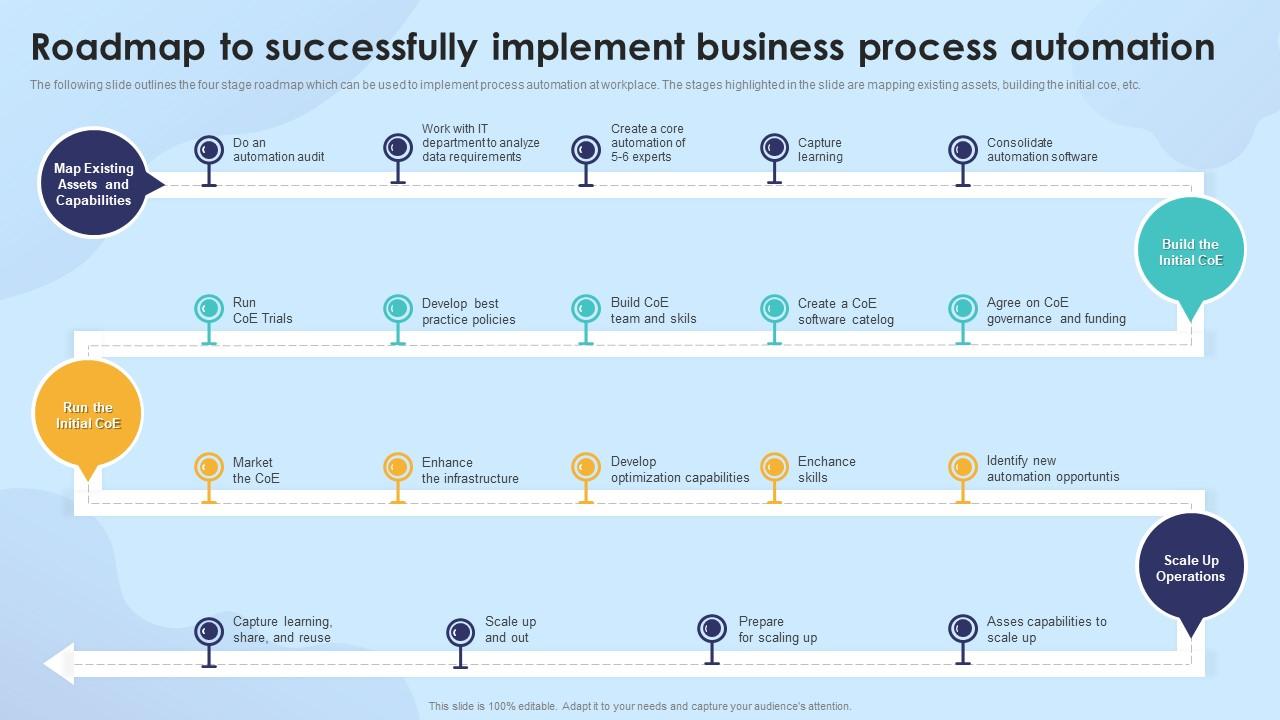
The following slide outlines the four stage roadmap which can be used to implement process automation at workplace. The stages highlighted in the slide are mapping existing assets, building the initial coe, etc.
People who downloaded this PowerPoint presentation also viewed the following :
Strengthening Process Improvement Roadmap To Successfully Implement Business Process with all 6 slides:
Use our Strengthening Process Improvement Roadmap To Successfully Implement Business Process to effectively help you save your valuable time. They are readymade to fit into any presentation structure.
FAQs for Strengthening Process Improvement Roadmap To Successfully
Key process improvement metrics include cycle time reduction, error rates, cost per transaction, customer satisfaction scores, and employee productivity measures. These metrics enable organizations to track operational efficiency, identify bottlenecks, and demonstrate ROI, with many companies finding that combining leading and lagging indicators delivers comprehensive insights into process performance and strategic business outcomes.
Lean methodologies integrate into existing workflows by eliminating waste, standardizing processes, and implementing continuous improvement cycles through value stream mapping and kaizen events. Organizations in manufacturing, healthcare, and financial services streamline operations by reducing cycle times, minimizing handoffs, and enhancing quality control, ultimately delivering faster service delivery and significant cost reductions.
Employee feedback serves as a critical diagnostic tool for identifying inefficiencies, bottlenecks, and improvement opportunities that management might overlook from their operational distance. Frontline workers in manufacturing, healthcare, and customer service often pinpoint specific workflow obstacles, resource gaps, and procedural redundancies, with many organizations finding that structured feedback systems deliver faster problem resolution and enhanced operational efficiency.
Technology automates repetitive tasks through robotic process automation (RPA), artificial intelligence, workflow management systems, and intelligent document processing. These solutions streamline operations by eliminating manual data entry, accelerating approvals, and reducing human error, with many organizations finding that automation delivers significant cost savings, faster processing times, and enhanced operational efficiency across departments.
Common challenges include resistance to change, insufficient resources, lack of leadership commitment, inadequate training, and poor communication across departments. Organizations often struggle with measuring success metrics, maintaining momentum during lengthy implementations, and balancing day-to-day operations with improvement activities, with many finding that early stakeholder engagement and phased rollouts significantly enhance adoption rates and sustainable outcomes.
PDCA applies to everyday operations by creating systematic cycles of planning changes, implementing solutions, measuring results, and standardizing successful practices across workflows. Through this iterative approach, organizations in manufacturing, healthcare, and retail continuously streamline processes, reduce waste, and enhance quality, with many finding that regular PDCA cycles deliver measurable efficiency gains and competitive advantage.
Root cause analysis enables organizations to identify underlying systemic issues rather than addressing superficial symptoms, ensuring process improvements deliver lasting results and prevent recurring problems. By systematically examining failure points, organizations in manufacturing, healthcare, and financial services can eliminate waste, reduce defects, and streamline operations, ultimately achieving sustainable competitive advantage through data-driven optimization.
Cross-functional teams enhance process improvement by bringing diverse expertise, identifying blind spots across departments, and ensuring holistic solutions that address end-to-end workflows. These collaborative approaches streamline implementation by reducing silos, accelerating decision-making, and fostering buy-in from multiple stakeholders, ultimately delivering more sustainable improvements and enhanced organizational efficiency.
Process improvement documentation best practices include creating detailed workflow maps, establishing clear standard operating procedures, implementing version control systems, defining measurable performance metrics, and maintaining accessible digital repositories. These approaches enhance organizational consistency by reducing training time, minimizing errors, and ensuring scalability, with many companies finding that standardized documentation ultimately delivers improved compliance, faster onboarding, and sustainable operational efficiency across departments.
Organizations can ensure process improvement alignment by establishing clear strategic objectives, mapping improvement initiatives to specific business outcomes, and implementing robust governance frameworks that regularly assess progress. Through strategic planning sessions, cross-functional teams systematically evaluate processes against organizational priorities, ensuring resource allocation supports competitive advantage, with many companies finding that this alignment delivers measurable ROI and accelerated growth trajectories.
A continuous improvement culture significantly enhances employee engagement by empowering workers to contribute ideas, participate in problem-solving, and see their suggestions implemented across operations. This approach fosters ownership, professional development, and meaningful participation in organizational success, with many companies finding that employees become more invested, productive, and satisfied when their insights drive measurable improvements.
Visual management tools support process improvement by making performance metrics, workflow bottlenecks, and progress indicators immediately visible through dashboards, Kanban boards, and status displays. These tools enable teams to identify inefficiencies faster, track improvement outcomes in real-time, and maintain accountability across departments, with many manufacturing and service organizations finding that visual transparency sustains long-term process optimization.
Training and development ensures team members possess essential skills like process mapping, data analysis, change management, and problem-solving methodologies required for successful improvement initiatives. Through comprehensive training programs, organizations enhance project outcomes, reduce implementation resistance, and build internal capabilities, with many companies finding that well-trained teams deliver faster results and sustainable improvements.
Prioritize processes by assessing impact versus effort, focusing on high-impact, low-effort improvements first, followed by critical bottlenecks affecting customer satisfaction or revenue generation. Many organizations find success targeting processes with measurable inefficiencies, such as approval workflows in finance or patient intake in healthcare, ultimately delivering quick wins that build momentum and demonstrate value for future investments.
Process improvement directly enhances customer satisfaction by reducing wait times, minimizing errors, streamlining service delivery, and creating more consistent experiences across touchpoints. These operational enhancements enable organizations to respond faster to customer needs, deliver higher quality services, and build stronger relationships, with many businesses finding that improved internal processes ultimately translate into measurably better customer loyalty and retention rates.
-
“Easy to use. I always wanted to have a quick search for products and SlideTeam has helped me have it.”
-
Illustrative design with editable content. Exceptional value for money. Highly pleased with the product.