Top Five Employee Engagement And Retention Strategies

Rating:
100%
Top Five Employee Engagement And Retention Strategies
Slide 1 of 6
Favourites Favourites

Try Before you Buy Download Free Sample Product

Audience Impress Your
Audience
Editable 100%
Editable
Time Save Hours
of Time
The Biggest Sale is ending soon in
0
0
:
0
0
:
0
0
AI-Ready
Upload this template to AI and ask it to make any changes to content or color
100% editable Powerpoint Template for AI-assisted presentations. Finish your work in less time. ​
Works with
Microsoft PowerPoint
Microsoft 365
Claude for PowerPoint
ChatGPT
Google Slides
Microsoft Copilot
Rating:
100%
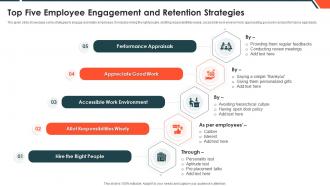
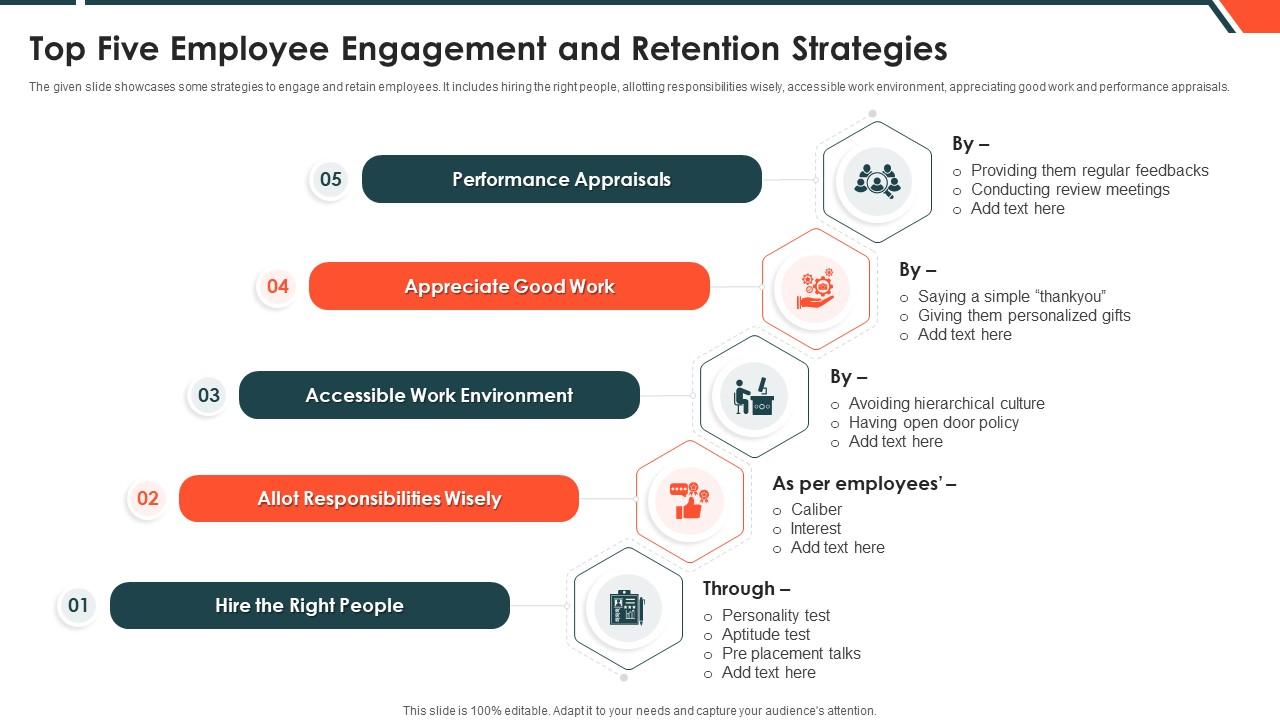
The given slide showcases some strategies to engage and retain employees. It includes hiring the right people, allotting responsibilities wisely, accessible work environment, appreciating good work and performance appraisals. Introducing our premium set of slides with Top Five Employee Engagement And Retention Strategies. Ellicudate the five stages and present information using this PPT slide. This is a completely adaptable PowerPoint template design that can be used to interpret topics like Performance Appraisals, Appreciate Good Work, Accessible Work Environment, Allot Responsibilities Wisely, Hire The Right People. So download instantly and tailor it with your information.
FAQs for Top Five Employee Engagement

Key indicators of employee engagement include productivity metrics, retention rates, participation in voluntary initiatives, feedback survey scores, and absenteeism patterns. These metrics enable organizations to assess workforce satisfaction, commitment levels, and overall morale, with many companies finding that engaged employees deliver higher performance, reduce turnover costs, and ultimately drive competitive advantage through enhanced customer experiences.

Feedback mechanisms enhance employee engagement by creating open communication channels, providing regular performance insights, and demonstrating organizational investment in employee growth and development. Through structured feedback systems, companies streamline recognition processes, address concerns proactively, and foster collaborative workplace cultures, with many organizations finding that consistent feedback loops ultimately deliver higher retention rates and improved productivity.

Leadership drives engagement culture through transparent communication, recognition programs, professional development opportunities, and modeling desired behaviors consistently across all organizational levels. Effective leaders in companies like Google and Microsoft create psychological safety, provide regular feedback, and align individual goals with company mission, ultimately delivering higher retention rates, increased productivity, and stronger employee satisfaction while building competitive advantage through engaged workforce dynamics.

Organizations can effectively measure employee engagement through regular pulse surveys, one-on-one feedback sessions, performance metrics analysis, exit interview insights, and employee net promoter scores. These measurement approaches enable companies to identify engagement gaps across departments, track improvement trends over time, and implement targeted interventions, with many finding that consistent measurement ultimately delivers higher retention rates and enhanced productivity.

Remote work significantly reshapes engagement strategies by requiring enhanced digital communication, virtual team-building initiatives, flexible performance metrics, and stronger focus on work-life balance support. Organizations increasingly leverage video collaboration platforms, online recognition systems, and digital wellness programs to maintain connection, with many finding that hybrid models deliver greater flexibility while preserving meaningful workplace relationships and productivity outcomes.

Innovative team-building activities include virtual escape rooms, skill-swap workshops, volunteer community projects, cross-departmental innovation challenges, and outdoor adventure experiences. These activities enhance collaboration, break down silos, and foster creative problem-solving, with many organizations finding that diverse team-building approaches significantly improve workplace relationships, communication, and overall employee satisfaction while strengthening company culture.

Recognition and rewards systems enhance engagement by aligning with individual preferences, celebrating both achievements and effort, and providing timely feedback that connects contributions to organizational goals. Through personalized approaches like peer nominations, milestone celebrations, and performance-based incentives, companies in sectors like retail and healthcare find that strategic recognition programs ultimately deliver improved retention, productivity, and workplace satisfaction.

Best practices for onboarding new employees include structured orientation programs, early goal-setting sessions, mentorship pairings, interactive training modules, and regular feedback checkpoints. These approaches streamline integration by establishing clear expectations, fostering meaningful connections, and providing immediate support systems, with many organizations finding that comprehensive onboarding significantly enhances retention rates and accelerates productivity across departments.

Organizations can align goals with employee aspirations through personalized development plans, career pathing programs, mentorship opportunities, cross-functional projects, and regular one-on-one discussions about individual objectives. This strategic alignment enhances retention, productivity, and job satisfaction, with many companies finding that employees who see clear connections between their personal growth and organizational success deliver significantly higher performance and engagement levels.

Training programs that empower employees include skills development workshops, leadership training, mentorship programs, cross-functional learning, and professional certification courses. These initiatives enhance engagement by building competencies, creating career advancement pathways, and demonstrating organizational investment in growth, with many companies finding that comprehensive training programs significantly improve retention rates and workplace satisfaction.

Workplace environment significantly influences employee engagement by affecting motivation, collaboration, and job satisfaction through physical comfort, technological resources, and cultural atmosphere. Organizations with well-designed spaces, flexible work arrangements, and supportive management cultures see enhanced productivity, reduced turnover, and stronger team dynamics, with many companies finding that strategic environmental investments deliver measurable competitive advantages.

Engaging diverse workforces requires inclusive leadership training, flexible work arrangements, multicultural mentoring programs, equitable advancement opportunities, and culturally aware communication strategies. These approaches streamline team collaboration by recognizing different perspectives, accommodating varying work styles, and celebrating cultural contributions, with many organizations finding that diverse engagement ultimately delivers enhanced innovation, broader market insights, and stronger competitive advantage.

Regular check-ins and one-on-ones enhance employee engagement by fostering open communication, providing personalized feedback, and addressing individual concerns before they escalate. These structured conversations enable managers to recognize achievements, clarify expectations, and support career development, with many organizations finding that consistent touchpoints significantly improve retention rates and job satisfaction.

Technological tools for employee engagement include collaboration platforms, pulse survey software, recognition systems, performance management apps, and internal communication tools. These technologies enhance engagement by streamlining feedback collection, facilitating real-time recognition, and enabling seamless collaboration across teams, with many organizations finding that integrated platforms deliver improved retention and productivity outcomes.

Organizations can leverage employee engagement surveys effectively by conducting them regularly with targeted questions, ensuring anonymity to encourage honest feedback, and most importantly, acting transparently on results through specific action plans. Successful companies like Google and Microsoft demonstrate that closing the feedback loop by communicating survey findings, implementing changes based on employee input, and tracking progress over time significantly enhances trust, retention, and overall workplace satisfaction.

Ratings and Reviews

100% of 100
Review Form
Write a review
Most Relevant Reviews
  1. 100%

    by Deshawn Schmidt

    Incredibly beautiful designs that will help you get noticed! These eye-catching templates are perfect for corporate presentations that can be altered to fit any occasion or taste.
  2. 100%

    by Dorian Armstrong

    I have been using SlideTeam for the past six months. Very happy and satisfied!

2 Item(s)

per page: