Triangle diagram for organizational marketing strategy

Triangle diagram for organizational marketing strategy
Slide 1 of 2
Favourites Favourites

Try Before you Buy Download Free Sample Product

Audience Impress Your
Audience
Editable 100%
Editable
Time Save Hours
of Time
The Biggest Sale is ending soon in
0
0
:
0
0
:
0
0
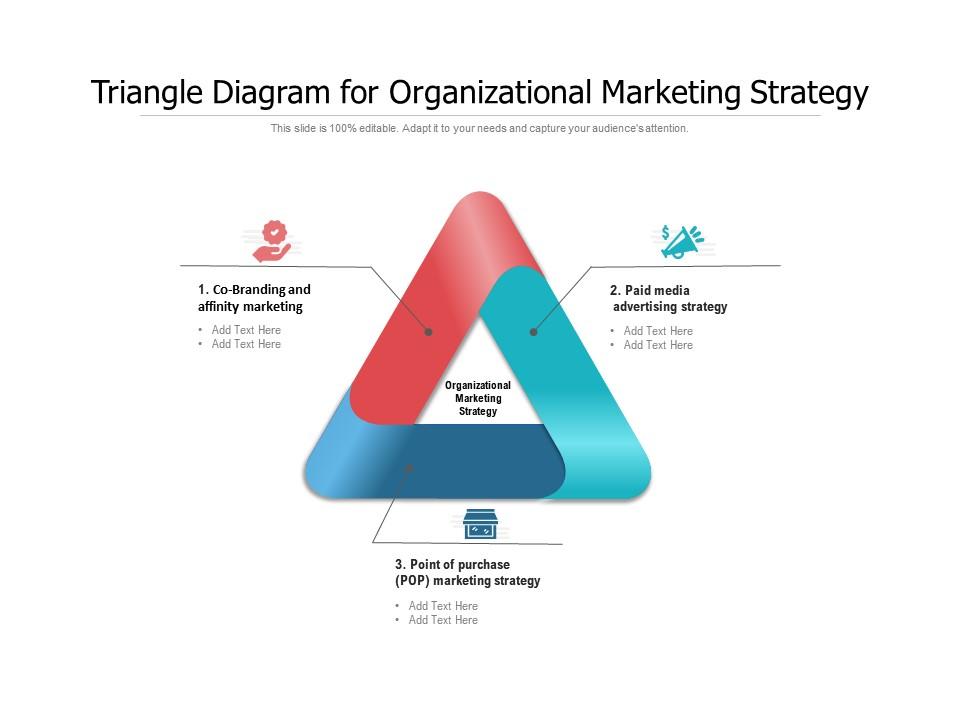
Presenting this set of slides with name Triangle Diagram For Organizational Marketing Strategy. This is a three stage process. The stages in this process are Co Branding And Affinity Marketing, Paid Media Advertising Strategy, Point Of Purchase Marketing Strategy. This is a completely editable PowerPoint presentation and is available for immediate download. Download now and impress your audience.

People who downloaded this PowerPoint presentation also viewed the following :

FAQs for Triangle diagram for

Triangle diagrams feature three interconnected vertices representing core elements, hierarchical relationships, balanced frameworks, directional flows, and central focal points for complex concepts. These components enhance data presentation by creating visual symmetry, simplifying multi-faceted information, and enabling stakeholders to quickly grasp relationships between elements, with many organizations finding that triangular structures effectively communicate strategic priorities, process dependencies, and balanced decision-making frameworks.

Triangle diagrams effectively illustrate organizational hierarchies by positioning leadership at the apex, middle management in the center tier, and operational staff at the base, creating clear visual authority lines and reporting structures. These diagrams enable companies across industries like healthcare, manufacturing, and financial services to streamline communication flows, clarify decision-making pathways, and enhance operational efficiency by making complex organizational relationships immediately comprehensible.

Triangle diagrams excel when illustrating hierarchical relationships, three-part frameworks, and interconnected systems where balance between elements matters most. They prove particularly effective for organizational structures, strategic planning models, and process flows in consulting, healthcare, and manufacturing sectors, while circular diagrams better suit cyclical processes and flowcharts work best for sequential workflows.

Best practices for designing visually appealing triangle diagrams include using consistent color schemes, maintaining balanced proportions, incorporating clear hierarchical text placement, ensuring adequate white space, and selecting readable fonts. These design principles enhance audience comprehension by creating logical visual flow, emphasizing key relationships, and delivering professional aesthetics, with many presenters finding that well-crafted triangular layouts significantly improve message retention and stakeholder engagement.

Triangle diagrams can be adapted by adjusting complexity levels, terminology, and visual elements to match audience expertise and needs. For executives, emphasize strategic outcomes and high-level relationships, while technical teams benefit from detailed processes and specific metrics, with educational audiences requiring simplified language and real-world examples, ultimately enhancing comprehension and engagement across diverse stakeholder groups.

Colors in triangle diagrams serve as visual differentiators, organizational tools, and cognitive anchors that enhance comprehension by creating distinct pathways for information processing, improving memory recall, and establishing clear hierarchical relationships between interconnected concepts. Strategic color application significantly boosts information retention by leveraging psychological associations and visual contrast, with many educational institutions and corporate training programs finding that well-designed color schemes increase audience engagement and long-term knowledge retention.

Triangle diagrams effectively demonstrate trade-offs by positioning competing priorities at each vertex, with the center representing optimal balance points between conflicting demands. Organizations use these models to visualize resource allocation decisions, such as balancing cost, quality, and speed in project management, or risk, return, and liquidity in investment strategies, ultimately helping stakeholders understand strategic compromises and make informed decisions.

Professional triangle diagram creation is best accomplished through Microsoft PowerPoint, Visio, Adobe Illustrator, Lucidchart, and Canva, each offering distinct advantages for different organizational needs. These platforms streamline diagram development by providing customizable templates, collaboration features, and export flexibility, with many businesses finding that PowerPoint delivers the optimal balance of accessibility and professional formatting for presentations.

Triangle diagrams excel in project management presentations by visualizing the project management triangle (scope, time, cost), stakeholder relationships, risk assessments, and three-phase project lifecycles. These frameworks enhance communication by clearly illustrating trade-offs, dependencies, and strategic priorities, with many project managers finding that triangle formats streamline complex concepts, improve stakeholder understanding, and ultimately deliver more focused decision-making processes.

Ensuring concise and clear triangle diagrams involves using brief, specific labels, maintaining visual hierarchy through consistent font sizes and colors, and limiting each section to essential information only. Strategic use of whitespace, contrasting colors, and logical information flow from base to apex helps organizations present complex relationships effectively, with many businesses finding that simplified language and balanced content distribution ultimately delivers better audience comprehension and engagement.

Common mistakes include overcrowding triangles with excessive text, using inconsistent visual hierarchy, poor color choices that reduce readability, misaligning elements, and failing to clearly establish relationships between components. These design flaws significantly undermine presentation effectiveness by confusing audiences, diluting key messages, and reducing professional credibility, with many organizations finding that clean, well-structured triangle diagrams enhance stakeholder comprehension and decision-making outcomes.

Triangle diagrams simplify complex educational concepts by breaking information into three interconnected components, creating visual hierarchies, and showing cause-and-effect relationships through clear geometric structure. These visual tools enhance student comprehension across subjects like science, literature, and business studies, with many educators finding that triangular frameworks streamline lesson planning while delivering improved retention and understanding.

Interactive triangle diagrams enhance audience engagement by enabling real-time exploration, clickable components, animated transitions, and personalized pathways through complex relationships. These dynamic visualizations transform static presentations into immersive experiences, with many presenters finding that audiences retain information better, participate more actively in discussions, and connect more deeply with strategic concepts, ultimately delivering stronger buy-in and comprehension.

**INPUT**: What industries or fields find the most value in using triangle diagrams, and why? **OUTPUT**: Triangle diagrams deliver exceptional value in strategic consulting, project management, healthcare systems, and organizational development, where complex three-way relationships require clear visualization. These sectors leverage triangular frameworks to streamline decision-making processes, enhance stakeholder communication, and demonstrate interdependencies between critical business elements, ultimately enabling faster strategic alignment and improved operational efficiency. **Word count: 54 words**

Audience feedback enhances triangle diagrams by identifying unclear hierarchies, confusing color schemes, overcrowded content areas, and poor visual flow between elements. Through surveys, focus groups, and presentation analytics, organizations can refine their diagram templates, optimize information placement, and improve visual clarity, ultimately delivering more engaging presentations and better audience comprehension across diverse business contexts.

Ratings and Reviews

0% of 100
Write a review
Most Relevant Reviews

No Reviews