Triangle graphic indicating 6 item of social recruitment

Triangle graphic indicating 6 item of social recruitment
Slide 1 of 2

or

Favourites Favourites

Try Before you Buy Download Free Sample Product

Audience Impress Your
Audience
Editable 100%
Editable
Time Save Hours
of Time
The Biggest Sale is ending soon in
0
0
:
0
0
:
0
0
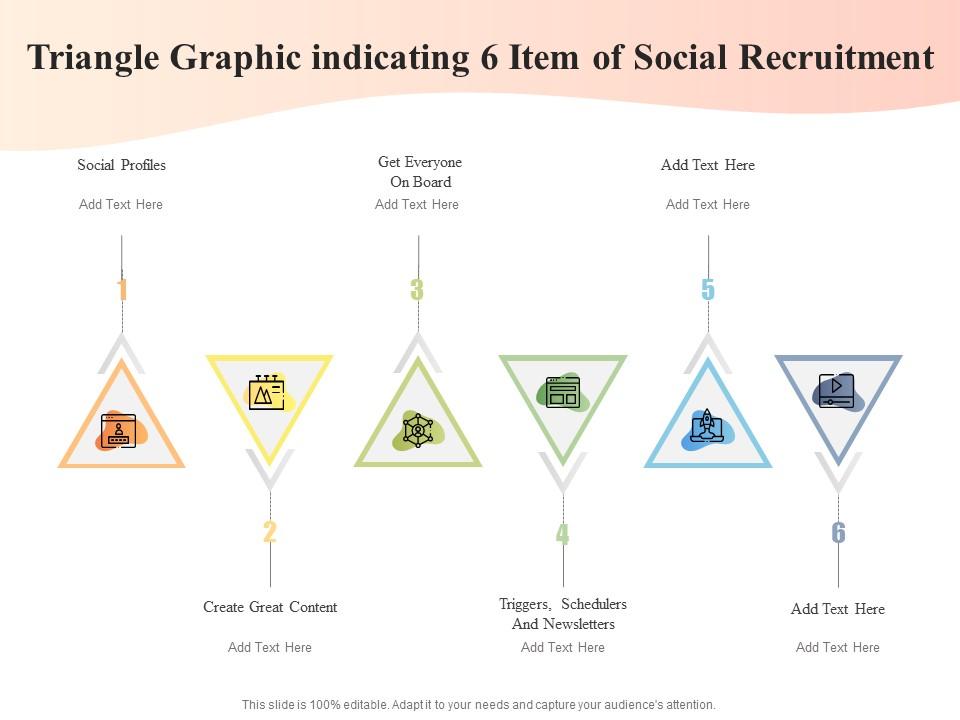
Presenting this set of slides with name Triangle Graphic Indicating 6 Item Of Social Recruitment. This is a six stage process. The stages in this process are Social Profiles, Get Everyone On Board, Create Great Content, Triggers, Schedulers And Newsletters. This is a completely editable PowerPoint presentation and is available for immediate download. Download now and impress your audience.

FAQs for Triangle graphic indicating 6 item

The Social Recruitment Triangle connects employers, candidates, and social networks to create transparent, relationship-driven hiring processes, leveraging platforms like LinkedIn, Twitter, and industry communities. Unlike traditional recruitment's one-way communication through job boards and agencies, this approach enables direct engagement, peer recommendations, and cultural fit assessment, ultimately delivering faster placements and higher-quality matches through authentic professional connections.

Social media platforms transform the Social Recruitment Triangle by enhancing employer branding through authentic company culture showcases, expanding candidate sourcing via professional networks like LinkedIn and targeted advertising, and streamlining recruitment processes through automated screening and direct messaging capabilities. These platforms enable organizations to reach passive candidates, accelerate hiring timelines, and create more engaging candidate experiences, ultimately delivering broader talent pools and stronger employer-candidate connections.

Employer branding serves as the foundation of the Social Recruitment Triangle, shaping how organizations present their culture, values, and opportunities across social platforms to attract quality candidates. Strong employer branding enhances recruitment efficiency by building trust and credibility, with companies in sectors like technology and healthcare finding that authentic brand messaging significantly reduces hiring costs while improving candidate quality and retention rates.

Companies effectively integrate social media into recruitment by establishing professional brand presence across LinkedIn, Twitter, and Facebook, creating engaging content that showcases company culture, and actively sourcing candidates through targeted social searches. This strategic combination enables faster talent identification, broader candidate reach, and enhanced employer branding, with many organizations finding that social recruitment ultimately delivers higher-quality hires while significantly reducing traditional recruitment costs.

Key social recruitment metrics include candidate quality scores, time-to-hire reduction, cost-per-hire, social media engagement rates, and conversion rates from social platforms to applications. These measurements enable organizations to streamline their hiring processes by tracking source effectiveness, candidate pipeline quality, and recruitment ROI, with many companies finding that strategic social recruitment delivers faster placements and significantly lower acquisition costs.

Organizations ensure diversity and inclusion through social recruitment by leveraging multiple platforms to reach underrepresented communities, partnering with diversity-focused professional groups, and using inclusive language in job postings. These strategic approaches enable companies to expand their talent pools beyond traditional networks, with many finding that diverse social media channels and targeted outreach significantly enhance workforce representation while strengthening organizational culture.

Visual job previews, employee testimonials, behind-the-scenes workplace content, professional development opportunities, and company culture highlights prove most effective for attracting candidates on social media. These content types engage potential hires by showcasing authentic workplace experiences, career growth paths, and team dynamics, with many organizations finding that video testimonials and day-in-the-life content generate significantly higher candidate engagement and quality applications.

Employee advocacy serves as the connecting force within the Social Recruitment Triangle, linking employer branding, candidate engagement, and recruitment marketing through authentic employee voices and experiences. When employees share their workplace stories across social platforms, organizations amplify their reach, enhance credibility with potential candidates, and create multiple touchpoints for talent attraction, ultimately delivering more authentic recruitment messaging and stronger candidate trust.

Companies face challenges including inconsistent brand messaging across platforms, measuring ROI effectively, managing candidate privacy concerns, and ensuring compliance with employment regulations. While social recruitment enhances reach and engagement, organizations often struggle with resource allocation, maintaining professional standards on informal platforms, and filtering quality candidates from high application volumes, ultimately requiring strategic balance between accessibility and selectivity.

Recruiters can leverage data analytics to enhance the Social Recruitment Triangle by tracking engagement metrics across platforms, analyzing candidate behavior patterns, and measuring conversion rates from social interactions to hires. Through predictive analytics and social listening tools, organizations streamline talent identification, optimize content strategies, and improve candidate experiences, ultimately delivering faster recruitment cycles and higher-quality hires.

Best practices for engaging passive candidates include creating compelling employer brand content, sharing authentic workplace stories, participating in industry discussions, personalizing outreach messages, and maintaining consistent professional presence across platforms. These strategies work by building genuine relationships rather than direct recruiting, with companies like Microsoft and HubSpot finding that thought leadership content and employee advocacy ultimately attract top talent organically.

Different generations leverage distinct social media strategies when job hunting, with Gen Z prioritizing TikTok and Instagram for company culture insights, Millennials utilizing LinkedIn and Twitter for networking, and Gen X focusing on professional platforms for industry connections. These generational preferences enable recruiters to tailor their social recruitment approaches across multiple platforms, ultimately reaching diverse talent pools while delivering more targeted candidate experiences.

Social recruitment significantly enhances candidate experience by enabling personalized interactions, transparent communication, and streamlined application processes through social platforms. This approach creates more engaging touchpoints throughout the hiring journey, with candidates experiencing faster feedback loops, authentic company culture insights, and seamless mobile-friendly applications, ultimately delivering higher satisfaction rates and stronger employer brand perception.

Companies maintain professionalism while being authentic by establishing clear brand voice guidelines, sharing genuine employee stories and company culture insights, and responding transparently to both positive and negative feedback. This strategic approach enables organizations to build trust through consistent messaging, showcase real workplace experiences, and demonstrate values in action, ultimately creating stronger candidate relationships and enhanced employer branding in competitive talent markets.

Technologies enhancing social recruitment include AI-powered candidate matching, social media analytics platforms, automated screening tools, applicant tracking systems, and chatbot integration. These solutions streamline talent acquisition by analyzing social profiles, automating initial screenings, and tracking engagement metrics, with many HR departments finding that strategic technology combinations reduce hiring time while improving candidate quality.

Ratings and Reviews

0% of 100
Review Form
Write a review
Most Relevant Reviews

No Reviews