Types quantitative analysis ppt powerpoint presentation slides files cpb

Types quantitative analysis ppt powerpoint presentation slides files cpb
Slide 1 of 2
Favourites Favourites

Try Before you Buy Download Free Sample Product

Audience Impress Your
Audience
Editable 100%
Editable
Time Save Hours
of Time
The Biggest Sale is ending soon in
0
0
:
0
0
:
0
0
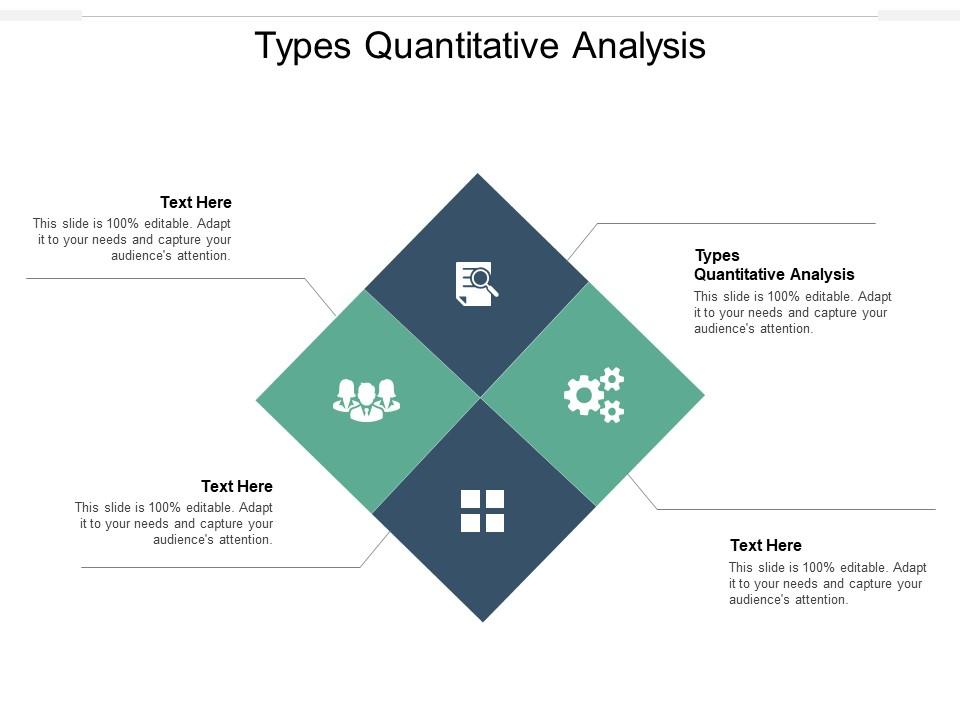
Presenting this set of slides with name Types Quantitative Analysis Ppt Powerpoint Presentation Slides Files Cpb. This is an editable Powerpoint four stages graphic that deals with topics like Types Quantitative Analysis to help convey your message better graphically. This product is a premium product available for immediate download and is 100 percent editable in Powerpoint. Download this now and use it in your presentations to impress your audience.

People who downloaded this PowerPoint presentation also viewed the following :

FAQs for Types quantitative analysis ppt powerpoint presentation

Descriptive quantitative analysis summarizes and presents existing data through measures like means, medians, frequencies, and distributions, while inferential analysis uses sample data to make predictions, test hypotheses, and draw conclusions about larger populations. Descriptive methods help organizations understand current performance metrics and trends, whereas inferential techniques enable strategic forecasting and decision-making, ultimately delivering actionable insights for competitive advantage.

Regression analysis identifies relationships between variables in historical data, enabling organizations to forecast future trends by analyzing patterns, correlations, and statistical dependencies. Through mathematical modeling, businesses can predict sales performance, market demand, and customer behavior with measurable accuracy, while financial institutions leverage these insights for risk assessment and investment strategies, ultimately delivering competitive advantage in strategic planning.

Time series analysis proves most beneficial when analyzing data patterns over chronological periods, particularly for forecasting demand, tracking financial performance, monitoring operational metrics, and predicting seasonal variations. Industries like retail, manufacturing, and financial services leverage this approach to anticipate market trends, optimize inventory management, and enhance strategic planning, ultimately delivering improved resource allocation and competitive advantage in increasingly dynamic business environments.

Experimental design enhances quantitative research reliability by controlling variables, randomizing participant selection, establishing control groups, and eliminating bias through blinding techniques. These methodological approaches enable researchers to isolate causal relationships, minimize confounding factors, and ensure reproducible results, with industries like pharmaceuticals, marketing, and manufacturing finding that rigorous experimental frameworks ultimately deliver more credible, actionable insights for strategic decision-making.

Statistical significance determines whether quantitative analysis results reflect genuine patterns rather than random chance, typically measured through p-values and confidence intervals. This validation enables organizations to make data-driven decisions with measurable confidence, especially in market research, financial forecasting, and operational optimization, ultimately delivering reliable insights that minimize risk and enhance strategic planning accuracy.

Different sampling methods significantly impact quantitative validity through representativeness, bias reduction, and generalizability factors. While probability sampling methods like stratified and systematic sampling enhance external validity by ensuring diverse representation, convenience sampling presents both accessibility advantages and potential selection bias concerns, with many research organizations finding that strategic sampling combinations ultimately deliver more reliable insights and broader applicability across varied populations.

Multivariate analysis enables simultaneous examination of multiple variables, revealing hidden relationships, patterns, and dependencies that univariate methods miss. This approach streamlines complex decision-making by identifying key drivers, reducing dimensionality, and enhancing predictive accuracy, with organizations in finance, healthcare, and marketing finding that comprehensive variable interactions ultimately deliver more robust insights and competitive analytical advantages.

Outlier detection enhances quantitative analysis by identifying anomalous data points that could skew results, improving statistical accuracy, and revealing hidden patterns or errors in datasets. By systematically removing or investigating outliers, organizations across finance, healthcare, and manufacturing can make more reliable predictions, reduce forecasting errors, and ultimately deliver more trustworthy insights for strategic decision-making.

Data visualization techniques enhance quantitative analysis by transforming complex datasets into intuitive charts, graphs, heatmaps, and interactive dashboards that reveal patterns, trends, and outliers instantly. These visual tools enable analysts across finance, healthcare, and retail to identify correlations, communicate insights more effectively, and accelerate decision-making processes, ultimately delivering faster strategic responses and enhanced stakeholder understanding.

Market segmentation leverages quantitative analysis through demographic data analysis, purchasing behavior metrics, statistical clustering techniques, and predictive modeling to identify distinct customer groups. These analytical methods enable businesses to measure segment size, profitability potential, and response patterns, with retail companies and financial institutions finding that data-driven segmentation delivers more precise targeting and significantly higher conversion rates.

Ethical considerations include informed consent, data privacy protection, voluntary participation, risk minimization, and transparent methodology disclosure. These principles safeguard participant welfare by ensuring confidentiality, preventing harm, and maintaining research integrity, with many institutions finding that robust ethical frameworks ultimately enhance data quality while building trust and enabling sustainable research practices across healthcare, social sciences, and market research sectors.

Quantitative analysis integrates with qualitative methods through mixed-methods approaches, sequential explanatory designs, triangulation techniques, and concurrent data collection strategies. This strategic combination enables organizations to validate numerical findings with contextual understanding, with many research teams finding that financial institutions leverage both statistical models and customer interviews to enhance decision-making accuracy and competitive advantage.

Common quantitative analysis software tools include SPSS for statistical analysis, R for advanced modeling, Excel for basic calculations, Python for machine learning, SAS for enterprise analytics, and MATLAB for mathematical computing. These platforms streamline data processing, automate complex calculations, and deliver comprehensive visualization capabilities, with many financial institutions, research organizations, and consulting firms finding that integrated analytics software significantly enhances decision-making speed and accuracy.

Hypothesis testing works by establishing a null hypothesis and alternative hypothesis, then using statistical methods like t-tests, chi-square tests, and ANOVA to determine significance levels. Through systematic data collection and analysis, researchers in fields like healthcare, finance, and marketing can validate assumptions, measure treatment effectiveness, and make evidence-based decisions, ultimately delivering measurable insights and competitive advantages.

Key metrics include revenue growth, profit margins, customer acquisition costs, operational efficiency ratios, and return on investment indicators. These financial and operational measures enable organizations to assess performance comprehensively, with many businesses finding that combining profitability metrics with efficiency indicators delivers clearer strategic insights and competitive advantage.

Ratings and Reviews

0% of 100
Write a review
Most Relevant Reviews

No Reviews