Use of proceeds for seed funding ppt information
Try Before you Buy Download Free Sample Product
Audience
Editable
of Time
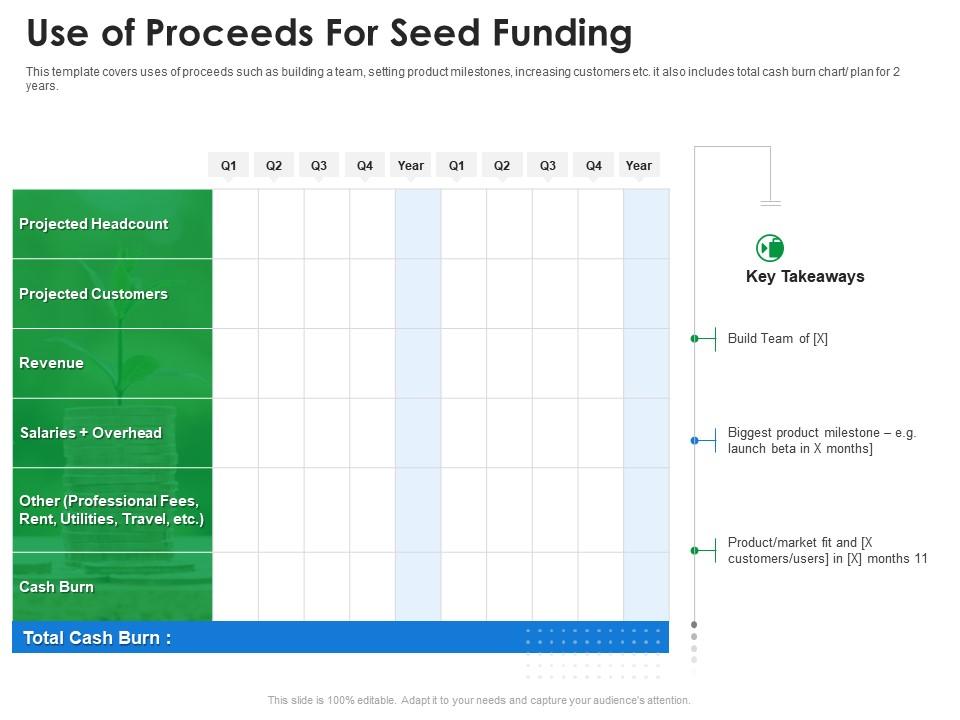
This template covers uses of proceeds such as building a team, setting product milestones, increasing customers etc. it also includes total cash burn chart plan for 2 years.
People who downloaded this PowerPoint presentation also viewed the following :
Use of proceeds for seed funding ppt information with all 2 slides:
Use our Use Of Proceeds For Seed Funding Ppt Information to effectively help you save your valuable time. They are readymade to fit into any presentation structure.
FAQs for Use of proceeds for seed
Seed funding is basically about proving your idea actually works before you go big. You're trying to show there's real demand for whatever you're building. Most of that money goes to product development and your first hires - usually tech people since they're expensive but crucial. Don't forget early marketing to test if you can actually get customers (spoiler: it's harder than expected). Basic stuff like legal setup and maybe office space eats up more cash than you'd think. Hit solid milestones so Series A investors will want to talk to you later.
Put about 40-50% into actually building your product - that's where the magic happens. Another 30-40% should go to hiring the right people (trust me, good talent is worth every penny). Marketing gets 10-20%, which feels low but you're not ready to scale yet anyway. I know it's tempting to buy nice office furniture and all that, but don't. Track your burn rate like your life depends on it because honestly, it does. Shoot for 12-18 months runway minimum. Oh, and start watching your unit economics now so you can tell the difference between real growth and just lighting money on fire.
Get your MVP solid first - everything's pointless if the product's garbage. Put most of your cash into that, then hire smart. Maybe start with a dev who actually knows what they're doing, or a salesperson who can close (good luck finding one though lol). Marketing? Only spend where you can track results. Skip the fancy office for now - work from your kitchen table if you have to. Watch your burn rate like a hawk and make sure you've got at least a year of runway. Probably closer to 18 months to be safe.
So your seed round basically becomes your starting point for valuation. But here's the thing - what you actually do with that money is what'll make or break your Series A pricing. Hit your big milestones (revenue growth, team building, proving people want your product) and investors will happily pay more next time. Screw it up though? You're looking at a flat round or worse, which honestly just makes everyone miserable. Focus hard on whatever metrics Series A folks care about in your industry - I'd probably track everything obsessively. Then have that growth story ready to go.
Dude, burn rate and runway are literally life or death - watch those like a hawk. After that, dig into the stuff that shows if people actually want your product: acquisition costs, how many users stick around, retention rates. Revenue obviously matters too, even early on. But honestly? So many founders get distracted by meaningless vanity metrics that make them feel good but don't move the needle. Just pick 3-5 things that actually track progress toward whatever milestone you're chasing next - could be PMF, could be proving your unit economics don't suck. Check 'em weekly with the team and that's it.
Look, I'd do like 70% product, 30% marketing in the early days. Build something solid first, obviously. But seriously don't disappear for 6 months just coding - I've seen too many friends do that and it never ends well. Get feedback early through content stuff, social media, whatever. Just start talking to people who might actually buy your thing. The trick is spending your tiny budget where your customers actually are, not where some blog told you they should be. You'll get way better insights that way and avoid building something nobody wants.
Dude, seed money is a game changer for hiring. You can actually pay people real salaries instead of just promising them equity that might be worthless. Good candidates won't leave their stable jobs for your startup unless you offer decent compensation - and honestly, I don't blame them. Having funding also makes you look legit rather than just another dreamer with no cash. You'll be able to hire specialists early too, like that CTO you've been desperately needing. Start making a list of who you want and what they'd cost.
Seed funding is your lifeline for getting an MVP built. Use it for developer salaries, basic infrastructure, the essential stuff. Don't build the perfect product yet - just prove your concept works. I've watched founders waste money on fancy offices (such a rookie mistake). Focus those dollars on bare minimum features that show value. Get feedback from real users, then spend the rest of your runway based on what you learn. You'll burn through cash fast if you're not strategic about it. The whole point is validating your assumptions before going bigger.
Dude, you absolutely need to stay tight with your seed investors. They're not just writing checks - these people have connections and can save you from making stupid mistakes they've watched other founders make. I learned this the hard way tbh. Send them updates regularly, even when stuff isn't going great. They'll respect the transparency. Ask for intros when you need them. The best part? Investors who feel involved are way more likely to fund your next round. Don't just take their money and disappear into a cave for six months.
Don't blow through your seed cash before hitting the milestones that matter for your next raise. Seriously, the "valley of death" is real - that's when you're broke but haven't proven product-market fit yet. Most founders I know overhire way too early. They act like they're already unicorns when they're still figuring out their core product. Also, don't give away huge equity chunks upfront because you'll need room for later investors and employee options. Honestly, just focus on proving your main assumptions first. Scaling comes after. Set burn rate targets and actually stick to them - easier said than done though.
Honestly, don't spread your seed money too thin trying every marketing channel out there. Pick 2-3 that you can actually measure - Google Ads and Facebook are solid bets since you'll see what's working fast. Content marketing's worth investing in too, but get someone who actually knows what they're doing. Skip the expensive PR firms for now (I learned this the hard way). Test small budgets first, then dump more money into whatever's converting. Oh, and track your customer acquisition costs from the start - that number will save your ass later when you need to make tough decisions about where to spend.
Honestly, don't expect much the first 6 months - you're basically just scrambling to hire people and figure out your product. Real traction starts showing up around month 6-12 once your team's actually executing. The meaningful stuff? That takes 12-18 months to really kick in. I'd set quarterly check-ins so you can pivot fast if things go sideways. By month 18, your metrics should tell the whole story about whether that seed money actually did anything. The early stage chaos is normal though - everyone's just winging it until something clicks.
Yeah so tech startups blow like 60-70% on product dev and hiring engineers. Consumer brands do the opposite though - they're pouring money into marketing and inventory. SaaS companies go crazy with customer acquisition costs, which honestly makes sense. Biotech is wild - they just burn cash on R&D and all that regulatory nightmare stuff. Hardware startups need insane upfront money for manufacturing compared to software companies. My advice? Find successful companies in your space and see how they spent their early rounds. Way more helpful than generic advice.
Break down every dollar into specific buckets - hiring, product dev, marketing, operations. Include real timelines too. "General business expenses" will kill your pitch faster than anything, I've literally watched investors tune out the second they hear that vague nonsense. Build a runway calculator showing how long the cash lasts. Each expense should tie directly to growth metrics or key milestones you'll actually hit. Honestly, start throwing this together in a basic spreadsheet now before you even think about pitching. They want to see your burn rate mapped out realistically.
Dude, location makes a huge difference with seed money. Your $500K in Silicon Valley? Maybe 6 months if you're lucky - everything's insanely expensive there. But Austin or Denver? That could stretch 18+ months easy. Here's the thing though - SF gets you crazy good access to investors and talent that's hard to find elsewhere. Really depends what you need right now. If you're trying to scale fast and make connections, maybe the expensive areas are worth burning through cash quicker. But if you need time to actually build something without stressing about runway, cheaper cities let your money breathe.
-
Out of the box and creative design.
-
I discovered this website through a google search, the services matched my needs perfectly and the pricing was very reasonable. I was thrilled with the product and the customer service. I will definitely use their slides again for my presentations and recommend them to other colleagues.
-
Content of slide is easy to understand and edit.
-
Professional and unique presentations.